Showing posts with label TJBL Read-Aloud-Rhymes. Show all posts

Monday, March 21, 2022

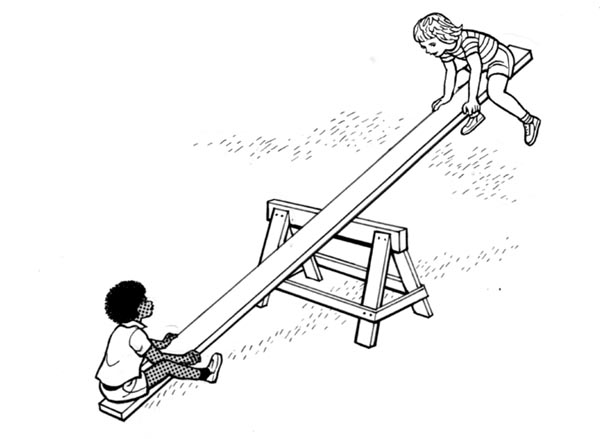
"See Saw Margery Daw": A Read-Aloud-Rhyme

Parents and teachers can read these rhymes aloud, and encourage little ones to repeat and even memorize them (I did when I was a kid!)

This rhyme may once have been used when children played on an actual seesaw (teeter-totter). You can "hear" the rhythm of the rhyme as children swing up and down. It might also have been used as a work song as men sawed wood by hand using a two-man saw.

See Saw Margery Daw,
Jack shall have a new master;
Jack shall earn but a penny a day,
Because he can't work any faster.

Meaning: Neither "Margery Daw" nor "Jack" refer to real people, but it may be that Margery ("Daw" means a lazy person in some dialects) had to go to work sawing because Jack--who can't work very fast--got fired ("shall have a new master"), and his new job pays poorly ("a penny a day").

--------

Some words to talk about:

  • master: a boss
  • a penny: the smallest coin; very, very little money

--------

ACTIVITIES:

Children can hold hands and "see saw" (lean forward and backward) as they recite the rhyme (or sing it! Check YouTube for melodies).

Discussion: Do you think it's fair that Jack only gets a penny a day? Is it fair that "lazy Margery" has to go to work? How could Jack work faster?

Monday, March 14, 2022

"A ten o' clock scholar": A Read-Aloud-Rhyme

Parents and teachers can read these rhymes aloud, and encourage little ones to repeat and even memorize them (I did when I was a kid!) The "speaker" in this rhyme may be the "ten o'clock scholar's" classmates making fun of him. "Why do you come so soon?" is a kind of sarcasm, like calling a tall person "Shorty" or a fast runner a "slow poke."

A diller, a dollar,
A ten o' clock scholar,
What makes you come so soon?
You used to come at ten o'clock,
But now you come at noon.

--------

Some words to talk about:

  • a diller: a lazy student, perhaps from the old word "dilatory" meaning "slow to act"
  • a dollar: a student who is not very smart, from the word "dullard"
  • noon: twelve o'clock in the day time
  • a scholar: a person who studies; a student, teacher, or writer
  • a ten o' clock scholar: a student who is often late


ACTIVITIES:

There are no special activities for this rhyme. Kids can memorize and recite it, and maybe "pretend" to be talking to a classmate who is "a ten o' clock scholar."

Discussion:

  • Is it nice to make fun of another student who comes late, or who is not too smart? How would you feel if someone did this to you? Give an answer to your classmates as though you were the "ten o' clock scholar."
  • Have you ever been late to class? How did you feel about it? What can you do to be sure you are on time?

Sunday, March 6, 2022

"Jack be Nimble": A Read-Aloud-Rhyme

Look at the animals on the right. Which ones are nimble? Which ones are not?

Parents and teachers can read these rhymes aloud, and encourage little ones to repeat and even memorize them (I did when I was a kid!)

Jack be nimble,
Jack be quick,
Jack jump over
the candle-stick.

--------

Some words to talk about:

  • nimble: able to move easily and lightly
  • quick: fast

ACTIVITIES:

Look at the four animals in the picture above. Which ones are "nimble"? Which ones are not? See the answer below.

Make a "candle" (not actually burning) out of a rolled up piece of paper; a paper towel or toilet paper tube will work nicely. Decorate it (paint will do), attach some yellow paper to the top for a "flame," and set it on the floor. Then jump over it one time for each line in the rhyme (four times total) as you recite the rhyme from memory. Fun!

Image from Sophie-World.com; directions there.

Answer: Monkeys and cats are nimble; turtles and cows are not.

Sunday, February 27, 2022

"Humpty Dumpty": A Read-Aloud-Rhyme

Parents and teachers can read these rhymes aloud, and encourage little ones to repeat and even memorize them (I did when I was a kid!)

Humpty Dumpty sat on a wall,
Humpty Dumpty had a great fall.
All the king's horses and all the king's men
Couldn't put Humpty together again.

Monday, January 10, 2022

"Hickory, dickory, dock": A Read-Aloud-Rhyme

Click to see Vol. I, Issue11 of the newsletter in which this article first appeared.

Listen to the audio of this article!

Parents and teachers can read these rhymes aloud, and encourage little ones to repeat and even memorize them (I did when I was a kid!) You can say or sing this one. (Hear the sung version on the audio version linked above.)

Hickory, dickory, dock!
The mouse ran up the clock.
The clock struck one,
The mouse ran down,
Hickory, dickory, dock!

You can add three (or more) verses, changing the number of "strikes" each time:

...The clock struck two...

...The clock struck three...

...The clock struck four...

and so on.

--------

Some words to talk about:

  • Hickory, dickory, dock: This is "nonsense"--that is, it has no meaning.
  • struck: made the sound of a bell. Some old clocks "strike" a bell at each hour: one at one o'clock, two at two o'clock, and so on.


ACTIVITIES

Here's some pretending! Before you start, ask your kid how he or she would "pretend" each of the lines. Then you can suggest doing the following things as you say the poem:

  • Hickory, dickory, dock!
       [tilt your head from side to side in time to the music]
  • The mouse ran up the clock.
       [hands at your sides, slowly raise them forward with your arms straight, until your hands are above your head]
  • The clock struck one,
       [clap your hands once above your head]
  • The mouse ran down,
       [lower your arms slowly, the same way you raised them]
  • Hickory, dickory, dock!
       [again, tilt your head from side to side in time to the music]

Of course, if you do "two," "three," "four," and so on, clap your hands the correct number of times.

Discussion: Can you think of other rhymes with "nonsense words"? Have you ever seen a mouse? Do you think one can get inside a clock? (Look at the clock in the picture!) What do you think a clock sounds like when it "strikes" each hour?

Sunday, January 2, 2022

"The Cat and the Fiddle": A Read-Aloud-Rhyme

Click to see Vol. I, Issue 10 of the newsletter in which this article first appeared.

Listen to the audio of this article!

Parents and teachers can read these rhymes aloud, and encourage little ones to repeat and even memorize them (I did when I was a kid!) Many people have tried to find "meaning" in this old rhyme--but most agree there is none! It's just nonsense, something fun to say. Enjoy!

Hey diddle, diddle!
The cat and the fiddle,
The cow jumped over the moon;
The little dog laughed
To see such sport,
And the dish ran away with the spoon.

--------

Some words to talk about:

  • fiddle: a violin, a type of musical instrument
  • sport: something fun to do


ACTIVITIES

Let's do some more pretending! First, ask your kid how he or she would "pretend" each of the lines. Then you can suggest doing the following things as you say the poem:

  • Hey diddle, diddle!
       [do a little dance step, or just "wiggle"!]
  • The cat and the fiddle,
       [play a fiddle, while saying "meow!"]
  • The cow jumped over the moon;
       [make a big leap, over a ball if you have one]
  • The little dog laughed to see such sport,
       [hold your sides and move like you're laughing; maybe bark a little]
  • And the dish ran away with the spoon.
       [run away, holding hands with a friend if one is with you]

Discussion: Does the rhyme say the cat is playing the fiddle? What do you think he's doing with it? Can a cow really jump over the moon? (Look at the picture for an idea; see the moon in the water?) Can dogs laugh? Can dishes and spoons run? Why does the rhyme say all these silly things?

Saturday, December 25, 2021

"Baa, Baa, Black Sheep": A Read-Aloud-Rhyme

Click to see Vol. I, Issue 9 of the newsletter in which this article first appeared.

Listen to the audio of this article!

Parents and teachers can read these rhymes aloud, and encourage little ones to repeat and even memorize them (I did when I was a kid!)

Here's another fun one, usually sung to the same tune as "Twinkle Twinkle Little Star" and the "Alphabet Song."

Baa, baa, black sheep,
Have you any wool?
Yes, Sir! Yes, Sir!
Three bags full!

One for my master,
One for my dame,
And one for the little boy
Who lives down the lane!

Baa, baa, black sheep,
Have you any wool?
Yes, Sir! Yes, Sir!
Three bags full!

--------

Some words to talk about:

  • baa: the sound a sheep makes, like cows say "moo" or cats say "meow"
  • dame: lady; the master's wife
  • lane: a small road or street
  • master: like a boss; or, for a sheep, an owner
  • wool: the hair of a sheep


ACTIVITIES

Have your kid tell the story with a little pretending: Use a child's voice and a sheep's; use gestures (bowing, holding up three fingers, pointing to three places as the recipient of each bag is named); and maybe dance a little the last time through!

Discussion: What kind of person would the black sheep's "master" be? Does it hurt for a sheep to give its wool? Why does "the little boy who lives down the lane" get some wool?

Saturday, December 18, 2021

"The House That Jack Built": A Read-Aloud-Rhyme

Click to see Vol. I, Issue 8 of the newsletter in which this article first appeared.

Listen to the audio of this article!

Parents and teachers can read these rhymes aloud, and encourage little ones to repeat and even memorize them (I did when I was a kid!)

Okay, this one is long, but so much fun! It's what we call a cumulative or progressive tale: one that starts with a simple scene, then builds scene upon scene.

See the "Activities" below for some ways to have fun with this.

This is the house that Jack built.

This is the cheese
That sat in the house that Jack built.

This is the rat,
That ate the cheese
That sat in the house that Jack built.

This is the cat,
That caught the rat,
That ate the cheese
That sat in the house that Jack built.

This is the dog,
That barked at the cat,
That caught the rat,
That ate the cheese
That sat in the house that Jack built.

This is the cow with the crumpled horn,
That chased the dog,
That barked at the cat,
That caught the rat,
That ate the cheese
That sat in the house that Jack built.

This is the maiden all forlorn,
That milked the cow with the crumpled horn,
That chased the dog,
That barked at the cat,
That caught the rat,
That ate the cheese
That sat in the house that Jack built.

This is the man all tattered and torn,
That kissed the maiden all forlorn,
That milked the cow with the crumpled horn,
That chased the dog,
That barked at the cat,
That caught the rat,
That ate the cheese
That sat in the house that Jack built.

This is the priest all shaven and shorn,
That married the man all tattered and torn,
That kissed the maiden all forlorn,
That milked the cow with the crumpled horn,
That chased the dog,
That barked at the cat,
That caught the rat,
That ate the cheese
That sat in the house that Jack built.

This is the cock that crowed in the morn,
That waked the priest all shaven and shorn,
That married the man all tattered and torn,
That kissed the maiden all forlorn,
That milked the cow with the crumpled horn,
That chased the dog,
That barked at the cat,
That caught the rat,
That ate the cheese
That sat in the house that Jack built.

This is the farmer sowing the corn,
That kept the cock that crowed in the morn,
That waked the priest all shaven and shorn,
That married the man all tattered and torn,
That kissed the maiden all forlorn,
That milked the cow with the crumpled horn,
That chased the dog,
That barked at the cat,
That caught the rat,
That ate the cheese
That sat in the house that Jack built.

--------

Some words to talk about:

  • cock: rooster; male chicken
  • crowed: went "cock-a-doodle-dooo!"
  • crumpled: bent; wrinkled up
  • forlorn: sad
  • maiden: girl; young woman
  • morn: morning
  • shaven and shorn: smooth-faced and with a haircut
  • sowing: planting in the ground
  • tattered: in pieces; torn up


ACTIVITIES

To start with, look at the last verse, and be sure your kid understands the connections from one step to the next. Start with new words; then actions; then the "link" between lines ("How is the farmer connected to the rooster?" etc.)

Now you're ready to start memorizing from the top. Start with the house and the cheese, and have your kid "pretend" like we did with "One, Two, Buckle My Shoe": "sit" like the cheese, "eat" like the rat, and so on. With each verse, add another action until you've learned them all.

If there is more than one kid available, have them take different parts: one kid (the cow holding fingers up like horns, and one is "crumpled") chases the dog, and so on.

When your kid (and you!) get good at reciting it, speed it up. 

Discussion: This would be a good rhyme to use for a discussion of connections between people, animals, plants, the earth, and so on--Beginning Ecology. You could also trace the "chain" of everyday things in your house: Where does cheese come from? Start with milk, then cows, then grain, farmers, the soil, and all the way up to rain!

Sunday, December 12, 2021

"One Two, Buckle My Shoe": A Read-Aloud-Rhyme

One through Twelve, from an old children's book

Click to see Vol. I, Issue 7 of the newsletter in which this article first appeared.

Listen to the audio of this article!

Parents and teachers can read these rhymes aloud, and encourage little ones to repeat and even memorize them (I did when I was a kid!)

With this old rhyme, kids can have fun while they practice counting. There are many different versions of this rhyme; this is the one I learned. But I never learned a melody for this as a kid, and none of the sources I've checked seem to be traditional, so I'll just say it.

One, two, buckle my shoe!
Three, four, shut the door!
Five, six, pick up sticks!
Seven, eight, lay them straight!
Nine, ten, a big fat hen!
Eleven, twelve, dig and delve!
Thirteen, fourteen, maids a-courting!
Fifteen, sixteen, maids a-kissing!
Seventeen, eighteen, maids a-waiting!
Nineteen, twenty, my plate's empty!

--------

Some words to talk about:

Before we look at separate words, let me comment on the more difficult lines.

One, two, buckle my shoe!

  • Long ago, shoes had buckles, like the kind we see on belts today. Nowadays we would say "tie my shoe."

Eleven, twelve, dig and delve!

  • Delve is an old word that means the same as dig. Today we might use it for "investigate": Delve into a mystery.

Thirteen, fourteen, maids a-courting!

  • To court is an old-fashioned word meaning "to look for a husband or wife." Today we don't usually court, we date. It can mean "try to get someone's attention" or "get someone to like us."
Now here are a few words and definitions:
  • buckle: close with a buckle, a special kind of clasp or closer
  • courting: trying to attract a boy or girl to be one's boyfriend or girlfriend
  • delve: dig, or investigate

ACTIVITIES

For each line, have your kid do some "pretending." Before you look at my suggestions below, ask your kid what she or he thinks is the best way to "pretend" each line.

One, two, buckle my shoe!

  • Bend over as if tying your shoe.

Three, four, shut the door!

  • Pretend to shut a door. Some people say "Knock on the door"; your kid can do that instead.

Five, six, pick up sticks!

  • Pretend to pick up sticks from the ground.

Seven, eight, lay them straight!

  • Pretend to lay the sticks down again, one by one, side by side.

Nine, ten, a big fat hen!

  • Pretend you're a chicken! Put each hand in your armpit and "flap" your elbows, while walking around and "pecking" at the ground.

Eleven, twelve, dig and delve!

  • Pretend to dig a hole with a big (pretend) shovel.

Thirteen, fourteen, maids a-courting!

  • Act like a girl seeing a boy she likes: tilt your head, look down, smile a little, blink your eyes quickly, cover your face like you're shy, and so on.

Fifteen, sixteen, maids a-kissing!

  • Give you hand a big kiss--or a lot of them!

Seventeen, eighteen, maids a-waiting!

  • Stand and look around like you're waiting for someone. Cross your arms, tap your foot, check your watch, and so on.

Nineteen, twenty, my plate's empty!

  • Hold up a (pretend) plate to show it's empty. Smile big!
--------

Speed it up: Here's another activity, one we've done before: once your kid has learned the rhyme, try saying it over and over, faster each time until it just gets crazy!

--------

Discussion: Does this make the numbers easier to remember? Which one do you think is funny? Which one is hard to understand?

Saturday, December 4, 2021

"Monday's Child": A Read-Aloud-Rhyme

Click to see Vol. I, Issue 6 of the newsletter in which this article first appeared.

Listen to the audio of this article!

Parents and teachers can read these rhymes aloud, and encourage little ones to repeat and even memorize them (I did when I was a kid!)

In simpler days, a Mother Goose rhyme tried to predict what a child's character would be, based on the day of the week he or she was born.

Monday's child is fair of face,
Tuesday's child is full of grace,
Wednesday's child is full of woe,
Thursday's child has far to go,
Friday's child is loving and giving,
Saturday's child works hard for a living,
But the child born on the Sabbath Day,
Is fair and wise and good and gay.

Some words to talk about:

  • fair: pretty; good-looking
  • gay: happy; lively
  • grace: pleasant behavior; beauty of movement
  • Sabbath Day: Sunday
  • woe: sorrow


ACTIVITIES

For younger kids:

Here are simplified versions of what the rhyme says about the child for each day. Work with your kid to match the day to its description. Correct answers are in the first comment below.

1. Monday
2. Tuesday
3. Wednesday
4. Thursday
5. Friday
6. Saturday
7. Sunday

A. kind
B. pleasant to be with
C. good in every way
D. sad
E. hardworking
F. good looking
G. must work extra hard, but will be a big success

For older kids:

Here's the same kind of exercise, but this time, an example of each child's personality is given.

1. Monday
2. Tuesday
3. Wednesday
4. Thursday
5. Friday
6. Saturday
7. Sunday

A. Susan likes to give small gifts to friends.
B. Evan just can't seem to catch a break, no matter what he does.
C. People are always asking to take Mark's picture.
D. People are always asking Marian for advice.
E. Joy is an actress, singer, dancer--it seems she can do anything.
F. Bill has a huge house and several luxury cars.
G. Brad often stays late at the office.

Discussion: Do you really think that all people born on the same day of the week have the same personality? Think of some of your friends: which type of child are they? Find out what day they were born, and see if it works!

Monday, November 29, 2021

"Going to Saint Ives": A Read-Aloud-Rhyme


Click to see Vol. I, Issue 5 of the newsletter in which this article first appeared.

Listen to the audio of this article!

Parents and teachers can read these rhymes aloud, and encourage little ones to repeat and even memorize them (I did when I was a kid!)

This old rhyme poses a "simple" question. But the answer may not be as easy as it seems!

As I was going to Saint Ives
I met a man with seven wives.
Each wife had seven sacks,
Each sack had seven cats,
Each cat had seven kits.
Kits, cats, sacks, and wives,
How many were going to Saint Ives?

--------

Some words to talk about:

  • sacks: bags
  • kits: kittens (baby cats)


ACTIVITIES

Ask your kid to mime the various actions: the speaker meeting a "man"; the wives carrying sacks; the cats (or kits) inside the sacks; and anything else you can think of. (How big would a sack be with seven cats and 49 kittens?)

Another fun thing you can do: memorize the rhyme, then try saying it as fast as possible!

Discussion: Ask your kid what his or her answer is to the question of "how many?". Then discuss some of the several answers!

  • 1: This is the traditional answer. The speaker ("I") was going to Saint Ives; the people she or he "met" were going the other way.
  • 2,802: one man + seven wives + 49 sacks + 343 cats + 2,401 kits, PLUS the speaker. This is the answer the traditional rhyme wants to trick you into figuring out, but really: who says they're not going to Saint Ives?
  • 2,800: The rhyme actually asks for the total of "kits, cats, sacks, and wives," excluding the man and the speaker.
  • 0: Again, if we want only "kits, cats, sacks, and wives," and they were coming from Saint Ives, then the answer is zero; the speaker cannot be counted.
  • 9: Only the speaker, the man, and the seven wives were "going"; the sacks, cats, and kits were all being carried!
  • 2: The man the speaker met had seven wives (who had sacks, cats, and kits) but they weren't with him at the time; at most, only the man and the speaker were going.
  • An unknown number: How do we know the speaker was traveling alone?

Of course, no child of "nursery rhyme" age can appreciate all of this. But I would ask the kid for her or his answer, then maybe start with "1," and perhaps talk about 2,802 (since we don't know which way "the man" and his "wives" were going).

Monday, November 22, 2021

"Little Boy Blue": A Read-Aloud-Rhyme

Click to see Vol. I, Issue 4 of the newsletter in which this article first appeared.

Listen to the audio of this article!

Parents and teachers can read these rhymes aloud, and encourage little ones to repeat and even memorize them (I did when I was a kid!)

Little Boy Blue, come blow on your horn,
The sheep's in the meadow, the cow's in the corn.
Where is the boy who looks after the sheep?
He's under a haystack, fast asleep.
Will you wake him? Oh no, not I,
For if I do, he'll surely cry.

Little Boy Blue, come blow on your horn,
The sheep's in the meadow, the cow's in the corn.
Where is the boy who looks after the sheep?
He's under a haystack, fast asleep.

--------

Some words to talk about:

  • fast: soundly; deeply
  • haystack: a large pile of hay (straw to feed horses and cows)
  • meadow: here it probably means a place where hay is grown for later use
  • surely: certainly; for sure
  • under: here it means "at the base of," not actually under


ACTIVITIES

Kids growing up in rural places might be more familiar with the images and ideas in this rhyme. Have your kid: pretend to blow on a horn; act like a sheep or cow; "sleep" while you try to wake her or him (being "fast asleep"); and use a pile of clothes or other soft items for your kid to lie "under" (at the base of).

Discussion: Ask your kid if she or he knows what's wrong: What mistake did "Little Boy Blue" make? What happened because of that? In line 5 there's a change of speaker: someone seems to ask the first speaker a question, and the first speaker answers "no." Why does the speaker want to save the boy from crying?

Tuesday, November 16, 2021

"Old MacDonald Had a Farm": A Read-Aloud-Rhyme


Click to see Vol. I, Issue 3 of the newsletter in which this article first appeared.

Listen to the audio of this article!

Parents and teachers can read these rhymes aloud, and encourage little ones to repeat and even memorize them (I did when I was a kid!)

Who doesn't know "Old MacDonald"? (If you don't, listen to the audio!)

Here's the basic idea:

Old MacDonald had a farm, E-I-E-I-O!
And on his farm he had a horse, E-I-E-I-O!
With a neigh-neigh here and a neigh-neigh there,
Here a neigh, there a neigh,
Everywhere a neigh-neigh,
Old MacDonald had a farm, E-I-E-I-O!

With each verse we sing about a different animal. Here are the animals I used in the audio, in order and with their sounds:

  • a horse (neigh-neigh)
  • a dog (woof-woof)
  • a duck (quack-quack)
  • a cow (moo-moo)
  • a hen (cluck-cluck)
  • a pig (oink-oink)
  • a turkey (gobble-gobble)
  • a sheep (baa-baa)
  • a donkey (hee-haw)

You and your kid can have a lot of fun with this. Here are some ways to crank it up:

  • Instead of saying words like "neigh," have your kid try to make the actual horse (and other) sounds.
  • While imitating the sound, have your kid imitate some action for each animal. "Toss your head like a horse" or "peck like a hen," etc.
  • This is my favorite. (It's kind of like "The Twelve Days of Christmas.") Sing the first verse. In the second verse, after the animal sounds ("with a woof-woof here" etc.) go back and repeat the horse sounds. The second time through should sound like this:

Old MacDonald had a farm, E-I-E-I-O!
And on his farm he had a dog, E-I-E-I-O!
With a woof-woof here and a woof-woof there,
Here a woof, there a woof,
Everywhere a woof-woof,
A neigh-neigh here and a neigh-neigh there,
Here a neigh, there a neigh,
Everywhere a neigh-neigh,
Old MacDonald had a farm, E-I-E-I-O!

  • The final time through should sound like this:

Old MacDonald had a farm, E-I-E-I-O!
And on his farm he had a donkey, E-I-E-I-O!
With a hee-haw here and a hee-haw there,
Here a hee-haw, there a hee-haw,
Everywhere a hee-haw hee-haw,
A baa-baa here and a baa-baa there,
Here a baa, there a baa,
Everywhere a baa-baa,
A gobble-gobble here and a gobble-gobble there,
Here a gobble, there a gobble,
Everywhere a gobble-gobble,
An oink-oink here and an oink-oink there,
Here an oink, there an oink,
Everywhere an oink-oink,
A cluck-cluck here and a cluck-cluck there,
Here a cluck, there a cluck,
Everywhere a cluck-cluck,
A moo-moo here and a moo-moo there,
Here a moo, there a moo,
Everywhere a moo-moo,
A quack-quack here and a quack-quack there,
Here a quack, there a quack,
Everywhere a quack-quack,
A woof-woof here and a woof-woof there,
Here a woof, there a woof,
Everywhere a woof-woof,
A neigh-neigh here and a neigh-neigh there,
Here a neigh, there a neigh,
Everywhere a neigh-neigh,
[TAKE A DEEP BREATH AND SLOW DOWN!]
Old MacDonald had a farm, E-I-E-I-O!


ACTIVITIES

Talk with your kid about each animal, using the pictures above or others you've found. What is the animal used for? Can we eat it? Should we eat it? What are its babies called (colt or foal, puppy, etc.)? Is there a difference in what we call the males and females (stallion and mare, bull and cow, etc.)? You may have noticed: that's a rooster in front of the hen!

Wednesday, November 10, 2021

"Jack and Jill": A Read-Aloud-Rhyme


Click to see Vol. I, Issue 2 of the newsletter in which this article first appeared.

Listen to the audio of this article!

Parents and teachers can read these rhymes aloud, and encourage little ones to repeat and even memorize them (I did when I was a kid!). If your child is ready, you can also move your finger along under the words so she or he connects the written word to its sound.

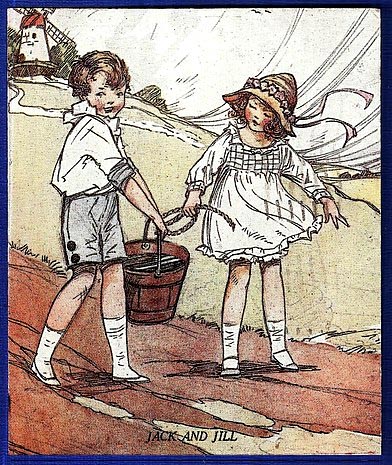
Jack and Jill went up the hill,
To fetch a pail of water;
Jack fell down, and broke his crown.
And Jill came tumbling after.

--------

Some words to talk about:

  • fetch: get; bring
  • pail: bucket
  • crown: head
  • tumbling: falling, and perhaps rolling (down the hill)

ACTIVITIES:

Encourage your child to tell the story of what happened to Jack and Jill in his or her own words. Where were Jack and Jill going? What were they going to do? What happened to Jack? What happened to Jill? How did Jack feel? How about Jill?