Showing posts with label Vol. I Issue 7. Show all posts

Monday, December 13, 2021

Vocabulary Builder: individual

Click to see Vol. I, Issue 7 of the newsletter in which this article first appeared.

individual (noun)

  • Meaning: one person; or a single thing, separate from others

  • Plural: individuals

  • Verb Forms: individualize, individualizes, individualized, individualizing (to make individual: "The committee encouraged the participants to individualize their nametags.")

  • Other Noun Forms:

    • individuality: the unique characteristic(s) of a certain individual: "Even members of some lower life-forms--fish, reptiles, etc.--may exhibit individuality in their behavior."

    • individualist (plural: individualists): one who asserts his or her individualistic traits: "Sometimes being an individualist makes it hard to get along with others."

    • individualism: the principle of being an individualist: "Her boss supported her individualism and didn't insist on her wearing the company uniform."

  • Adjective Forms:

    • individual: separate: "The pretzels came in individual packages."

    • individualistic: insisting on being a unique individual: "His individualistic behavior made it difficult for his office mates to accept him."

  • Adverb Forms:

    • individually: one by one: "The group arrived individually before sitting down together."

    • individualistically: in an individualistic way: "She dressed individualistically to stand out from the crowd."


  • PRACTICE:

    Place the correct form of "individual" in each sentence. Correct answers are in the first comment below.

    1. individual (adj.)
    2. individual (noun)
    3. individualism
    4. individualist
    5. individualistic
    6. individualistically
    7. individualists
    8. individuality
    9. individualize
    10. individualized
    11. individualizes
    12. individualizing
    13. individually
    14. individuals
    1. If you behave too ________, people will think you're weird.
    2. A team is made up of many agreeable ________.
    3. Some people admire the type of person we call a "rugged ________."
    4. Please place each sandwich in an ________ bag.
    5. Each slice of cheese comes ________ wrapped. What a waste of plastic!
    6. Dealing with a group of ________ is a little bit like "herding cats."
    7. He ________ his kids' lunches by adding each kid's favorite snack.
    8. Did you meet the ________ I told you about? What was he like?
    9. He ________ his house by putting up black Christmas lights.
    10. Some feel that a person's ________ is what makes him or her worth knowing.
    11. Mel was so ________ that no one was comfortable around him.
    12. Many organizations find it difficult to tolerate ________ in their members.
    13. You can ________ your wardrobe with these colorful scarves.
    14. I have been ________ my dogs by giving each one a different collar.

Sunday, December 12, 2021

Charlemagne's "Mini-Renaissance"

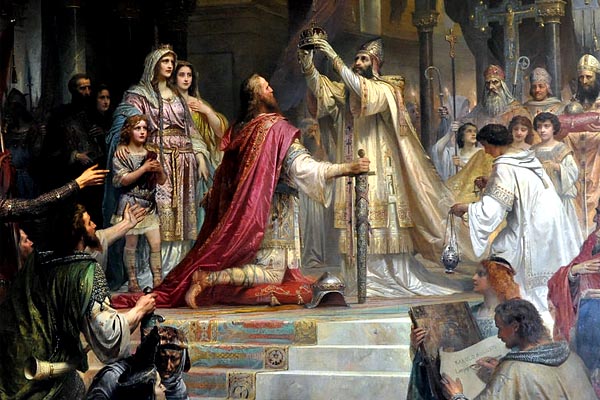
The Imperial Coronation of Charlemagne, by Friedrich Kaulbach, 1861

Click to see Vol. I, Issue 7 of the newsletter in which this article first appeared.

Listen to the audio of this article!

For nearly three years, I wrote my columns the Shenzhen Daily in the form of dialogues between college students meeting in the "Common Room" of their dormitory. Usually there was one "international student" (from another country) and one American student who explained things to them--although sometimes, the international student did the explaining! I thought it might be fun to share one of these with you. In this conversation, a Chinese boy named Ming talks with an American named Mark.

Ming: Hi, Mark. Can I ask you a question about the alphabet we use?

Mark: Sure!

Ming: I've heard you call the way we write letters "the Latin alphabet." Does that mean we write like the Romans did?

Mark: Sort of. But of course, they wrote two thousand years ago, so there have obviously been a few changes.

Ming: For example?

Mark: Well, at some point Roman writing lacked J, U, and W. These were added later.

Ming: I see.

Mark: You know, before the ease and speed of modern communication, and even travel, there were many regional ways of writing.

Ming: So the writing in, say, France, might be different from that in Holland?

Mark: Yes, though in the period I'm talking about, those countries didn't exist yet.

Ming: Okay. But how did writing become standardized?

Mark: That happened under a man named Charlemagne, who was born sometime in the 740s and died in 814.

Ming: He was a French king, right?

Mark: Almost! He was King of the Franks, a more-or-less German-speaking nation which gave rise to what are now both France and Germany. In fact, at one point Charlemagne ruled over most of Western Europe, and laid much of the foundation for modern Western civilization. People call him "The Father of Europe."

Ming: Cool!

Mark: The name we call him, Charlemagne, is based on the French form of the words "Charles the Great," and spoken in Latin Carolus Magnus. So the way we write today is based on something called Carolingian script, which began to be developed in his time.

Ming: Amazing! What else did he do?

Mark: His rule was sort of a "mini-Renaissance," because he organized and promoted learning. This ended the early part of the Middle Ages--the part we call the Dark Ages--but there were still a few more centuries of the Medieval Period before the real Renaissance got started in Italy.

Ming: I see. So, how did he "promote learning"? Was he, like, a teacher?

Mark: No. Interestingly, Charlemagne himself couldn't read or write until he was a grown man--and even then he wasn't too good at it. One of his teachers said that, because "he did not begin his efforts in due season, but late in life, they met with ill success."

Ming: That's too bad.

Mark: Nevertheless, he valued education. He brought a monk named Alcuin of York from England to his capital in Aachen, now in Germany, to organize his school and library.

Ming: Oh, I love libraries! So, he had a place where people could borrow books?

Mark: No, it wasn't that type of library. Actually, they called it a scriptorium. It's where they copied manuscripts, or hand-written books. That's how they used the new handwriting.

Ming: I see.

Mark: So, Charlemagne made the first steps toward a revival of learning, preserved a lot of Greco-Roman literature, and promoted a flowering of art and architecture. The Pope crowned him "Emperor of the Romans" in 800, the first to be recognized as such since the Western Roman Empire fell around three centuries earlier.

Ming: Wow! Thanks for teaching me about him, Mark!

Mark: It was my pleasure.

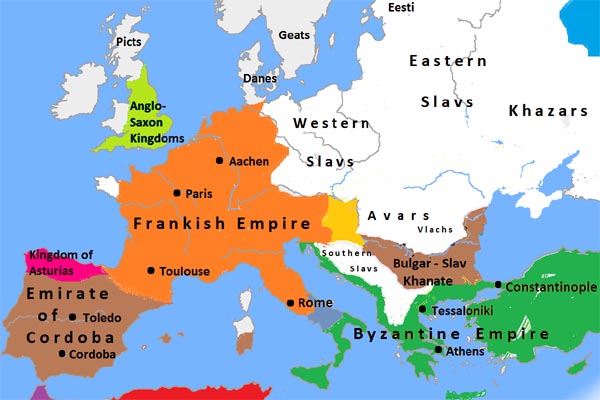
Europe around 814, when Charlemagne died. Note also the
Geats and Danes, featured in Beowulf, in the north.

PRACTICE:

Vocabulary: Match the words to their meaning. Correct answers are in the first comment below.

  1. civilization
  2. coronation
  3. dormitory
  4. emperor
  5. flowering
  6. foundation
  7. Greco-Roman
  8. Medieval Period
  9. revival
  10. standardized
  1. made the same for everyone
  2. the culture or society of a particular place, time, or group
  3. basis; groundwork; beginnings
  4. place where students or company employees sleep
  5. "king of kings," ruling over more than one country
  6. development; maturing; growth
  7. renewal; fresh start
  8. of the Greeks and Romans; classical
  9. another word for the Middle Ages, from the 5th to perhaps the 15th century (depending where)
  10. ceremony where a ruler is crowned

Questions to Answer: Answer the following questions in your own words. Suggested answers are in the first comment below.

  1. What is our alphabet called? Where did we get it?
  2. What is our alphabet based on?
  3. Who was Charlemagne?
  4. How did Charlemagne promote learning?
  5. How did the Pope reward Charlemagne?

Questions to Think About: These questions do not have "right" or "wrong" answers. They only ask your opinion.

  1. Did you ever think about where our alphabet came from? Do you know anything about other writing systems?
  2. Why do you think a king--who couldn't read or write for most of his life--was so interested in learning?
  3. Why was it important for Charlemagne's scholars to copy manuscripts?

Rachel Carson, Conservationist

Click to see Vol. I, Issue 7 of the newsletter in which this article first appeared.

Listen to the audio of this article!

Most of us today are aware of the need to take good care of the earth and the environment. This can be seen in today's emphasis on "envirotech" (environmental technology). In industry, businesses, and homes, "green technology" is almost a given, with heavy emphasis on renewable energy, purification of water and air, treatment of sewage and solid waste, and so on.

It was not always so.

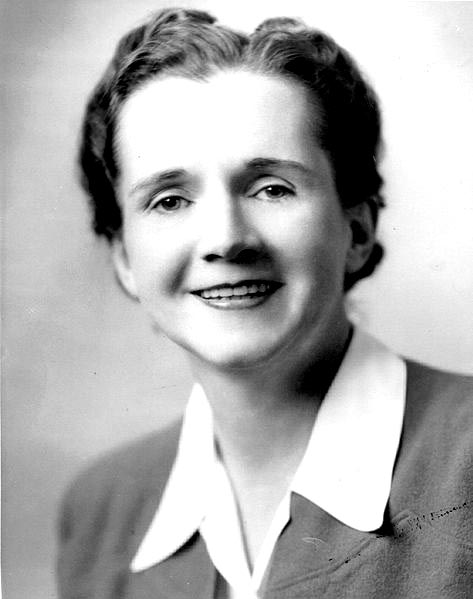
There was a time when the oceans and the sky seemed illimitable, capable of absorbing whatever we could throw into them. One of the harbingers of the change in our attitudes and understanding was a quiet little woman with a big "voice." Rachel Carson (1907-1964) was trained as a marine biologist, and her first three books, Under the Sea Wind, The Sea Around Us, and The Edge of the Sea, concentrated on that specialty.

The Sea Around Us won a U.S. National Book Award, making Carson financially secure. As a result, she was able to write about her passion: conservation, what we often today call "ecology." Her fourth book, Silent Spring, literally changed the course of history. One Carson scholar has said, "Silent Spring altered the balance of power in the world. No one since would be able to sell pollution as the necessary underside of progress so easily or uncritically."

The book describes the environmental effects of overusing synthetic pesticides such as DDT. Chemicals sprayed on plants, she found, got into the water system--streams, rivers, and lakes--and killed wildlife, especially birds--thus, the season of spring would be silent: without birdsong. (Birds exposed to DDT would produce eggs with shells so thin they would crack before they hatched, or not hatch at all.) She accused the chemical industry of lying about the effects of such chemicals, and she accused the government of accepting the industry's claims without sufficient attempts at independent verification.

Silent Spring caused an uproar, with fierce pushback by chemical companies. As a result of her work, the government banned DDT nationwide, and a movement began, especially amongst American youth, that led to the creation of the Environmental Protection Agency (EPA) in 1970, the same year as the first Earth Day celebration. Numerous schools, a bridge, a trail, two research vessels, conservation areas, science and research prizes, and more have been named in her honor.

President Jimmy Carter awarded Rachel Carson the Presidential Medal of Freedom posthumously in 1980.


PRACTICE:

Vocabulary: Match the words to their meaning. Correct answers are in the first comment below.

  1. absorbing
  2. financially secure
  3. a given
  4. harbingers
  5. illimitable
  6. marine biologist
  7. pesticide
  8. posthumously
  9. pushback
  10. renewable
  11. synthetic
  12. uncritically
  13. underside
  14. uproar
  1. unable to be limited; boundless
  2. without thinking about it
  3. one who studies life in the sea
  4. able to be replaced
  5. not worried about money
  6. taking in; accommodating
  7. poison used on insects and rodents
  8. unseen part
  9. sign of a future event; person who foretells something
  10. disturbance; clamor
  11. something everybody assumes
  12. resistance; opposition
  13. after [someone's] death
  14. made in a laboratory; not natural

Questions to Answer: Answer the following questions in your own words. Suggested answers are in the first comment below.

  1. What are some elements of "green technology"?
  2. What training did Rachel Carson have?
  3. What was the effect of Carson's book, *Silent Spring?
  4. How were pesticides affecting wildlife, especially birds?
  5. What honor did Rachel Carson receive posthumously from President Jimmy Carter?

Questions to Think About: These questions do not have "right" or "wrong" answers. They only ask your opinion.

  1. Why did people feel the world was "illimitable"?
  2. Why is "green technology" important? Can you think of examples you've seen of "green technology"?
  3. Why would industry fight against environmental policies? Is that still happening today?

"The Man Who Never Laughed Again" from 1001 Nights

Click to see Vol. I, Issue 7 of the newsletter in which this article first appeared.

Listen to the audio of this article!

This article is designed for younger readers, with activities more suitable for children. My favorite story from the Arabian Nights (also called the 1,001 Nights) is not "Ali Baba and the Forty Thieves" or even "Aladdin," but this one, called "The Man Who Never Laughed Again."

A young man wasted the money his father had left him. Soon he was begging on the street. One day an old man offered him a strange job, with a stranger rule. He would live in a house with the old man and ten more like him. But if he ever saw them crying, he must not ask them why.

He took the job and lived a good life in a comfortable house. But over time, each old man died. The younger man buried them in the garden next to the house. At last, only the old man who hired him was left. When his time to die came, the young man asked him a question. "For all these years I kept your rule. I never asked the reason the old men sometimes cried. Won't you tell me now, while you're still here?"

"No," the old man replied, "I cannot say. But if you wish to live a happy life, do not open that door." And he pointed to a door that led to another part of the house. "If you open it, you will cry as we did!"

Well, one day, long after the old man died, the young man couldn't help himself. He opened the door, and went through--and it was amazing! A great eagle carried him to a delightful land. There, he married a beautiful queen and became a king. He was very rich, and lived in a wonderful palace. He could do anything he wanted there--except open a certain door.

But, of course, after seven years, he did. The same eagle then carried him back to the first door. He returned to the house of the old men. His heart was broken. He cried until the day came when he was buried in the garden, too, with the other old men.

--------

Some words to talk about:

  • begging: asking people that you don't know for money
  • buried: put under the ground
  • delightful: making a person happy; very pleasing
  • hired: gave a job to someone
  • wasted: used in a bad way; like, threw away


QUESTIONS TO ANSWER:

Choose the best answer. Correct answers are in the first comment below.

1. Why was the young man begging?
  A. Because he wanted to work for the old man.
  B. Because he had wasted the money his father had left him.
  C. Because he wanted to become a king.

2. What strange rule did the young man have to follow?
  A. He must not ask why the old men are crying.
  B. He must always bury the old men.
  C. He must open a door in the house.

3. What did the young man ask the old man before he died?
  A. "What is behind that door?"
  B. "Who will bury me?"
  C. "Why did the old men cry?"

4. What happened when the young man opened the door?
  A. He was buried.
  B. He found himself in a wonderful land, and became a king.
  C. He had to bury the old man who hired him.

5. What happened to the young man in the end?
  A. He cried until he died.
  B. He flew like an eagle.
  C. He had to bury another old man.

QUESTIONS TO THINK ABOUT:

These questions do not have "right" or "wrong" answers. They only ask your opinion.

  1. When people in stories are given "one rule," why do they (almost) always break it?
  2. Why couldn't old man just tell the young man why the others were crying?
  3. Why didn't the young man learn his lesson from opening the door in the house, and NOT open the door in the palace?

"One Two, Buckle My Shoe": A Read-Aloud-Rhyme

One through Twelve, from an old children's book

Click to see Vol. I, Issue 7 of the newsletter in which this article first appeared.

Listen to the audio of this article!

Parents and teachers can read these rhymes aloud, and encourage little ones to repeat and even memorize them (I did when I was a kid!)

With this old rhyme, kids can have fun while they practice counting. There are many different versions of this rhyme; this is the one I learned. But I never learned a melody for this as a kid, and none of the sources I've checked seem to be traditional, so I'll just say it.

One, two, buckle my shoe!
Three, four, shut the door!
Five, six, pick up sticks!
Seven, eight, lay them straight!
Nine, ten, a big fat hen!
Eleven, twelve, dig and delve!
Thirteen, fourteen, maids a-courting!
Fifteen, sixteen, maids a-kissing!
Seventeen, eighteen, maids a-waiting!
Nineteen, twenty, my plate's empty!

--------

Some words to talk about:

Before we look at separate words, let me comment on the more difficult lines.

One, two, buckle my shoe!

  • Long ago, shoes had buckles, like the kind we see on belts today. Nowadays we would say "tie my shoe."

Eleven, twelve, dig and delve!

  • Delve is an old word that means the same as dig. Today we might use it for "investigate": Delve into a mystery.

Thirteen, fourteen, maids a-courting!

  • To court is an old-fashioned word meaning "to look for a husband or wife." Today we don't usually court, we date. It can mean "try to get someone's attention" or "get someone to like us."
Now here are a few words and definitions:
  • buckle: close with a buckle, a special kind of clasp or closer
  • courting: trying to attract a boy or girl to be one's boyfriend or girlfriend
  • delve: dig, or investigate

ACTIVITIES

For each line, have your kid do some "pretending." Before you look at my suggestions below, ask your kid what she or he thinks is the best way to "pretend" each line.

One, two, buckle my shoe!

  • Bend over as if tying your shoe.

Three, four, shut the door!

  • Pretend to shut a door. Some people say "Knock on the door"; your kid can do that instead.

Five, six, pick up sticks!

  • Pretend to pick up sticks from the ground.

Seven, eight, lay them straight!

  • Pretend to lay the sticks down again, one by one, side by side.

Nine, ten, a big fat hen!

  • Pretend you're a chicken! Put each hand in your armpit and "flap" your elbows, while walking around and "pecking" at the ground.

Eleven, twelve, dig and delve!

  • Pretend to dig a hole with a big (pretend) shovel.

Thirteen, fourteen, maids a-courting!

  • Act like a girl seeing a boy she likes: tilt your head, look down, smile a little, blink your eyes quickly, cover your face like you're shy, and so on.

Fifteen, sixteen, maids a-kissing!

  • Give you hand a big kiss--or a lot of them!

Seventeen, eighteen, maids a-waiting!

  • Stand and look around like you're waiting for someone. Cross your arms, tap your foot, check your watch, and so on.

Nineteen, twenty, my plate's empty!

  • Hold up a (pretend) plate to show it's empty. Smile big!
--------

Speed it up: Here's another activity, one we've done before: once your kid has learned the rhyme, try saying it over and over, faster each time until it just gets crazy!

--------

Discussion: Does this make the numbers easier to remember? Which one do you think is funny? Which one is hard to understand?

Saturday, December 11, 2021

"Let sleeping dogs lie"

My dog Bella. When she's sleeping, I just let her lie.

Click to see Vol. I, Issue 7 of the newsletter in which this article first appeared.

Proverb: Let sleeping dogs lie.

Meaning: If a matter is settled, there's no need to bring it up again.

  • Numerous sayings make the same point: "Let bygones be bygones," "Leave well enough alone," etc. the Romans said, Quieta non movere ("Don't move things that are quiet") and many others.

Mini-Dialogue: Sam sees his friend Dave looking a little low.

Sam: Hey, Dave. What's wrong?
Dave: Oh, my girlfriend and I had a fight last week. I think she smokes too much! The argument's over, but the smoking still bothers me.
Sam: Are you willing to break up with her over it?
Dave: Well, not really. She's a great person!
Sam: Then maybe you should just let sleeping dogs lie.
Dave: Yeah, you may be right.


QUESTION:

  1. In which situation would you use the proverb, "Let sleeping dogs lie"? The correct answer is in the first comment below.
    A. Your boss scolded you last week; you want to go to him and explain yourself.
    B. Your friend wants to start a rock and roll band, and asks you to join.
    C. Your brother broke his friend's bike and offers to pay for it.

Friday, December 10, 2021

Beowulf, an Early English Epic

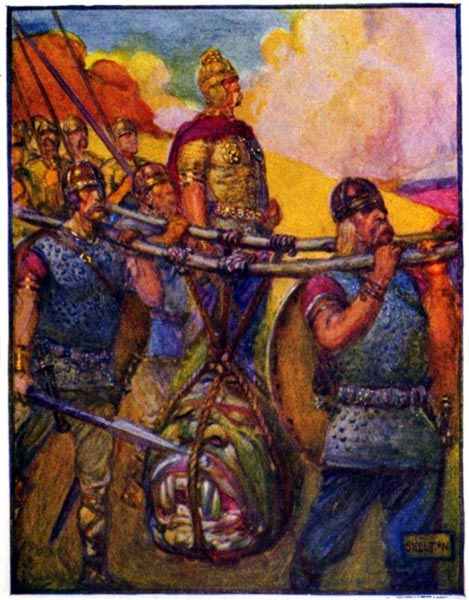
It took four men to carry Grendel's head.

Click to see Vol. I, Issue 7 of the newsletter in which this article first appeared.

Listen to the audio of this article!

"Old English"

I'm always amused when I hear people say things like, "I can't read Shakespeare. That Old English is so hard to understand."

Well, here's some news: That's not Old English. In fact, it's modern English. Before that came Middle English, and before that was Old English, also called Anglo-Saxon.

Middle English is the language in which Chaucer wrote; it contains a great deal of French, the result of the English loss at the Battle of Hastings in 1066 to the Norman French, and the subsequent rule of William the Bastard--usually called "the Conqueror."

But before that was an extremely German-sounding language brought over from the European continent by the Angles, Saxons, and Jutes when they invaded England--"Angle Land"--mainly from the mid-fifth to the early seventh centuries. The mélange of dialects they brought synthesized into what we now call "Anglo-Saxon" or "Old English."

For comparison, here is the first line of the Lord's Prayer in four "Englishes":

  • Anglo-Saxon (995): Fæder ūre þū þē eart on heofonum...
  • Middle English (1389): Oure fadir That art in hevenes...
  • Elizabethan (1611): Our father which art in heauen...
  • Contemporary (now):"Our Father who is in heaven... (or, more simply, Our Father in heaven...)

The Elizabethan, it should be noted, is from the time of Shakespeare: Early Modern English.

--------

Grendel

It is to that earliest period of English--before Shakespeare, before even Chaucer--that we must turn to find the earliest epic available to us in any kind of English. Homer's Iliad and Odyssey are earlier still, and Gilgamesh is even older. But this is the first epic to have come from the culture that gives us modern English.

Beowulf is both the name of the epic, and the name of its protagonist. He was a hero of some people called the Geats, who lived in the southern part of Sweden. (The "earliest English epic" did not take place in England! It was carried in by immigrants.) Hrothgar, king of the Danes, was having a little monster problem, and Beowulf gained fame by coming to his aid.

The name "Beowulf," by the way, may mean "bee-wolf" or "bee-hunter," a reference to a bear. (Old English uses a poetic device called kennings, in which two words are put together to signify a third. Famous examples include "whale-road" and "swan-road" for the sea, and "sky-candle" for the sun. The kenning forms given here are translations of hron-rād and heofon-candel, respectively.)

As the story goes, Hrothgar has built a mead hall named Heorot, a place to drink mead (a liquor made from honey) and celebrate victories in previous battles, as well as mourn the loss of fallen warriors. Unfortunately, a monster named Grendel lives nearby, and, hearing the songs of celebration, becomes jealous. And so, the story says (in one translation):

"[T]he hall's merriment was brought to an end by a grim foe named Grendel.... This wretched being… was a descendent of Cain, whom the Lord had banished from mankind for the slaying of Abel."

Let's pause for just a moment to get some "feel" for Anglo-Saxon poetry. It did not achieve a pleasant sound through rhyme, as we might expect, but instead by alliteration, the use of similar opening sounds in words (like "Peter Piper picked a peck of pickled peppers..."). What's more, each line was split in half; one side was to use the alliterating sound once, and the other twice, like this:

wæs se grimma gæst     Grendel hāten

A translation that tries to keep the sound reads:

Grendel that ghost was called, grisly and terrible,

Grimma means "grim"; gæst might mean "ghost" or "demon," though some use "stranger" (like "guest") or even "foe," as in the quote above. Grendel, of course, is Grendel. Kennings used for him include "hall-watcher," "corpse-maker," and "shadow-walker."

Back to our story: Grendel had been attacking Hrothgar's men for twelve long years when Beowulf decided to cross the sea and take on the monster. After his arrival and the usual formalities--including some drinking and bragging--Beowulf beds down and pretends to sleep in the hall--without weapons, so he and Grendel can have a fair fight. Beowulf, after all, is said to have the strength of thirty men. The monster comes, they fight, and in the struggle Beowulf rips off Grendel's arm. The beast returns home, where (we learn later) he dies.

--------

Grendel's Mother

There is much rejoicing--more drinking, more bragging--after the hall is cleaned up from the struggle.

But the trouble isn't over! Grendel's mother decides to avenge her son's death, and attacks the hall again, where she kills an earl who was Hrothgar's dearest friend. Beowulf and his men follow her to the pond where she lives, and Beowulf dives in to battle with her in an underwater cavern, while his fourteen companions, with Hrothgar and his men, wait on the shore.

It would have taken nearly a whole day for Beowulf to reach the bottom, but while he is still on his way Grendel's mother attacks, along with the help of water-beasts who batter him with their tusks. She drags him into a waterless underground cavern, where the battle begins.

But as Beowulf engages the water witch, his sword fails him, and he throws it away in anger. The monster stabs at him with a knife, but he's protected by his good chain-mail coat (these sagas always make a big deal out of weapons and armor). Looking around, he spies a huge old sword hanging on the wall amongst other armor. It's clearly the handiwork of giants.

So our hero stabs her with the sword, and as he does the poison in her body melts the sword up to the hilt. She dies, and at once the water turns clear, with light shining like the sun. Beowulf sees Grendel's armless body and cuts off his head as a trophy to present to Hrothgar.

Hrothgar and his men, meanwhile, have given up hope that Beowulf is alive and have headed back to Heorot. But Beowulf's own men faithfully remain on watch, heartsick at the thought of losing him. Imagine their joy when he emerges from the pond with the magic sword hilt--and Grendel's gigantic head! (It took four men to carry it.)

--------

The Dragon

Now a certified hero, Beowulf--after more drinking, bragging, and gift-giving--returns to his people, where in time he becomes king, and governs the land for fifty years--until more trouble came.

A runaway slave takes shelter in a cave, which happens to be where a dragon has been guarding his hoard for over 300 winters. Thinking he might have found a way to buy his way back into his master's good graces, the man takes a huge golden cup--awakening the dragon's wrath.

The "worm" goes on a rampage, burning the people's homes--and Beowulf's, too. The King sees it as his duty to rid his country of this plague and--as he did Grendel and his mother--to do so single-handedly, without relying on his troops. So, approaching the lair, he tells his men to wait as he calls the dragon out.

And out it comes. Unlike back in Denmark, this time Beowulf has a sword and shield. But the shield does nothing to stop the flames shooting from the beast's mouth, and the hero suffers excruciating burns.

One of his men, Wiglaf, decides to help his lord (after haranguing the others for their cowardice). As he rushes in, the dragon's flames burn his wooden shield to ashes. (I have to ask" who fights a fire-breathing dragon with a wooden shield? Anyway...). Wiglaf hides under Beowulf's shield and makes his attack.

Beowulf, meanwhile, strikes the beast's head, but he's so strong that his sword shatters. The dragon rushes upon him, and seizes him by the neck with its poisonous fangs. Wiglaf, though scorched, takes this opportunity to smite the dragon lower down on its neck, and the fire begins to abate. The King draws his war-knife and ends the monster's life. Working together, the two have destroyed the enemy of the people--but that enemy has also destroyed Beowulf.

Beowulf, though, is dying of the poison inflicted by the dragon's bite. When Wiglaf brings him water, Beowulf laments that he has no son to whom he can leave his armor. He asks Wiglaf to pile up some of the hoard--elaborately described--where he can see it, and expresses his pleasure that he can leave this to his people.

He gives Wiglaf instructions for his burial, in a barrow out on a headland overlooking the sea, which he predicts will be called "Beowulf's Barrow" and serve as a guide to sailors. He bestows his armor on Wiglaf--a great honor--and seems to name him as his successor. Wiglaf, a distant cousin, is Beowulf's last surviving relative. (He may also be Beowulf's nephew, a very significant relationship in Anglo-Saxon and other medieval European cultures; the word nepotism, meaning "favoritism in business and politics toward a relative," derives from an Italian word for "nephew.")

At last, declaring he now must join all of his departed relatives, he dies.

--------

Those who see traces of The Lord of the Rings in this story might be interested to know that the author, J.R.R. Tolkien, was an expert in the study of not only this story but others like it, and produced a translation of Beowulf in the 1920s.
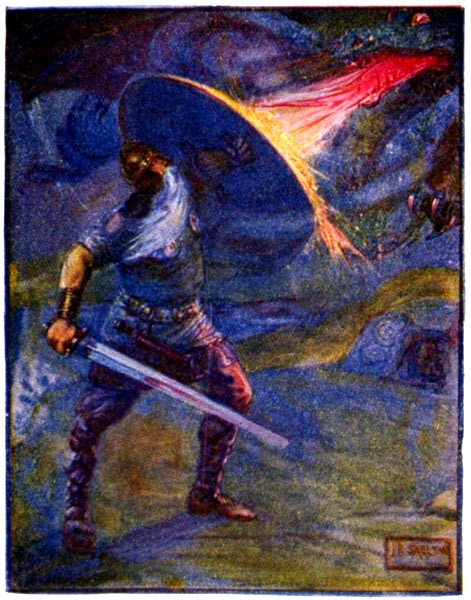
The shield does nothing to stop the flames shooting from the beast's mouth

PRACTICE:

General Vocabulary: Match the words to their meaning. Correct answers are in the first comment below.

  1. banished
  2. Cain and Abel
  3. cowardice
  4. dialects
  5. excruciating
  6. grim
  7. haranguing
  8. mélange
  9. mourn
  10. synthesized
  1. mixture
  2. brothers in the Bible, sons of Adam and Eve. One killed the other, and was condemned to wander the earth.
  3. be sad about; grieve
  4. sent away; exiled
  5. extremely painful
  6. making a long, scolding attack
  7. made up by combining two or more parts
  8. local forms of a language
  9. being afraid in the face of danger
  10. dark; savage and cruel

Vocabulary more specific to Beowulf's world: Match the words to their meaning. Correct answers are in the first comment below.

  1. armor
  2. barrow
  3. chain-mail
  4. epic
  5. headland
  6. hilt
  7. hoard
  8. sagas
  9. smite
  10. worm
  1. earthen burial mound
  2. pile of saved-up treasure
  3. shirt made of metal rings
  4. another word for "dragon"
  5. a long poem about a hero
  6. covering for the body
  7. long historical or legendary stories of a person or family
  8. promontory of land sticking out into the sea or another body of water
  9. strike; hit (old fashioned)
  10. handle of a sword or dagger

Questions to Answer: Answer the following questions in your own words. Suggested answers are in the first comment below.

  1. What problem did King Hrothgar have?
  2. How did Grendel die?
  3. How did Grendel's mother die?
  4. Who killed the dragon?
  5. What did Beowulf leave for his people?

Questions to Think About: These questions do not have "right" or "wrong" answers. They only ask your opinion.

  1. Does it surprise you that the English language came from so many places--Scandinavia, France, and so on? Why is this information important to know?
  2. What model does Beowulf present of "the hero"? Is this a comfortable model for you? Is it appropriate in today's world?
  3. The only strong female character in Beowulf is Grendel's mother. What does this--and the absence of other strong women--tell us about the role of women in that society?