Showing posts with label TJBL Audio. Show all posts

Sunday, January 16, 2022

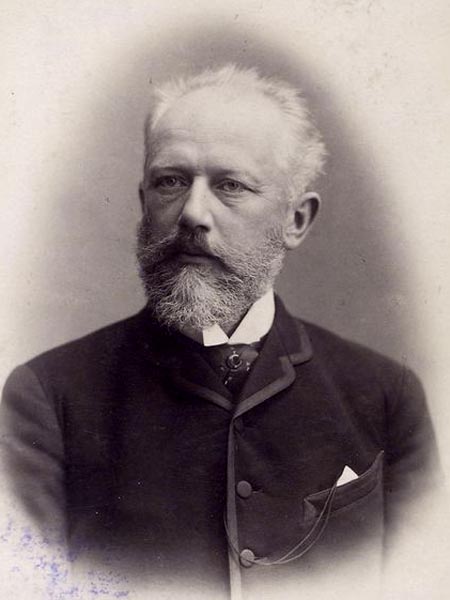
The Tragic Tchaikovsky

Peter Ilyich Tchaikovsky

Click to see Vol. I, Issue 11 of the newsletter in which this article first appeared.

Listen to the audio of this article!

What would Christmas be without The Nutcracker? Many people know "The Dance of the Sugar Plum Fairies" without knowing the name of the work--or its composer.

Russian composer Peter Ilyich Tchaikovsky lived from 1840 to 1893.  The booming cannons and ringing church bells of his 1812 Overture are part of the pops repertoire all over the world, and you don't have to be familiar with ballet to recognize music from Swan Lake, The Sleeping Beauty, or the aforementioned Nutcracker. He also wrote symphonies, operas, and numerous other works.

Tchaikovsky was the first Russian composer to become internationally famous. He toured Europe and the United States as a guest conductor, and led the first concert at New York's famous Carnegie Hall in 1891.

Tchaikovsky had four brothers, and two sisters (one by his father's previous marriage). His father was an engineer, and both father and mother (who was half French) were well-trained in the arts, including music. Peter started playing the piano at age five, but his parents did not encourage him to pursue a musical career as a boy. At that time in Russia, the only job for people with musical training was teaching, considered to be a lowly position. Only later did his father change his mind.

Tchaikovsky studied in St. Petersburg. At first, he trained as a civil servant, but later entered a music school, graduating in 1865. There he learned a more European style, which he combined with native Russian music to create a unique sound.

Although he was a success professionally, he suffered many personal tragedies. While he was at school, his mother died. He never got over it, and called it "the crucial event" that shaped his life. His closest friend, Nikolai Rubinstein, died young; he himself had a failed marriage; and his patron of 13 years suffered financial losses and could no longer support him. Tchaikovsky died suddenly at age 53, supposedly from cholera, but some scholars think he may have committed suicide.


Background to Some Popular Works of Tchaikovsky
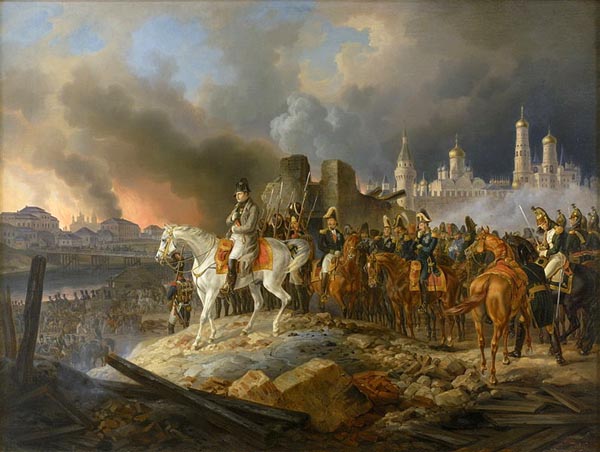
Napoleon watches Moscow burn in 1812 (by Adam Albrecht, 1841)

Let's take a closer look at the background to some of the works mentioned above.

The 1812 Overture (1880): In June of 1812, Napoleon's Grande Armée launched the "Russian Campaign." Though they outnumbered the Russians by more than two-to-one, it was no picnic for the French. When at last they occupied Moscow in September, they found the city abandoned--and soon, on fire. While waiting for negotiations that never happened, the French army ran low on supplies, and were ill-equipped for the bitter cold.

Napoleon left in early December, and the shattered remnants of the no-longer-Grande Armée within a few weeks. Many horses had died, and others had been eaten, so the cavalry ceased to exist--the remaining horsemen shuffled out on foot--and cannons and wagons were abandoned.

Nearly seven decades later, Tchaikovsky was commissioned to write a work that commemorated this victory, and The Year 1812 Solemn Overture, with its booming cannons, ringing bells, and--these days--fireworks displays, was debuted in August of 1872. It remains Tchaikovsky's most popular work.

---

Swan Lake (1875-76): The first of Tchaikovsky's three ballets is based on Russian and German folk tales. There are several versions of the story, but in one of them, a princess named Odette has been turned into a swan by an evil sorcerer's curse. She and her flock become human again each night, and in that form she meets Prince Siegfried, whose mother has ordered him to marry. Siegfried swears to love Odette forever.

But the sorcerer Rothbart, who had cast the spell on the swan-maidens, tricks Siegfried into agreeing to marry his daughter Odile by making her look like Odette. Realizing his betrayal too late, Siegfried rushes to the lake, where he and Odette drown themselves in order to be together forever. In the end, they are seen ascending into the Heavens together, united forever in their love.

---

The Sleeping Beauty (1889): This one is based directly on the "original" fairy tale by French writer Charles Perrault--essentially the version we all know about Princess Aurora being cursed by an evil fairy to die on her sixteenth birthday, until another fairy converts the curse to falling asleep for 100 years, when she will be awakened by a handsome prince (here named "Prince Désiré"). The song used in the Disney version, "Once Upon a Dream" ("I know you, I walked with you once upon a dream...") was borrowed from Tchaikovsky's ballet, as was most of the other music in the film.

---

The Nutcracker (1892): The story is adapted from one by E. T. A. Hoffmann, "The Nutcracker and the Mouse King." There are several versions, but mainly the ballet goes like this: A talented toymaker joins the family of Clara and her brother Fritz for a party on Christmas Eve, bringing with him among other gifts a nutcracker carved to look like a man. Later, Clara sneaks down to see it as the clock strikes midnight and the room fills with mice. The nutcracker grows to man-size, and the mice battle an army of gingerbread soldiers. The nutcracker and his troops join the gingerbread soldiers, and with Clara's help he defeats the Mouse King.

The nutcracker becomes a handsome Prince and leads Clara to a pine forest filled with dancing snowflakes. They travel to the Land of Sweets, where personified treats from around the world--one of them the "Sugar Plum Fairy"--dance for Clara before sending her back home in a reindeer-drawn sleigh.
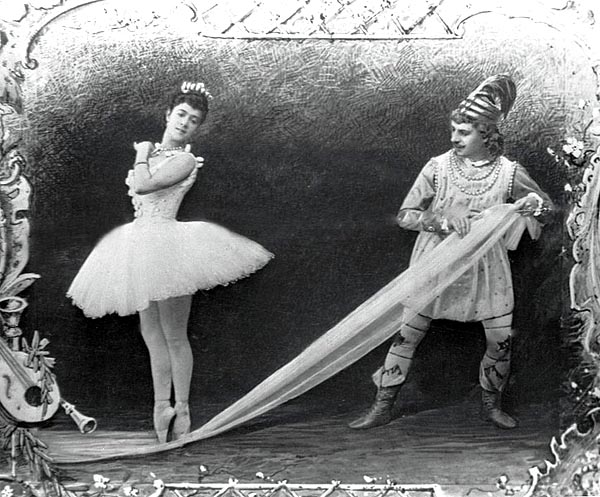
The Sugar Plum Fairy and her Cavalier in an early performance of The Nutcracker


PRACTICE:

Vocabulary: Match the words to their meaning. Correct answers are in the first comment below.

  1. abandoned
  2. ballet
  3. cholera
  4. commemorated
  5. composer
  6. lowly
  7. no picnic
  8. overture
  9. patron
  10. personified
  11. pops
  12. remnants
  13. repertoire
  14. suicide
  15. supposedly
  1. a difficult situation
  2. empty; OR left behind
  3. all of the pieces that an orchestra can perform, taken as a group
  4. a person who writes music
  5. a classical form of dance
  6. served as a memorial for; honored
  7. believed by many, but possibly not true
  8. classical music that is known and enjoyed by many people
  9. an often-fatal disease, usually spread by dirty water
  10. made like a human
  11. the act of killing oneself
  12. not respected
  13. the parts that are left
  14. a person who supports an artist
  15. a piece of music often (but not always) used as an introduction to a larger work, and usually made up of several distinct themes

Questions to Answer: Answer the following questions in your own words. Suggested answers are in the first comment below.

  1. What are some of the "personal tragedies" in the life of Tchaikovsky?
  2. What event did the 1812 Overture commemorate?
  3. What is Swan Lake about?
  4. What famous film studio used Tchaikovsky's music in their version of The Sleeping Beauty?
  5. What sorts of creatures dance to please Clara in The Nutcracker?

Questions to Think About: These questions do not have "right" or "wrong" answers. They only ask your opinion.

  1. Is it possible that "suffering"--as with Tchaikovsky's tragedies--helps contribute to the creation of great art?
  2. Which of the three ballets' stories do you like best? And least?
  3. Do you think being a music teacher is a "lowly position"? Why or why not?
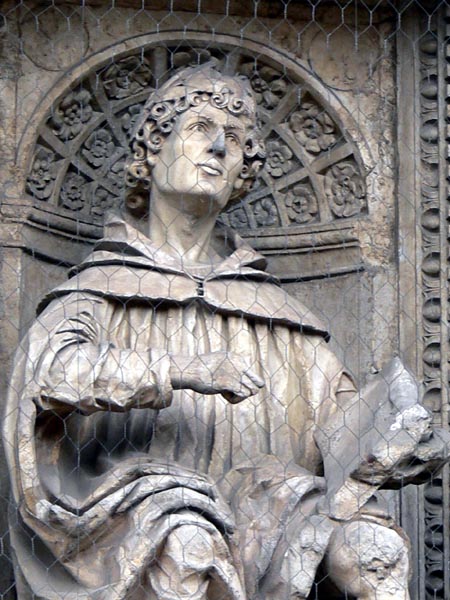
Pliny the Elder, an Early Scientist

Pliny the Elder (supposedly)

Click to see Vol. I, Issue 11 of the newsletter in which this article first appeared.

Listen to the audio of this article!

Gaius Plinius Secundus (23-79 CE), is usually called Pliny the Elder to distinguish him from his nephew (and adopted son), the lawyer and author Pliny the Younger (61-113).

The elder author was a naturalist and military commander, and a personal friend of the Roman emperor. His work is distinguished by his willingness to go out in the field and "get his hands dirty," making direct observations rather than just speculating on the nature of things, like many natural philosophers of his day.

Pliny was a single man, without children. At times he lived with his sister, mother of his nephew Pliny the Younger, whom he is said to have adopted. Certainly the younger man was familiar with his uncle's daily routine, describing his eating and working habits in letters to his contemporaries.

His greatest work is called the Natural History, similar to an encyclopedia that contained much of the current knowledge of his day. Its 37 books were completed within a few years of his death, and contain new materials as well as summaries of his earlier works and the works of others. It covers biology (both botany and zoology) as well as astronomy and geology. It is also a major source for understanding the art and artists of his time.

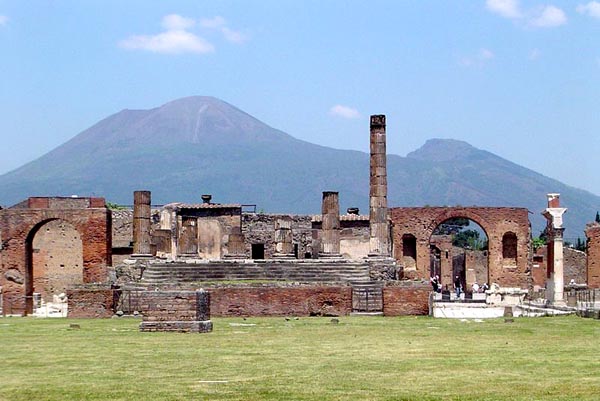
Pliny died as a result of one of the best-known events of classical times. As a naval commander, he was stationed at Misenum, across the Bay of Naples from Mount Vesuvius, which erupted spectacularly in the year 79. This was one of the volcano's many eruptions, and the one which buried the town of Pompeii.

Pliny was preparing to visit the shores near the blast to observe the phenomenon more closely when word came that some of his friends needed to be rescued. He sailed across the bay in a fast boat. Unable to leave again because the wind was against him, he dined with his friends, and was unable to stand up to leave. (One story says he was sitting in a bath, perhaps because he had asthma and he was trying to clear his lungs.) His friends left him behind, where he died, most probably from inhaling the bad air.


From The Natural History

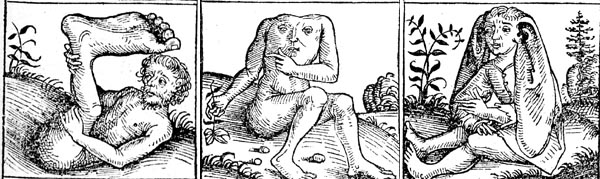
Creatures such as these are described by Pliny; learn more about them here.

As we mentioned, Pliny's Natural History covered essentially all of the knowledge of his day, but it also contained philosophical observations. Here's some of what he said about humankind's most fascinating subject--humankind--in Book VII, Chapter 1: "Man."

Humans are the only animals, Pliny says, that have to get their covering (i.e. clothes) by stealing it from other creatures; nature has given "shells, crusts, spines, hides, furs, bristles, hair, down, feathers, scales, and fleeces" to other forms of life, and even the trunks of trees are protected by bark. Humans alone, he says, "at the very moment of their birth" are "cast naked upon the naked earth" and "abandon[ed] to cries, to lamentations, and--a thing that is the case with no other animal whatever--to tears: this, too, from the very moment that he enters upon existence." And again, "The animal which is destined to command all the others, lies--bound tightly hand and foot [in swaddling bands], and weeping aloud! This is the penalty he has to pay on beginning life, for the sole fault of having been born."

He reflects further:

"How soon do humans gain the power of walking? How soon do they gain the faculty of speech? How soon are their mouths fitted for chewing?... While other animals have an instinctive knowledge of their natural powers--some, of their swiftness of pace, some of their rapidity of flight, and some again of their power of swimming--humans are the only ones that know nothing, that can learn nothing without being taught; they can neither speak, nor walk, nor eat*, and, in short, they can do nothing, at the prompting of nature only, but weep. For this reason, many have been of the opinion that it would be better not to be born, or if born, to be annihilated at the earliest possible moment." [Pliny is alluding to a common saying: "Those whom the gods love, die young."]

[*A footnote points out that Pliny has forgotten that infants do not need to be taught how to suck.]

Pompeii with Mount Vesuvius behind

PRACTICE:

Vocabulary: Match the words to their meaning. Correct answers are in the first comment below.

  1. annihilated
  2. asthma
  3. botany
  4. encyclopedia
  5. faculty
  6. geology
  7. i.e.
  8. inhaling
  9. instinctive
  10. naturalist
  11. phenomenon
  12. speculating
  13. swaddling bands
  14. volcano
  15. zoology
  1. guessing; imagining
  2. natural; innate; not learned
  3. the study of the earth
  4. the study of animals
  5. an ability; a capacity for something
  6. wiped out; destroyed
  7. a mountain that can explode and send out materials
  8. a disease of the lungs which makes breathing difficult
  9. an event; something that happens
  10. the study of plants
  11. that is; in other words
  12. an early kind of scientist
  13. a set of books that discusses every subject known to a culture
  14. long, narrow pieces of cloth wrapped around a baby to keep it from moving
  15. breathing in

Questions to Answer: Answer the following questions in your own words. Suggested answers are in the first comment below.

  1. Who was Pliny the Younger?
  2. What was Pliny the Elder's occupation, aside from being a naturalist?
  3. What was did Pliny's write about in his *Natural History?
  4. How and when did Pliny die?
  5. How does Pliny seem to feel about human beings?

Questions to Think About: These questions do not have "right" or "wrong" answers. They only ask your opinion.

  1. Could one person write a work covering all of the knowledge available to us today? Why do you think that was possible for Pliny?
  2. Why do you think other naturalists in Pliny's day were unwilling to "get their hands dirty"?
  3. Do you agree with Pliny's opinion of humankind? Why or why not?
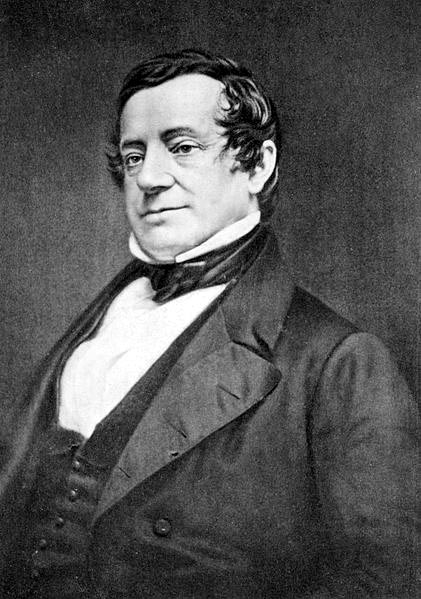
Washington Irving, International Best-Seller

Click to see Vol. I, Issue 11 of the newsletter in which this article first appeared.

Listen to the audio of this article!

Washington Irving (1783-1859) holds a unique place in American literature. He is considered to be the first American author to become a best-seller in Europe. Not only was his work well-known, but he inspired such 19th-century American greats as Nathaniel Hawthorne (author of The Scarlet Letter), Herman Melville (Moby Dick), Henry Wadsworth Longfellow (The Song of Hiawatha), and Edgar Allan Poe (numerous poems and macabre tales).

Irving's best-known works are stories like "Rip Van Winkle" (1819; see below) about a man who fell asleep in the woods for over 20 years; and "The Legend of Sleepy Hollow" (1820), about a "Headless Horseman" playing a prank on poor schoolteacher Ichabod Crane.

Despite the lighthearted nature of these popular tales, Irving was quite a serious author. He drew on local history for these stories, and was in fact as much a historiographer and biographer as he was a storyteller. He wrote biographies of great men like George Washington (in five volumes!) and Muhammad, as well as histories of Spain (he was in fact U.S. ambassador to Spain between 1842 and 1846).

Irving was in the first generation of his family born in America--his parents having come from the British Isles--and the youngest of 11 children (only eight of whom survived to adulthood). He was born the week that his fellow-citizens learned the American colonists had defeated the British, so his mother named him after the great hero of that war, George Washington. Once he became president, Washington lived in New York--the nation's capital at the time--where the Irvings also lived, and young Washington Irving was able to meet his namesake at age six.

His writing career began with letters written under a pseudonym and sent to the local newspaper. His letters were good enough to catch the publisher's eye, and he was soon writing as a professional.

He lived a long and productive life, over 20 years of it in Europe, and at age 76 died of a heart attack at his home, named "Sunnyside," in New York State.


Rip Van Winkle

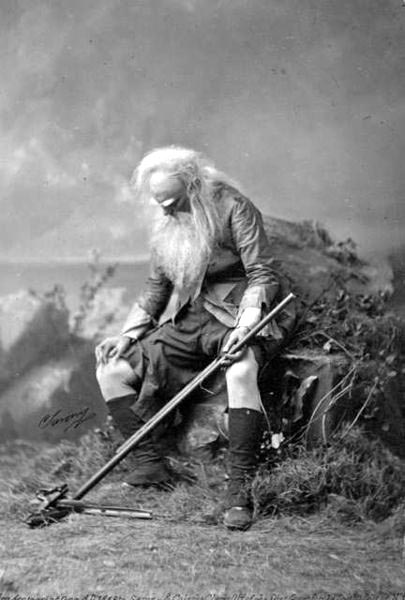
A 19th-century actor as Rip Van Winkle

In Irving's short story, "Rip Van Winkle," the titular character lives in a small Dutch town along New York's Hudson River, near the Catskill Mountains, shortly before the time of the American Revolution. Everyone loves him--his neighbors, children, even animals--for, though he is lazy, he is a genial soul. He does odd jobs for his neighbors, though his own farm is in disrepair. Sadly, he is beset by a nagging wife.

To escape her shrewishness, he spends more time than he should at the local tavern, named for the English King George III, where he and his friends enjoy a quaff of ale. Whenever his wife catches him there, he and his dog, Wolf, head off to go squirrel hunting in the hills.

One autumn day up in the woods, Rip and Wolf sit down to rest a spell as the sun prepares to set. As they start for home, Rip hears someone calling his name, and sees a short little man in antiquated Dutch clothing calling for help in hauling a keg of liquor.

As they proceed up the mountain, Rip begins to hear noises like thunder. They reach a hollow, where Rip sees the source of the sounds: a group of men with grizzled beards and dressed much like the first one are playing nine-pins.

No one says a word to Rip, who is puzzled at how the first fellow knew his name. He drinks some of the liquor from their keg and soon falls asleep. When he wakes, he discovers the men are all gone. Wolf does not answer when he calls; his gun has rusted almost to nothing; and his beard now reaches past his chest!

Bewildered, he heads back down the mountain, but when he reaches his village, he doesn't recognize a soul. The town itself looks different, and people are asking him how he has cast his ballot. Confused, he tells them he is a loyal subject of King George III, not realizing that the American Revolution has been fought and the country has become independent from England while he was asleep!

With difficulty, he finds his house and discovers it has fallen into ruins. His favorite inn, the King George III, has a new sign: it is now named for George Washington. He asks a group of men there about his old friends, and learns they are all dead--many of them died in the Revolution--or have moved away.

An old woman comments that he looks a lot like Rip Van Winkle, but everyone knows that Rip is a much younger man. It turns out this "younger man" is his son. Then a young woman appears and says she is old Rip's daughter (and young Rip's sister), Judith. After she tells the old man that her mother died of a fit of temper many years ago, Rip at last tells her who he is.

A historian confirms Rip's story about how he had wandered away, and explains that the men Rip saw were the ghosts of the crew of Henry Hudson, an early explorer for whom the Hudson River is named. They appear every 20 years to drink and play nine-pins.

Rip moves in with his daughter and continues his indolent ways, hanging out at the re-named inn and telling his story to anyone who will listen.

And to this day, when thunder rolls, the children of the area say Hudson's men are rolling the ball again.


The Legend of Sleepy Hollow

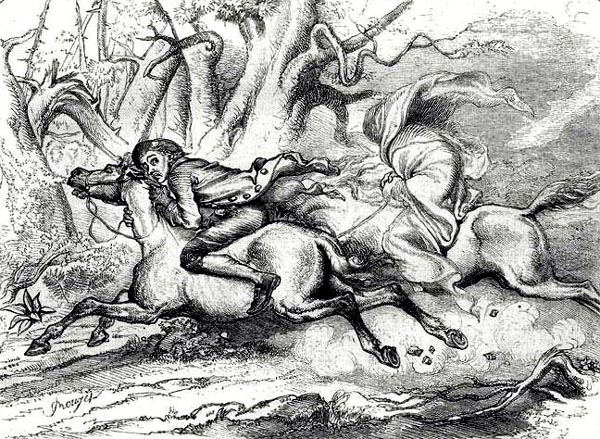
Ichabod Crane races against the Headless Horseman

Irving's other famous story, "The Legend of Sleepy Hollow," is set in roughly the same time and place as "Rip," the era when Dutch and English people were living side-by-side in New York State.

And, like that story, it features another hapless fellow, one Ichabod Crane, a schoolmaster who has moved to the Sleepy Hollow area from Connecticut. He is tall and lanky, and more than just a bit of a scaredy-cat. This is not good, as Sleepy Hollow is well-known for its ghosts! The most famous of these is "The Headless Horseman," said to have been a soldier whose head was shot off by a cannonball in "some nameless battle" of the American Revolution. He often rides out at night, looking for his head. Or so they say.

In a typical arrangement for the time, the schoolmaster stays with different families in rotation. Crane helps out around the house or farm of whomever he's staying with. He also helps out with the children, which endears him to the town's women. It seems he's also a bit of a gossip--another thing the ladies love about him! He especially loves to hear stories from the older women, and of course these include stories of ghosts and the Horseman.

Ichabod is enamored of an 18-year-old girl named Katrina Van Tassel, daughter of a wealthy farmer. He hopes that by marrying Katrina he can better his station in life, and even become wealthy. But his rival is the town bully, Abraham Van Brunt, known as "Brom Bones." Brom tries to goad Ichabod into fighting, man to man, but the teacher is too clever to fall for that. So instead, Brom always plays pranks on Crane, to make him look foolish and perhaps to provoke him into a fight.

One autumn night, Crane attends a harvest party at the Van Tassels' farm, after which he proposes to Katrina. She turns him down, and--"heavy-hearted and crestfallen"--he heads toward his lodging on his old horse, "Gunpowder." Each time he passes the sites of the supposed hauntings he has been told about, he gets more and more fearful, until at last he meets a cloaked rider--whose head is not on his shoulders, but sitting on his saddle!

In a well-known feature of the Horseman's legend, he cannot cross the water in the stream that runs next to the Old Dutch Burying Ground. Every time he tries, he vanishes as soon as he reaches the bridge. Naturally, Ichabod turns his horse that way immediately and races against the specter, hoping to lose him at the bridge.

He makes it! But after crossing the bridge, he turns back, only to see the specter hurl its head directly at him! It strikes his own head, and he falls senseless in the dust.

The next morning, poor Ichabod is nowhere to be found. But near the bridge they find his hat, his horse's saddle, and the remains of a shattered pumpkin. The old women say he was taken by the Headless Horseman, and that his spirit is sometimes still seen in the area.

Later, Brom Bones marries Katrina.


PRACTICE:

Vocabulary: Match the words to their meaning. Correct answers are in the first comment below.

  1. antiquated
  2. biographer
  3. genial
  4. grizzled
  5. historiographer
  6. hurl
  7. indolent
  8. macabre
  9. namesake
  10. prank
  11. provoke
  12. pseudonym
  13. senseless
  14. shrewishness
  15. specter
  1. someone who writes people's life stories
  2. person whose profession is writing history
  3. with a dark, frightening tone or atmosphere
  4. two people (or things) that share the same name, especially when one is named after the other
  5. a trick; a practical joke
  6. a false or "pen" name, as when Samuel Clemens called himself "Mark Twain"
  7. throw with great force
  8. push someone into action
  9. unconscious
  10. ghost
  11. old-fashioned; outdated
  12. friendly; agreeable
  13. gray
  14. lazy
  15. bad temper; nagging

Questions to Answer: Answer the following questions in your own words. Suggested answers are in the first comment below.

  1. What "first" was Washington Irving famous for?
  2. What other writers were influenced by Washington Irving?
  3. How do we know Washington Irving was a serious author?
  4. What is "Rip Van Winkle" about?
  5. What is "The Legend of Sleepy Hollow" about?

Questions to Think About: These questions do not have "right" or "wrong" answers. They only ask your opinion.

  1. Why do you think Irving was so successful in Europe?
  2. George Washington was Irving's namesake, and he met him at age six. How do you think this might have affected his later success?
  3. How much do you think the serious nature of Irving's scholarship contributed to his success as a popular writer?

Monday, January 10, 2022

"Hickory, dickory, dock": A Read-Aloud-Rhyme

Click to see Vol. I, Issue11 of the newsletter in which this article first appeared.

Listen to the audio of this article!

Parents and teachers can read these rhymes aloud, and encourage little ones to repeat and even memorize them (I did when I was a kid!) You can say or sing this one. (Hear the sung version on the audio version linked above.)

Hickory, dickory, dock!
The mouse ran up the clock.
The clock struck one,
The mouse ran down,
Hickory, dickory, dock!

You can add three (or more) verses, changing the number of "strikes" each time:

...The clock struck two...

...The clock struck three...

...The clock struck four...

and so on.

--------

Some words to talk about:

  • Hickory, dickory, dock: This is "nonsense"--that is, it has no meaning.
  • struck: made the sound of a bell. Some old clocks "strike" a bell at each hour: one at one o'clock, two at two o'clock, and so on.


ACTIVITIES

Here's some pretending! Before you start, ask your kid how he or she would "pretend" each of the lines. Then you can suggest doing the following things as you say the poem:

  • Hickory, dickory, dock!
       [tilt your head from side to side in time to the music]
  • The mouse ran up the clock.
       [hands at your sides, slowly raise them forward with your arms straight, until your hands are above your head]
  • The clock struck one,
       [clap your hands once above your head]
  • The mouse ran down,
       [lower your arms slowly, the same way you raised them]
  • Hickory, dickory, dock!
       [again, tilt your head from side to side in time to the music]

Of course, if you do "two," "three," "four," and so on, clap your hands the correct number of times.

Discussion: Can you think of other rhymes with "nonsense words"? Have you ever seen a mouse? Do you think one can get inside a clock? (Look at the clock in the picture!) What do you think a clock sounds like when it "strikes" each hour?

"The Tortoise and the Hare" from Aesop's Fables


Click to see Vol. I, Issue 11 of the newsletter in which this article first appeared.

Listen to the audio of this article!

This article is designed for younger readers, with activities more suitable for children. It is from Aesop's Fables.

One day, a Hare made fun of the short legs and slow speed of the Tortoise. But the Tortoise just laughed and said: "You are as fast as the wind, but I will beat you in a race anyway."

The Hare thought this was impossible, so he agreed to the race. They decided that their friend the Fox should choose the course and set the finish line.

On the day of the race the two lined up. When the Fox said "GO!" the two started together. The Tortoise never stopped, even for a moment. She went on with slow but steady steps straight to the finish line.

But the Hare lay down by the side of the road and fell asleep! When he woke up, he ran as fast as he could. But he saw that the Tortoise had already run the race. She was taking a nap because she was tired from walking so far.

Moral: Slow but steady wins the race.

--------

Some words to talk about:

  • finish line: the place that marks the end of a race
  • hare: an animal like a rabbit
  • moral: the lesson we can learn from a story
  • nap: a short sleep
  • steady: without stopping
  • tortoise: an animal like a turtle


QUESTIONS TO ANSWER:

Choose the best answer. Correct answers are in the first comment below.

  1. What did the Hare say about the Tortoise in the beginning?
       A. The Hare said the Tortoise had long legs.
       B. The Hare said the Tortoise moved too slowly.
       C. The Hare said the Tortoise should take a nap.
  2. What did the Tortoise say to that?
       A. The Tortoise said the Hare should take a nap.
       B. The Tortoise laughed and said she could beat the Hare in a race.
       C. The Tortoise said the Hare should be friends with the Fox.
  3. Why did the Hare agree to the race?
       A. The Hare agreed because he thought it was impossible for the Tortoise to win.
       B. The Hare agreed because the Tortoise laughed at him.
       C. The Hare agreed because he thought he was the best at everything.
  4. How did the Hare lose the race?
       A. The Hare lost because he laughed at the Tortoise.
       B. The Hare lost because he thought the Tortoise had short legs.
       C. The Hare lost because he lay down to sleep.
  5. How did the Tortoise win the race?
       A. The Tortoise won because she was faster than the Hare.
       B. The Tortoise won because she took a nap.
       C. The Tortoise won because she didn't stop.

QUESTIONS TO THINK ABOUT:

These questions do not have "right" or "wrong" answers. They only ask your opinion.

  1. Why did the Tortoise and Hare decide that "their friend the Fox should choose the course and set the finish line"?
  2. Why do you think the Hare lay down to sleep?
  3. How do you think the Hare felt at the end of the story? How did the Tortoise feel?
  4. The lesson (the "moral") of this story is, "Slow but steady wins the race." Do you agree? Is it always true?

Sunday, January 2, 2022

"The Cat and the Fiddle": A Read-Aloud-Rhyme

Click to see Vol. I, Issue 10 of the newsletter in which this article first appeared.

Listen to the audio of this article!

Parents and teachers can read these rhymes aloud, and encourage little ones to repeat and even memorize them (I did when I was a kid!) Many people have tried to find "meaning" in this old rhyme--but most agree there is none! It's just nonsense, something fun to say. Enjoy!

Hey diddle, diddle!
The cat and the fiddle,
The cow jumped over the moon;
The little dog laughed
To see such sport,
And the dish ran away with the spoon.

--------

Some words to talk about:

  • fiddle: a violin, a type of musical instrument
  • sport: something fun to do


ACTIVITIES

Let's do some more pretending! First, ask your kid how he or she would "pretend" each of the lines. Then you can suggest doing the following things as you say the poem:

  • Hey diddle, diddle!
       [do a little dance step, or just "wiggle"!]
  • The cat and the fiddle,
       [play a fiddle, while saying "meow!"]
  • The cow jumped over the moon;
       [make a big leap, over a ball if you have one]
  • The little dog laughed to see such sport,
       [hold your sides and move like you're laughing; maybe bark a little]
  • And the dish ran away with the spoon.
       [run away, holding hands with a friend if one is with you]

Discussion: Does the rhyme say the cat is playing the fiddle? What do you think he's doing with it? Can a cow really jump over the moon? (Look at the picture for an idea; see the moon in the water?) Can dogs laugh? Can dishes and spoons run? Why does the rhyme say all these silly things?

"George Washington and the Cherry Tree" from American folklore

Parson Weems' Fable (1939) by Grant Wood

Click to see Vol. I, Issue 10 of the newsletter in which this article first appeared.

Listen to the audio of this article!

This article is designed for younger readers, with activities more suitable for children. It is from American folklore.

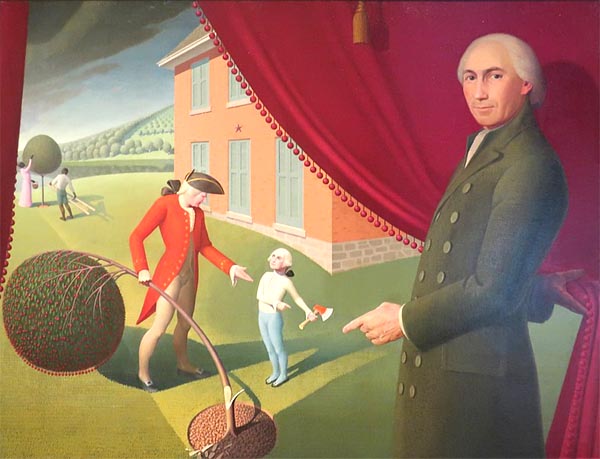
In 1800, a man named Mason Locke Weems (1759-1825), usually referred to as "Parson Weems," wrote a story about George Washington, the first President of the United States. Weems said it was told to him by an old lady who was a "cousin" of Washington's. Today we know the story didn't really happen. But we keep telling it for the lesson it teaches, and because it makes Washington look like a good man.

The story the old lady told goes like this:

When George was about six years old, his father gave him a hatchet. Like most little boys, he liked his hatchet very much. He went around chopping everything he saw.

One day he was in the garden, chopping the sticks his mother used to hold up her vegetables. But when he got bored with this, he cut the trunk of his father's favorite cherry tree.

The next day, his father saw what happened to the tree. He went in the house and asked in an angry voice, "Who cut my tree! It's probably going to die!"

At first no one answered. But then George came into the room, carrying his hatchet. "George," his father asked, "do you know who killed that beautiful cherry tree in the garden?"

It was a difficult question, but after a minute George looked at his father and said, "I can't tell a lie, Pa. I cut it with my hatchet."

"Run to my arms, dear boy," his father said, hugging him. "A tree is only a tree. But to have a son so brave and so honest is worth more than a thousand trees, even if their flowers were silver, and their fruit was gold!"

--------

Some words to talk about:

  • chopping: cutting by hitting with something sharp
  • hatchet: a small ax, a tool for cutting trees and other wood
  • hugging: putting your arms around someone and squeezing (nicely!)
  • trunk: the main part of a tree, that holds up the rest
  • is worth more: has more value; is more important


QUESTIONS TO ANSWER:

Choose the best answer. Correct answers are in the first comment below.

  1. Why did George Washington cut the trunk of his father's favorite cherry tree?
       A. He was bored after cutting some other things.
       B. He was angry with his father.
       C. He hated the vegetables his mother was growing.

  2. What did George's father think would happen to the tree after George cut it?
       A. He thought the tree would die.
       B. He thought the tree would have golden fruit.
       C. He thought the tree would needed to be cut.

  3. Why didn't George answer right away?
       A. He was afraid his father would punish him.
       B. He didn't want his mother to know he had cut the sticks in her garden.
       C. He wasn't in the room when his father asked the question.

  4. What did George say before telling his father that he cut the tree?
       A. "Please don't punish me, but..."
       B. "I can't tell a lie, Pa..."
       C. "The tree looked sick, so..."

  5. What did George's father say after he told the truth?
       A. He said that he was going to punish George.
       B. He said that George had to work in his mother's garden.
       C. He said it was better to have an honest son than a wonderful tree.

QUESTIONS TO THINK ABOUT:

These questions do not have "right" or "wrong" answers. They only ask your opinion.

  1. Why do we keep telling stories about famous people that we know are not true?
  2. Why would a father give a boy a dangerous "toy" like a hatchet?
  3. Would you always tell the truth, even if you might get punished for it?

Saturday, January 1, 2022

Hiroshige, Japanese Woodblock Artist

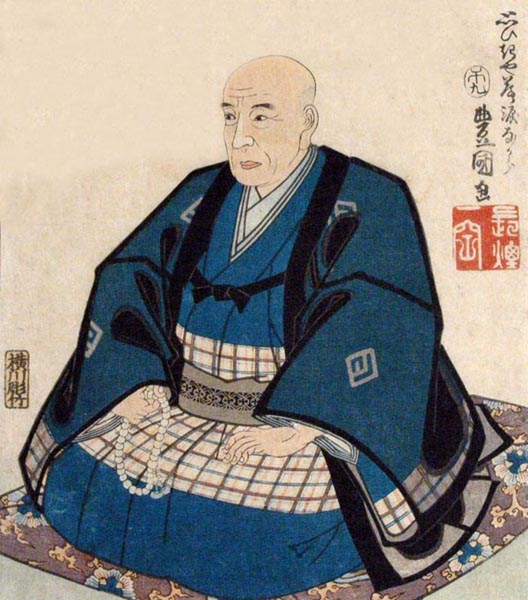
Portrait of Hiroshige as a Buddhist monk

Click to see Vol. I, Issue 10 of the newsletter in which this article first appeared.

Listen to the audio of this article!

The Japanese artist Utagawa Hiroshige (1797-1858; also called Ando Hiroshige but usually known simply as "Hiroshige") was a traveler and keen observer. 

Hiroshige was born in what was then called Edo, now Tokyo. His parents died when he was twelve; his father, fire warden for the area, left his duties to his young son. In charge of preventing fires in the Shogun's home, Edo Castle, he began painting during his ample leisure time. Though working as an apprentice, by age 15 he was permitted to sign his own works.

At age 26, he passed most of his fire warden duties on to his son, and continued to paint and produce ukiyo-e, the woodblock prints for which he became famous. The art of woodblock printing is a painstaking process. The artist carves a piece of wood (in reverse) and makes a print from it. At first, prints were in one color, sometimes with other colors added by hand.

But by Hiroshige's time, prints were often made using multiple blocks, one for each color. This allowed for easy reproduction, and the beautiful but inexpensive prints were collected by the rising merchant class in Edo.

Hiroshige came along near the end of ukiyo-e's two centuries of popularity. He produced over 8,000 works, mainly on the popular themes of the day: beautiful women, famous actors, historical and literary scenes, flowers and animals, and, most notably, landscapes.

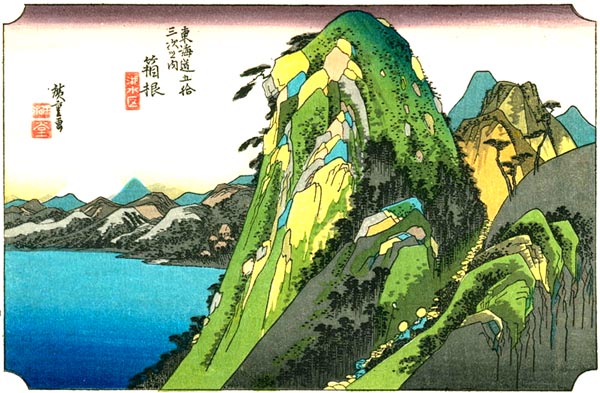
Perhaps the most famous of these is his Fifty-three Stations of the Tokaido (made in several editions, the first in 1833-34). This showed the stations along a road from Edo to Kyoto. At that time, the Emperor lived in Kyoto, but the military ruler, the Shogun, was in Edo. The road was built with 53 stations along the way, to facilitate rapid communication between the two cities.

[In 2001, the 400th anniversary of that road, I made the journey, walking for 35 days entirely on foot. Along the way, I tried my best to take photos matching the scenes Hiroshige portrayed. Though much has changed, some of the sights were still there to be seen.]

In 1856, Hiroshige retired from the outside world and became a Buddhist monk. He died in 1858, just as modernization was bringing an end to the popularity of ukiyo-e. His influence lived on, however, and Western artists like Monet and van Gogh were known to be admirers of his work.

Hakone, #11 of Hiroshige's Fifty-three Stations of the Tokaido

PRACTICE:

Vocabulary: Match the words to their meaning. Correct answers are in the first comment below.

  1. admirers
  2. ample
  3. apprentice
  4. carves
  5. facilitate
  6. in reverse
  7. keen observer
  8. literary
  9. notably
  10. painstaking
  11. reproduction
  12. warden
  1. making copies
  2. a kind of student who works for a "master"
  3. plenty of
  4. make something easier or even possible
  5. requiring great care and/or hard work
  6. backwards
  7. importantly
  8. a kind of guard; person in charge of
  9. from stories or poems
  10. one who looks carefully
  11. people who like or respect something
  12. cuts into something using a knife

Questions to Answer: Answer the following questions in your own words. Suggested answers are in the first comment below.

  1. What unusual job did Hiroshige have as a boy?
  2. How did his "day job" make it possible for him to become a painter?
  3. What is an ukiyo-e? Who bought them?
  4. What were some of the subjects of Hiroshige's art? What series was especially well known?
  5. How did Hiroshige influence western art?

Questions to Think About: These questions do not have "right" or "wrong" answers. They only ask your opinion.

  1. What advantage do you think ukiyo-e artists had over, say, oil painters?
  2. Why do you think travel pictures were so popular? What sorts of "travel pictures" do we make today?
  3. Why do you think a successful artist like Hiroshige would become a Buddhist monk?

Marcus Aurelius, Philosopher-Emperor

Click to see Vol. I, Issue 10 of the newsletter in which this article first appeared.

Listen to the audio of this article!

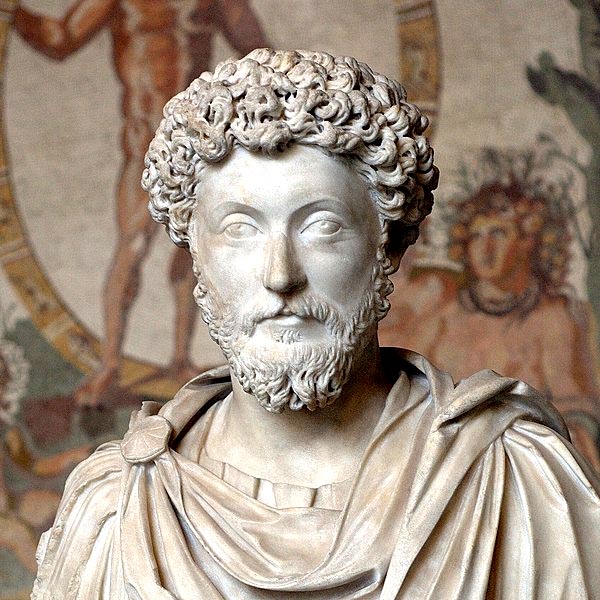
The Stoic philosopher Marcus Aurelius was not just "any old writer": he was a Roman Emperor, and a fairly successful one by most accounts: he was the last of the "Five Good Emperors," so-called because almost all of those who followed after him were so bad. He lived from 121 to 180, and ruled from 161 until his death.

Though busy leading the empire, Marcus took time to write down his thoughts, often, it is believed, while he was out in the field on a military campaign: in those days, a king was also expected to be a general and warrior.

Stoicism is a school of philosophy that says one should live a good life in accordance with nature, aligning one's decisions with the way things are. To be so aligned was considered "virtue." The modern meaning of "stoic," which is to be unmoved by joy or (especially) grief, and to accept whatever happens with equanimity, comes from this idea.

The book that we call Meditations was actually Marcus's private journal; the title was added much later (and in fact it has had several, including Treatise to Himself). There is no indication that he thought it would be seen by others, let alone published. So keep in mind that in the following selections from the Meditations, when Marcus says you, he is addressing himself, reminding himself of how to behave.


  • If you are troubled by any external thing, it is not the thing that disturbs you, but your own attitude toward it. And it is in your power to change this attitude now…. Is a cucumber bitter? Throw it away. Are there briars in the road? Turn aside from them. This is enough. Do not add, "And why were such things made in the world?"
  • Be like a rocky promontory against which the restless surf continually pounds; it stands firm while the churning sea is lulled to sleep at its feet. I hear you say [when bad things happen], "How unlucky that this should happen to me!" Not at all! Say instead, "How lucky that I am not broken by what has happened and am not afraid of what is about to happen. The same blow might have struck anyone, but not many would have absorbed it without capitulation or complaint."
  • I have often wondered how it is that every man loves himself more than all the rest of men, but yet sets less value on his own opinion of himself than on the opinion of others.
  • When you wake up in the morning, tell yourself: "The people I deal with today will be meddling, ungrateful, arrogant, dishonest, jealous and surly. They are like this because they can't tell good from evil. But I have seen the beauty of good, and the ugliness of evil, and have recognized that the wrongdoer has a nature related to my own - not of the same blood and birth, but the same mind, and possessing a share of the divine. And so none of them can hurt me. No one can implicate me in ugliness. Nor can I feel angry at my relative, or hate him. We were born to work together like feet, hands and eyes, like the two rows of teeth, upper and lower. To obstruct each other is unnatural. To feel anger at someone, to turn your back on him: these are unnatural."
  • Live a good life. If there are gods and they are just, then they will not care how devout you have been, but will welcome you based on the virtues you have lived by. If there are gods, but unjust, then you should not want to worship them. If there are no gods, then you will be gone, but will have lived a noble life that will live on in the memories of your loved ones.
  • How much time he gains who does not look to see what his neighbor says or does or thinks, but only at what he does himself, to make it just and holy.

Let me encourage you to find a copy of the Meditations and dip into it regularly.

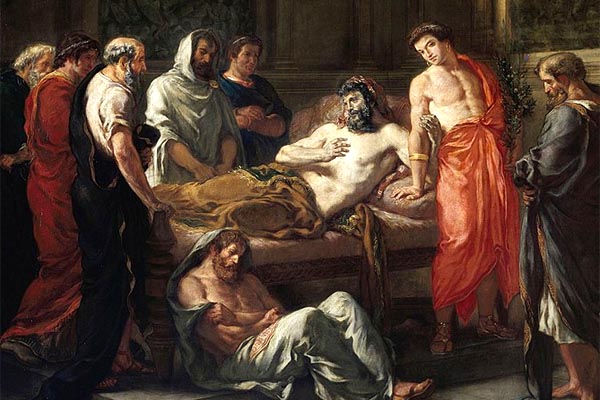
Last Words of the Emperor Marcus Aurelius (detail; 1844) by Eugene Delacroix

PRACTICE:

Vocabulary: Match the words to their meaning. Correct answers are in the first comment below.

  1. absorbed it
  2. aligned
  3. briars
  4. capitulation
  5. churning
  6. equanimity
  7. implicate
  8. in accordance with
  9. lulled
  10. meddling
  11. obstruct
  12. promontory
  13. surly
  14. unjust
  15. virtue
  1. soothed; quieted
  2. giving up; surrendering
  3. plants with sharp thorns
  4. following along with; conforming to
  5. mental or emotional stability in a time of stress
  6. interfering (with)
  7. swirling; agitated
  8. get in the way of; prevent
  9. accepted it; taken it in
  10. unfair
  11. moral excellence; goodness; righteousness
  12. brought into agreement; lined up (with)
  13. a high point of land projecting into the sea
  14. involve; include (usually in a negative way)
  15. rude; bad-tempered; unfriendly

Questions to Answer: Answer the following questions in your own words. Suggested answers are in the first comment below.

  1. How do we know Marcus Aurelius was a successful ruler?
  2. Where was Marcus during much of the time he wrote the Meditations?
  3. What is the basic idea of Stoicism?
  4. Did Marcus call his book Meditations?
  5. To whom did Marcus address his work?

Questions to Think About: These questions do not have "right" or "wrong" answers. They only ask your opinion.

  1. Do you think it would be easy to accept the Stoic point of view, accepting all things as they are? Why or why not?
  2. Marcus was an emperor. Does it surprise you that he would be so concerned about being a good person? Why or why not?
  3. If someone found a journal with your private thoughts, would you want it to be published? If so, what title do you think it should have? If not, why not?

Friday, December 31, 2021

Langston Hughes, Poet of the Harlem Renaissance

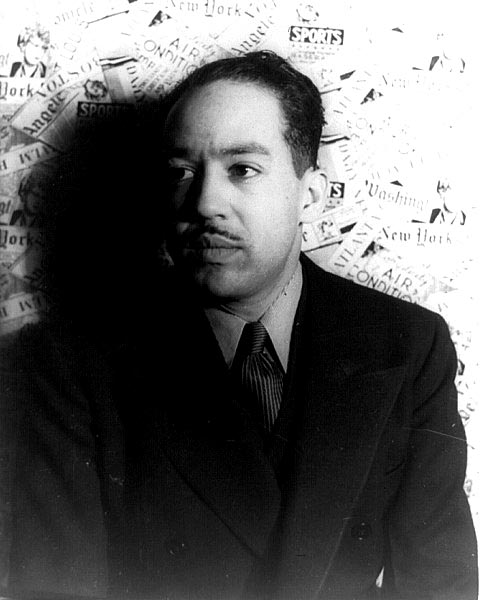
Langston Hughes, 1936

Click to see Vol. I, Issue 10 of the newsletter in which this article first appeared.

Listen to the audio of this article!

The American "jazz poet" Langston Hughes (1902-1967) worked in a fascinating era. Born less than a half-century after the enslaved Black people of America gained their freedom, he lived in a time of expansive creativity and new opportunity, while racial oppression was still devastatingly common. Although he worked as a novelist, playwright, and columnist, it is for his poetry that he is best remembered.

Hughes was born in Joplin, Missouri. When he was a young child, his family moved frequently around the Midwest. After his parents' divorce, he was fostered out, first to his grandmother, and then to family friends. He wrote of this time: "I was unhappy for a long time, and very lonesome, living with my grandmother. Then it was that books began to happen to me, and I began to believe in nothing but books and the wonderful world in books--where if people suffered, they suffered in beautiful language, not in monosyllables, as we did in Kansas."

He was elected class poet in grammar school, and wrote for the high school newspaper in Cleveland, Ohio, where he was also editor of the school yearbook. At this time, he began his creative writing, as well.

Following his father's wishes, he began to study engineering at Columbia University in New York, but left because of racial prejudice on the part of professors and fellow-students. While a student he often frequented Harlem, a "Black" neighborhood of jazz clubs and night life. He traveled abroad, and returned to complete his degree around age 27 at Lincoln University in Pennsylvania. After graduation, he returned to Harlem, where he remained the rest of his life.

Hughes is most prominently associated with the Harlem Renaissance, a movement centered in Harlem from the late 'teens to the mid-thirties, though some of its proponents lived elsewhere (including Paris), and its influence lasted much longer.


Like the other writers in the movement, Hughes was unabashed about his race, and celebrated it in poems like "The Negro Speaks of Rivers" (which he wrote at age seventeen, in, as he says, about "ten or fifteen minutes" on "the back of an envelope"):

I've known rivers:
I've known rivers ancient as the world and older than the
     flow of human blood in human veins.

My soul has grown deep like the rivers.

I bathed in the Euphrates when dawns were young.
I built my hut near the Congo and it lulled me to sleep.
I looked upon the Nile and raised the pyramids above it.
I heard the singing of the Mississippi when Abe Lincoln
     went down to New Orleans, and I've seen its muddy
     bosom turn all golden in the sunset.

I've known rivers:
Ancient, dusky rivers.

My soul has grown deep like the rivers.


"Harlem" expresses some of the frustration felt when barriers are encountered, seen or unseen. The poem evokes a verse in the Bible, Proverbs 13:12: "Hope deferred maketh the heart sick: but when the desire cometh, it is a tree of life."

What happens to a dream deferred?

   Does it dry up
   like a raisin in the sun?
   Or fester like a sore--
   And then run?
   Does it stink like rotten meat?
   Or crust and sugar over--
   like a syrupy sweet?

   Maybe it just sags
   like a heavy load.

   Or does it explode?

Lorraine Hansberry's play A Raisin in the Sun in turn takes its title from Hughes's poem.


"I, Too" embodies a similar sentiment.

I, too, sing America.

I am the darker brother.
They send me to eat in the kitchen
When company comes,
But I laugh,
And eat well,
And grow strong.

Tomorrow,
I'll be at the table
When company comes.
Nobody'll dare
Say to me
"Eat in the kitchen,"
Then.

Besides,
They'll see how beautiful I am
And be ashamed-
I, too, am America.


Hughes died at age 66 from complications after abdominal surgery related to prostate cancer. His ashes are interred in a Black cultural center in Harlem.

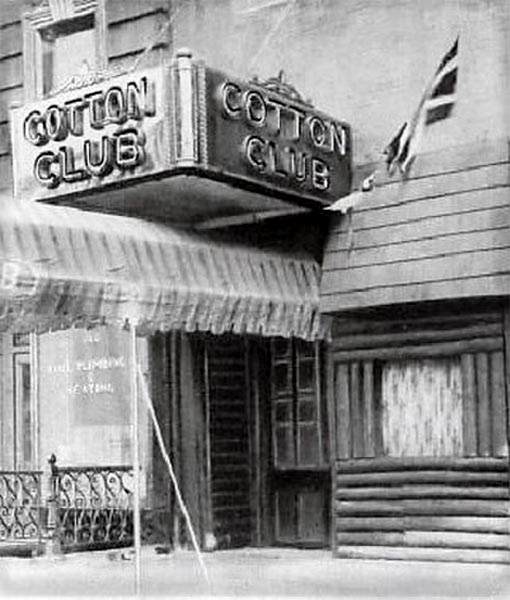
Harlem's famous Cotton Club, 1930

PRACTICE:

Vocabulary: Match the words to their meaning. Correct answers are in the first comment below.

  1. abdominal
  2. bosom
  3. complications
  4. crust
  5. deferred
  6. devastatingly
  7. dusky
  8. embodies
  9. evokes
  10. expansive
  11. fester
  12. fostered (out)
  13. frequented
  14. interred
  15. monosyllables
  16. prominently
  17. proponents
  18. sags
  19. syrupy
  20. unabashed
  1. people who are in favor of, or who support, something
  2. buried
  3. gives form to; expresses
  4. like a sticky liquid
  5. of the "belly"
  6. noticeably; obviously
  7. hangs down
  8. get infected; become filled with pus; grow worse
  9. placed in a home outside of one's family
  10. encouraging new, wider activities
  11. often went to
  12. calls forth; brings to mind
  13. not ashamed or embarrassed
  14. form a hard surface over
  15. breast; surface
  16. single sounds like "uh" and "oh"
  17. dark; shadowy
  18. delayed; put off, sometimes indefinitely
  19. causing much grief or dismay
  20. difficulties; negative reactions

Questions to Answer: Answer the following questions in your own words. Suggested answers are in the first comment below.

  1. What was unusual about Harlem when Hughes lived and worked there? What was not so good about it?
  2. What early life experience did Hughes have that encouraged him to read?
  3. What were some of Hughes's early achievements as a writer?
  4. Why did Hughes drop out of Columbia University?
  5. What other experiences did Hughes have before moving to Harlem?

Questions to Think About: These questions do not have "right" or "wrong" answers. They only ask your opinion.
  1. Which of the three poems--"The Negro Speaks of Rivers," "Harlem," or "I, Too"--do you like best? Why? Which do you like the least?
  2. Find out where each of these rivers is located: the Euphrates, the Congo, the Nile, and the Mississippi. What is significant about each of these places, perhaps especially for a Black American?
  3. What do you think happens when the fulfillment of a hope is delayed, when a "dream [is] deferred"?
  4. What is Hughes saying about the treatment of Black Americans in his time, and what does he predict (or at least hope for) in their future? has his prediction come true (yet)?

Saturday, December 25, 2021

Don Quixote de la Mancha


Click to see Vol. I, Issue 9 of the newsletter in which this article first appeared.

Listen to the audio of this article!

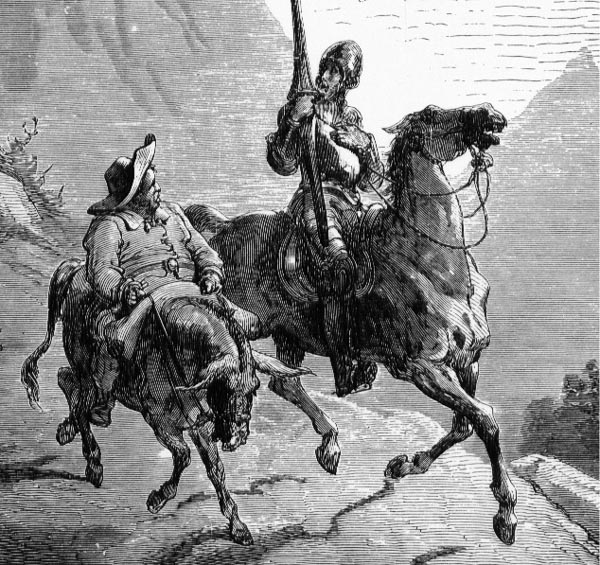
Miguel de Cervantes's comic novel The Ingenious Gentleman Don Quixote of La Mancha (1605-1615) has earned its place in the canon of world literature. Cervantes was a man of broad experience, almost as fascinating as the "knight errant" himself: wounded in battle, captured by pirates, five years a slave in North Africa, he may have started writing his classic while imprisoned for mishandling the King of Spain's money.

Nevertheless, his influence is so great that some people have called Spanish "the language of Cervantes." He is to Spanish as Shakespeare is to English. (Remarkable, then, that both men died on the same day.) And, like Shakespeare, he has given us new words: "quixotic" has come to mean impulsive and unpredictable, but also chivalrous, romantic, and visionary.

The story starts with Alonso Quixano, a (fictional) minor nobleman living in the 15th century--long after the days of chivalric culture--who reads so many novels about that romantic age that he loses his mind and fancies himself to be Don Quixote de la Mancha, a "knight-errant" who will wander the countryside with his trusty squire (actually a simple farmer), Sancho Panza--righting wrongs, freeing captive maidens, and slaying dragons. As is the custom with such "knights errant," he receives a nickname--but his, of course, is comical: "The Knight of the Sad Face" (sometimes rendered "the Woeful Countenance").

The whimsical Part I of the book's two parts is by far the more popular, and was published in 1605, ten years before the second, more serious and philosophical part.

In Part I, the nearly-50-year-old Quixano lives with his niece and his housekeeper, and believes every word of the romances he reads. He dons an old suit of armor and dubs his tired old horse "Rocinante," meaning, actually, a low-quality workhorse. He chooses a local farm girl, Aldonza Lorenzo, as his inspiration, his "lady love," and renames her "Dulcinea del Toboso." She is unaware of this social promotion.

After setting out alone--Sancho has not joined him yet--"Don Quixote" comes to an inn, which in his madness he takes for a castle. He insists that the innkeeper (the "Lord of the Castle") formally knight him. After he keeps his vigil, the innkeeper humors him by performing a mock ceremony and sends him on his way.

Next, he comes across a slave named Andres who is tied to a tree and being beaten by his master. Don Quixote makes the master swear to treat the slave fairly, but after he rides away, the master reneges and the beatings are doubled.

When some traveling merchants he encounters on the road insult his "Dulcinea," he attacks them. They beat him severely and the altercation ends with him lying by the side of the road. A neighboring peasant finds him and returns him to his home.

There, as he lies ill, his niece, the housekeeper, the local priest, and a barber (who in those days functioned as a kind of doctor) burn his library to prevent him from getting even more crazy ideas, telling Quixano/Quixote that the books were destroyed by an evil wizard. Cervantes uses this section to comment on many popular books of the day, including his own.

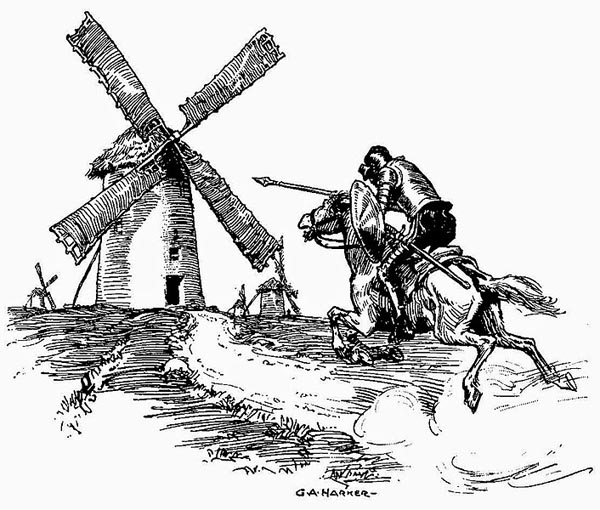
Feigning good health, the old knight sets out again, this time having recruited his trusty "squire" Sancho Panza. Sancho's earthy common sense provides balance to Don Quixote's head-in-the-clouds approach. It is on this, the second sally, that the famous story of the mad knight attacking some windmills, believing them to be giants, takes place. Even today, in English, "tilting at windmills" is used to mean "attacking imaginary enemies."

The two companions encounter a party that includes two Benedictine friars and a lady in a carriage--companions of the road, but not actually members of one party. Quixote takes the two for enchanters holding the lady hostage, and attacks, knocking one of the friars from his horse. An armed Basque takes up the fight, turning away the old man's ineffectual blows by using a pillow from the carriage as a shield (as he has none). In the end, the gracious lady commands those traveling with her to "surrender" to Don Quixote.

After further adventures with goat herders, a shepherdess, musketeers, muleteers, a dead body, a group of galley slaves, a spurned lover, a spurious princess, pilgrims, and others, Part I ends with a promise of more.

Part II takes a more serious turn. In the end, after recovering from a serious illness, Quixano awakes as from a dream with his sanity fully restored. The practical Sancho actually tries to convince him to maintain his illusions, but Quixano apologizes to all for the harm his fantasies have caused others. Before he dies, he dictates his will, which specifies that his niece will be disinherited if she marries a man who reads the books of chivalry which brought him so much mental distress.

Tilting at windmills...

PRACTICE:

Vocabulary: Match the words to their meaning. Correct answers are in the first comment below.

  1. altercation
  2. chivalric
  3. errant
  4. feigning
  5. humors
  6. rendered
  7. romances
  8. tilting
  9. vigil
  10. whimsical
  1. translated; interpreted
  2. lighthearted; humorous
  3. pertaining to the medieval practice of knighthood
  4. wandering; roving
  5. angry disagreement, sometimes leading to violence
  6. long period of watching, usually at night
  7. charging on horseback at something holding a long spear
  8. cooperates with someone to ease a disagreement
  9. pretending; faking
  10. early novels

Questions to Answer: Answer the following questions in your own words. Suggested answers are in the first comment below.

  1. How can we describe the importance of the author Miguel de Cervantes in Spanish culture?
  2. Describe Alonso Quixano.
  3. What does "quixotic" mean?
  4. Who was Sancho Panza?
  5. What is the most famous adventure of Don Quixote?

Questions to Think About: These questions do not have "right" or "wrong" answers. They only ask your opinion.

  1. Why do you think Don Quixote was nicknamed "The Knight of the Sad Face" (or "the Woeful Countenance")?
  2. Don Quixote chose a squire, a "steed" or "charger," and a "lady love," like every good knight should have. But his was really a farmer, a broken-down old horse, and a simple farm girl. Why did Cervantes make these things so silly-looking?
  3. Quixano's niece, the housekeeper, the local priest, and the barber burned his books? Can you think of other ways to solve the problem of his behavior?

Albert Einstein, THE Scientist of the 20th Century

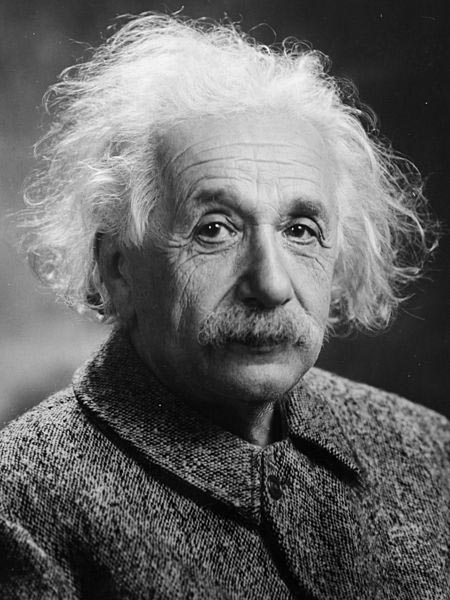
Dat mug

Click to see Vol. I, Issue 9 of the newsletter in which this article first appeared.

Listen to the audio of this article!

Perhaps no scientist in history has achieved the public recognition of the German Albert Einstein (1879-1955). His name and face (not to mention his hairstyle) seem to be known around the world.

As familiar as his face is, though, few of us really understand his insights. That is, although "the world's most famous equation"--E=mc2--is almost as well-known as his appearance, being able to recite it without grasping it is about as far as most of us can go.

The formula is part of Einstein's famous "theory of relativity." It demonstrates the equivalence of energy (E) to mass (m) in any quantity of matter, saying that the amount of energy (in Joules) in matter is equal to the amount of matter (in kilograms) times the speed of light (c) squared (expressed in meters per second). (A Joule is a measure of energy, basically the amount needed to move something one meter.)

Again:

  • E: Energy
  • =: is equivalent to
  • m: mass
  • c: the speed of light
  • 2: (written as a superscript) squared, or times itself

"Energy = mass times the speed of light squared."

Or, the amount of energy in any "thing" is equivalent to the amount of mass in that thing times the speed of light squared. (One needs to use the correct units for each value to make this work: Joules, kilograms, and meters per second.)

The theory remained controversial for many years; his 1921 Nobel Prize in Physics did not include any citation to relativity at all.

Einstein was born in what was then the Kingdom of Württemberg. His father was a businessman and engineer, who made electrical equipment in Munich. Though a non-observant Jew, Einstein attended Catholic school for three years, and then a public primary and secondary school for seven more years.

After his father's business failed, the family moved to Italy. Albert stayed on in Germany a little longer to finish at the German school, but noted later that he hated the "rote learning" there. He joined his family in Italy at the end of 1894.

At age 16, he entered a polytechnic school in Zurich, Switzerland, where his grades were good but he did poorly on examinations. There he met his future wife.

After having two children with his first wife, he divorced her in 1919. He remarried almost immediately (to a woman he had had an affair with since 1912) and in 1933, the couple immigrated to America. His second wife died there in 1936.

During World War II, Einstein contributed to the Manhattan Project, which developed the atomic bomb for America. Some of his public reputation is based on his later opposition to nuclear weapons.

Surprisingly, he was offered the presidentship of the then-new nation of Israel after the death of the first president. He regretfully turned it down.

Much has been made of Einstein's thoughts on religion and philosophy. Like Mark Twain and Abraham Lincoln, he often has things attributed to him that he never said. But he did in fact say some things on subjects outside of science, and his thoughts are well worth reading. Try The World as I See It for starters.

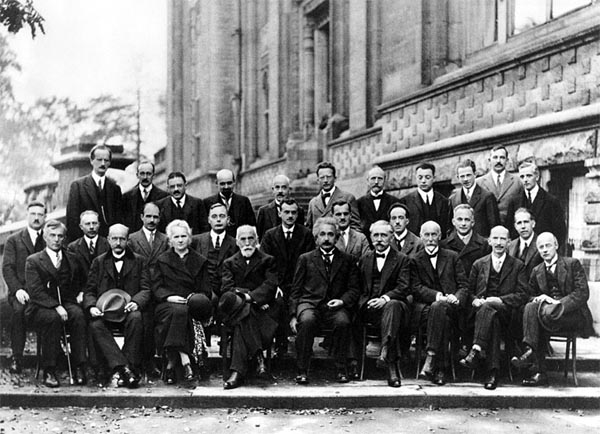
A--pack? gaggle? bevy?--of physicists at the Solvay Conference, 1927. Einstein is at center.

PRACTICE:

Vocabulary: Match the words to their meaning. Correct answers are in the first comment below.

  1. attributed
  2. controversial
  3. equation
  4. equivalence
  5. formula
  6. immigrated
  7. insights
  8. non-observant
  9. opposition
  10. rote
  1. not following the practice of a religion
  2. condition of being the same
  3. by memorization, without understanding
  4. assigned to; credited to
  5. not accepted by all; causing disagreement
  6. a symbolic expression of a rule or principle
  7. objection to; antagonism toward
  8. moved into another country
  9. ideas; discoveries
  10. a mathematical sentence in which both sides are balanced

Questions to Answer: Answer the following questions in your own words. Suggested answers are in the first comment below.

  1. What is Einstein's formula (E=mc2) meant to tell us?
  2. What do the three letters (E, m, and c) mean in Einstein's famous formula?
  3. Did Einstein's Theory of Relativity make him famous?
  4. What famous project did Einstein work on in America, and what was its purpose?
  5. How did Einstein feel about nuclear weapons later in life?

Questions to Think About: These questions do not have "right" or "wrong" answers. They only ask your opinion.

  1. What would cause a person like Einstein to change his mind about something like nuclear weapons?
  2. Many people thought Einstein was "wise" about religion and philosophy. Does being good at one thing mean you're automatically good at everything?
  3. Einstein had an affair in his 30s, then divorced his wife and married his lover. How should a person be judged for something like that, no matter his accomplishments otherwise?

The Death of Socrates

The Death of Socrates (1787) by Jacques-Louis David

Click to see Vol. I, Issue 9 of the newsletter in which this article first appeared.

Listen to the audio of this article!

Few individuals have affected the history of Western thought as profoundly as did the Greek philosopher Socrates, mainly through the writings of his student, Plato. The English philosopher Alfred North Whitehead once said, "The safest general characterization of the European philosophical tradition is that it consists of a series of footnotes to Plato"--and by extension, Socrates. Four of Plato's dialogues--the Euthyphro, the Apology, the Crito, and the Phaedo--give information that helps us understand what happened in the trial and death of Socrates.

And few paintings capture the impact of Socrates on his followers (and, ultimately, on us) more than the 1787 work of French painter Jacques-Louis David, The Death of Socrates.

In the painting, Socrates is sitting up on a bed, gesturing with one hand (still teaching!) as he reaches for a cup with the other. The person holding the cup is turned away and covering his face in grief.

Because the cup, you see, is filled with poison, and Socrates is drinking it as a form of execution by the state.

He had been tried and convicted on two charges: corrupting the youth of Athens, and impiety (worshipping false gods and not those of the state). The first charge resulted from his criticizing the leaders of Athens, and encouraging the youth to "question authority." Socrates denied that this was his intention. The second, which he freely admitted to in his trial, was because he deemed the gods, not like humans in nature, but more like concepts.

What had happened was this: a friend and follower of Socrates, Chaerephon, had gone to the Oracle at Delphi, and asked if Socrates was the wisest of men. The Oracle answered that no man was wiser than Socrates. When told this, Socrates doubted it, and began asking questions of prominent men in an effort to find one wiser than he was.

Alas, no one stood the test. Furthermore, the idle youth of the city began following him around and witnessing the disgrace of the leaders, which led to the charge that Socrates was "corrupting the youth."

Interestingly, in David's painting, Socrates is surrounded by grieving students (while his family waits outside in a hallway). Plato, anachronistically depicted as an old man, sits alone at the foot of his bed, while most of the others are crowded around the head. Their attitude stands in contrast to the confidence of Socrates, who had scolded them for their "womanly" signs of grief.

The man who has lived a moral life, he told them, had nothing to fear from death.


PRACTICE:

Vocabulary: Match the words to their meaning. Correct answers are in the first comment below.

  1. anachronistically
  2. convicted
  3. corrupting
  4. deemed
  5. depicted
  6. disgrace
  7. idle
  8. impiety
  9. oracle
  10. prominent
  1. found guilty
  2. leading astray; make immoral
  3. considered; thought (to be)
  4. not working; hanging around
  5. important
  6. in the wrong time period; here, at the wrong age
  7. shame; loss of respect
  8. shown; portrayed
  9. lack of respect for sacred things
  10. a kind of fortune teller

Questions to Answer: Answer the following questions in your own words. Suggested answers are in the first comment below.

  1. What is in the cup Socrates is about to drink from? Why must he drink it?
  2. What were Socrates's "crimes," according to the government?
  3. What did Socrates think of the gods?
  4. How did Socrates cause the youth of Athens to question authority?
  5. What did Socrates think of death?

Questions to Think About: These questions do not have "right" or "wrong" answers. They only ask your opinion.

  1. Why do you think Socrates doubted that he was "the wisest of men."
  2. Do you think a teacher should be punished for causing young people to ask questions about their societies' leaders?
  3. Do you agree with Socrates, that a good person doesn't need to be afraid of death?

"King Alfred and the Cakes" from English tradition


Click to see Vol. I, Issue 9 of the newsletter in which this article first appeared.

Listen to the audio of this article!

This article is designed for younger readers, with activities more suitable for children. It is found in the body of England's folklore.

King Alfred of England was called "Alfred the Great" because of the many ways he helped his people. One of the most famous stories about him was actually a legend, not a true story. It happened just after he became king.

Another group of people, the Danes, were attacking England. In those days a king had to fight to protect his kingdom. So after a surprise attack, Alfred was out hiding in a swampy area. He was dressed like a common soldier, not a king.

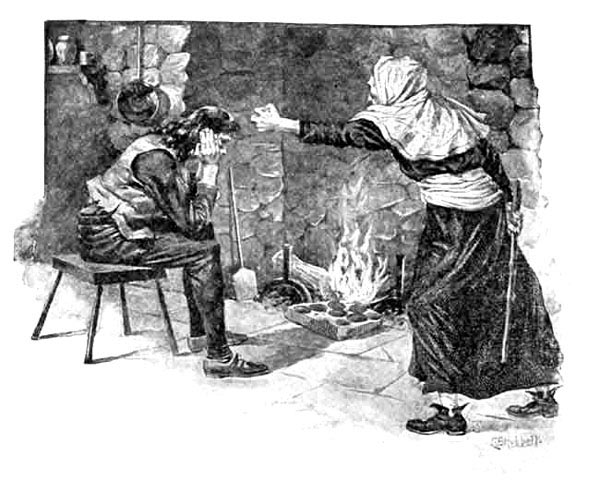
One night he was looking for a place to sleep, and asked an old woman if he could stay in her cottage. She hid his horse in her pig-barn and let him sit by her fire.

Because she was busy, she asked him to keep an eye on some cakes she was cooking on the fire. (Actually, they were more like pancakes.) He said he would. But while she was out getting some water, he started thinking of his problems and forgot to watch the cakes.

Suddenly, "What do you think you're doing?" came a shriek from behind him. The king had let the cakes burn! She hit his head with her broom, and kicked him out of her house. She made him sleep in the barn with his horse--and the pigs!

--------

Some words to talk about:

  • cottage: a small house, often outside of the city
  • legend: a story about a famous person. It might not be true, but it tells us something about that person's character
  • shriek: a high-pitched scream
  • swampy: wet, like a marsh or bog


QUESTIONS TO ANSWER:

Choose the best answer. Correct answers are in the first comment below.

  1. This story really happened.
       A. True
       B. False

  2. Why was King Alfred hiding?
       A. Because the Danes were attacking England.
       B. Because the old lady was mad at him.
       C. Because he had to sleep in the barn.

  3. What was King Alfred dressed like?
       A. He was dressed like an old lady.
       B. He was dressed like a common soldier.
       C. He was dressed like a king.

  4. How was King Alfred supposed to help the old lady?
       A. He was supposed to hide his horse.
       B. He was supposed to get some water.
       C. He was supposed to keep the cakes from burning.

  5. What did the old lady do to King Alfred?
       A. She hit him and made him sleep in the barn.
       B. She made him eat the burnt cakes.
       C. She told him to get some water.

QUESTIONS TO THINK ABOUT:

These questions do not have "right" or "wrong" answers. They only ask your opinion.

  1. Why do you think people told this story about King Alfred? What lessons does it teach us?
  2. Was the old lady right to hit her guest (whom she did not know was a king) with her broom?
  3. Would you forgive the guest if he let your cakes burn? How about if you knew he was a king? Are he rules different for kings (or rich people) and other people?