Showing posts with label Vol. I Issue 2. Show all posts

Wednesday, November 10, 2021

Vocabulary Builder: context


Click to see Vol. I, Issue 2 of the newsletter in which this article first appeared.

context (noun)

  • Meaning: the setting, situation, or circumstances in which something is found.
    • Often it's used to refer to a particular word in a particular sentence: "You can usually figure out the meaning of a word from its context"--that is from the words that come before and/or after it.
  • Plural: contexts
  • Verb forms: contextualize, contextualizes, contextualized, contextualizing
  • Adjectives:
    • contextual: relating to the context: "the contextual understanding of a word"
    • contextualized (also a verb form): same as contextual, but often used as a subject complement (after the verb to be): "A person's actions are easier to understand if they are contextualized."
    • uncontextualized: the opposite of contextualized: "contextualized vs uncontextualized words"

PRACTICE:

Place the correct form of "context" in each sentence. Answers in the first comment below.

  1. context
  2. contexts
  3. contextualize
  4. contextualizes
  5. contextualized (verb)
  6. contextualizing
  7. contextual
  8. contextualized (adj.)
  9. uncontextualized

  1. My best professor always ________ the literature he taught by discussing the author's time and place.
  2. Decisions are better understood if they can be ________.
  3. The ________ cues in a text can make it easier to understand.
  4. He ________ the books he teaches so the students understand them better.
  5. A word is easier to understand if you can ________ it.
  6. A(n) ________ statement can often be misunderstood.
  7. The conference was made more interesting by the various cultural ________ of the participants.
  8. I understand a word better if I can see it in its original ________.
  9. Sometimes ________ a decision helps people understand it better.

"The early bird gets the worm."

Click to see Vol. I, Issue 2 of the newsletter in which this article first appeared.

Proverb: The early bird gets the worm.

  • You can also say, "The early bird catches the worm."

Meaning: The one who is prepared--or who gets there first--is more likely to succeed.

  • These days, people like to make a joke about this: "The early bird may catch the worm, but the second mouse gets the cheese!"

Mini-Dialogue: Mario sees his friend Melissa waiting at the campus ticket office pn the morning tickets for a concert go on sale...

Mario: Hi, Melissa. Why are you already in line? The ticket office isn't even open yet!
Melissa: Well, like our teacher always tells us, "The early bird gets the worm."
Mario: Good luck! I hope you get what you came for.


QUESTION:

Which situation illustrates the proverb, "The early bird gets the worm"? Answer is in the first comment below.

A. getting to the bakery before other customers, while the bread is still hot
B. waiting until the day of the deadline to send in an application
C. leaving home with just enough time to reach your destination

"Jack and Jill": A Read-Aloud-Rhyme


Click to see Vol. I, Issue 2 of the newsletter in which this article first appeared.

Listen to the audio of this article!

Parents and teachers can read these rhymes aloud, and encourage little ones to repeat and even memorize them (I did when I was a kid!). If your child is ready, you can also move your finger along under the words so she or he connects the written word to its sound.

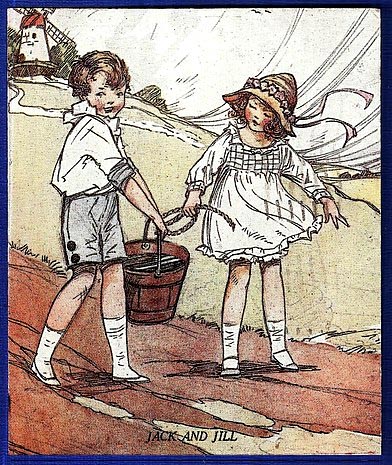
Jack and Jill went up the hill,
To fetch a pail of water;
Jack fell down, and broke his crown.
And Jill came tumbling after.

--------

Some words to talk about:

  • fetch: get; bring
  • pail: bucket
  • crown: head
  • tumbling: falling, and perhaps rolling (down the hill)

ACTIVITIES:

Encourage your child to tell the story of what happened to Jack and Jill in his or her own words. Where were Jack and Jill going? What were they going to do? What happened to Jack? What happened to Jill? How did Jack feel? How about Jill?

"My Shadow" by Robert Louis Stevenson

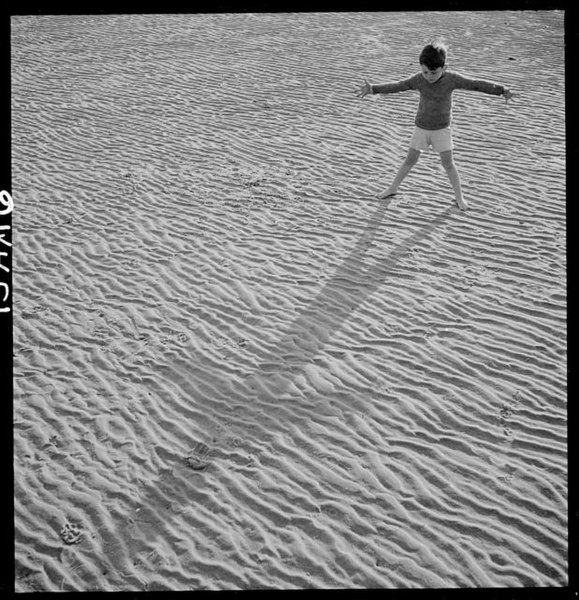
"...he sometimes shoots up taller like a bouncing rubber ball..."

Click to see Vol. I, Issue 2 of the newsletter in which this article first appeared.

Listen to the audio of this article!

This article is designed for younger readers, with activities more suitable for children.

Mr. Stevenson wrote this poem in 1885. Because it's old, some of the words might be difficult for some young readers. So I have re-written parts of it, to make it easier.

I have a little shadow that goes in and out with me,
And what can be the use of him is more than I can see.
He is very, very like me from the heels up to the head;
And I see him jump before me, when I jump into my bed.

The funniest thing about him is the way he likes to grow—
Not at all like proper children, which is always very slow;
For he sometimes shoots up taller like a bouncing rubber ball,
And he sometimes gets so little that there's none of him at all.

He hasn't an idea of how children ought to play,
And he only makes a fool of me in every sort of way.
He stays so close beside me, he's a coward you can see;
I'd be shamed to hang on Mommy like that shadow hangs on me!

One morning, very early, before the sun was up,
I rose and found the shining dew on every buttercup;
But my lazy little shadow, like a real sleepy-head,
Had stayed at home behind me and was fast asleep in bed.

--------

Some words to talk about:

  • buttercup: a type of flower
  • coward: someone who is afraid
  • dew: water found outside in the morning, before the sun comes and dries it
  • shamed: embarrassed, feeling shy

QUESTIONS:

Choose the best answer. Answers in the comments below.

1. True or false: The speaker thinks his shadow is useful.

2. What does the speaker's shadow do when the speaker jumps into bed?
A. Jumps before he does.
B. Jumps with him.
C. Jumps after he does.

3. What is unusual about the way the speaker's shadow grows?
A. The shadow always grows bigger, like a regular child.
B. The shadow sometimes grows bigger, and sometimes grows smaller.
C. The shadow always grows smaller.

4. How does the shadow embarrass the speaker?
A. The shadow throws a rubber ball.
B. The shadow grows smaller.
C. The shadow hangs onto him like it's afraid.

5. True or false: It's possible for your shadow to stay in bed while you go outside to look at flowers.

ACTIVITY:

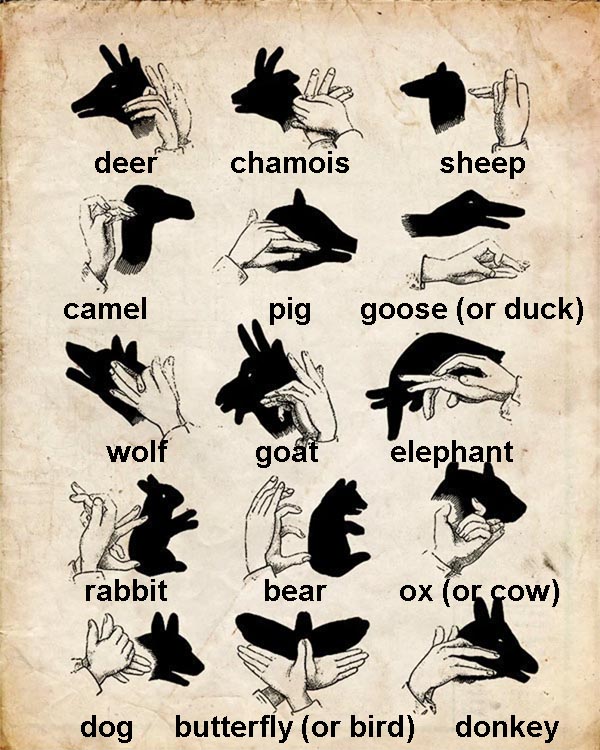
Look at the picture and try to make the "shadow animals."


European Cave Art

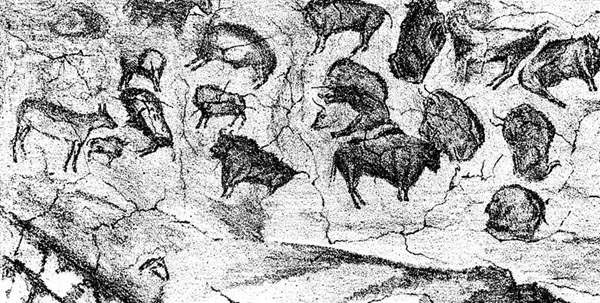
Sautuola's 1880 illustration of the great hall of polychromes of Altamira

Click to see Vol. I, Issue 2 of the newsletter in which this article first appeared.

Listen to the audio of this article!

Altamira
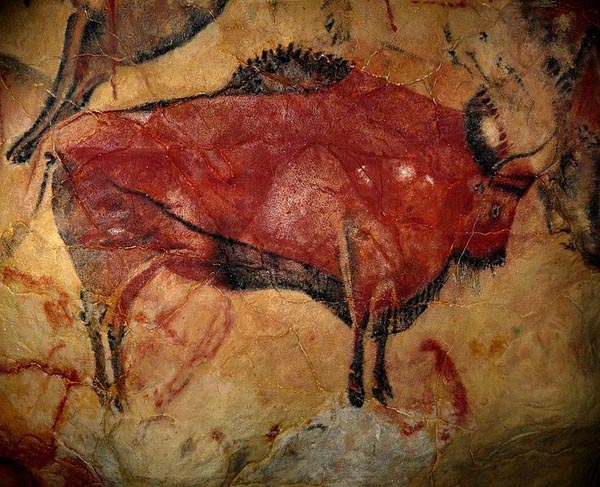
Reproduction of a bison drawing in Altamira's great hall

In 1868, Modesto Cubillas Pérez, a weaver who also worked on the farm of a Spanish jurist and amateur archaeologist named Marcelino Sanz de Sautuola, was out hunting when his dog ran away. While searching for the dog, Cubillas discovered a cave on Sautuola's property.

In 1879, Sautuola's eight-year-old daughter María led him into the cave to observe some drawings on the walls. The polychrome drawings portray the abundant wildlife of an ancient era: the steppe bison (now extinct), horses, goats and deer, and what may be a wild boar. There are also abstract images, and the outlines of handprints made by blowing powder over a hand placed on the wall.

Sautuola called in a professional archaeologist from the University of Madrid, and in 1880 they published their find, claiming the drawings were from the Paleolithic era.

Other professionals rejected and ridiculed their conclusions; the drawings were in such pristine condition that they seemed to be fake.

It was not until other, similar sites were found that Sautuola's conclusions were accepted, in 1902. Unfortunately, he was not around to hear their apologies: he had died 14 years earlier.

The cave is about 3,300 feet (1,000 meters) long, with a series of chambers connected by twisting passages. Artifacts deposited under the floor indicate two periods of occupation: about 18,500 years ago, and again from 16,590 to 14,000 years ago. In between, only wild animals lived in the cave.

--------

Trois-Freres
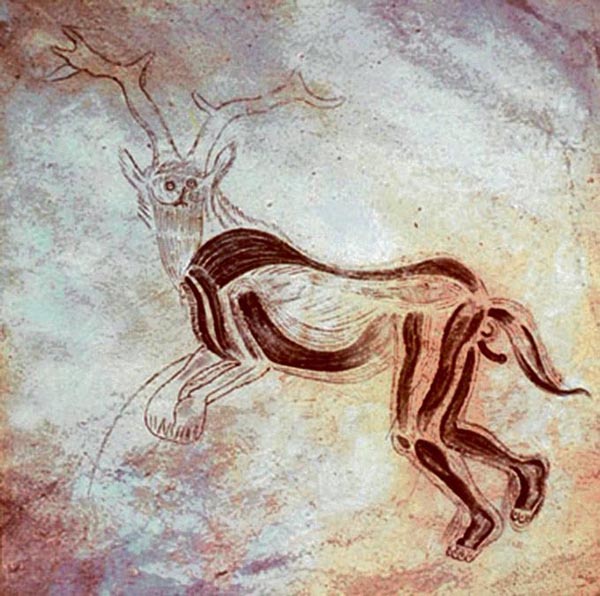
Drawing of the "Sorcerer" at Trois-Freres

In 1914, three young men, sons of Count Henri Begouen, were exploring caves on their father's land along with a couple of their friends when they stumbled onto an amazing find. Now called "Trois-Freres," meaning "Three Brothers," the cave is considered one of the most important sites of Paleolithic cave art.

After the war, the site was studied by famed French priest-archaeologist Abbe Henri Breuil, who rated it one of the six best in the world (there are some 350 painted caves in France and Spain alone).

The cave is over 1,300 feet (400 meters) long, and is located on three levels. The river that created the caves still flows through the bottom-most level; the upper two contain an explosion of over 350 figures, which seem to date back as early as 15,000 to 14,000 years ago.

The art of Trois-Freres includes 84 horses, 170 bison, 20 ibex (a kind of wild goat), 40 reindeer, eight bears, six felines, two mammoths, one woolly rhinoceros, six birds, seven human- or god-like figures, five hand stencils, and numerous wedges, dots, semi-circles, and other abstract designs.

The cave may be best known, though, for a controversial figure called "The Sorcerer." No one knows what he (or it) really symbolizes, but Breuil guessed it was a type of priest or magician dressed for a ceremony. Others see it as a "Master Animal" (a kind of spirit) or even a god. Most people know it from Breuil's drawing, which in recent years has been challenged as inaccurate.

--------

Lascaux
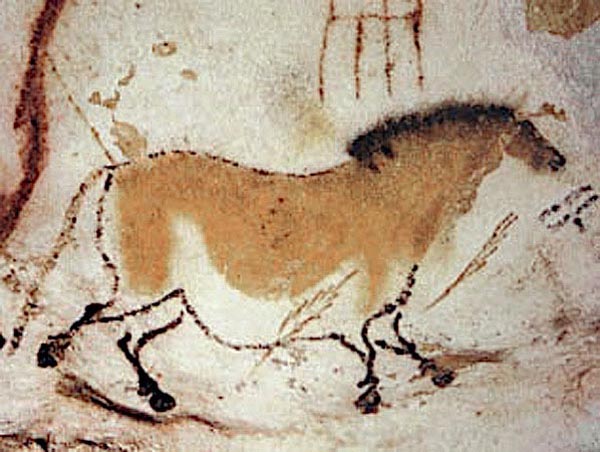
A horse at Lascaux

In September 1940, an 18-year-old was out in southwestern France with his dog, Robot, when Robot fell into a hole. Returning with three friends, the young man descended a 50-foot (15-meter) shaft to discover galleries filled with images primarily of large animals that would have lived in the area some 17,000 years earlier.

Father Breuil showed up here, too, and his drawings are heavily relied upon today due to the deterioration of the originals caused by the carbon dioxide expelled by visitors--some 1,200 per day--from the cave's opening to the public in 1948 until its closing in 1963.

The galleries have been given picturesque names like the Hall of the Bulls and the Chamber of Felines. The paintings are the work of many generations of artists, and include nearly 6,000 figures of animals (over 900), humans, and abstract designs. Of the animals, 605 have been identified with certainty. 364 of these are horses, and 90 are stags. Others include cattle and bison, felines, a bird, a bear, a rhinoceros, and a human.

--------

We sometimes like to think that we modern humans are the best at everything. But the sophistication of the artwork in these caves dates back to a time when much of Europe was still covered in ice and reindeer was the main dish in many a meal in France and Spain.


PRACTICE:

Vocabulary: Match the words to their meaning. Answers in the first comment below.

  1. abundant
  2. amateur
  3. archaeologist
  4. chamber
  5. descended
  6. deterioration
  7. extinct
  8. felines
  9. jurist
  10. mammoths
  11. Paleolithic Period
  12. polychrome
  13. pristine
  14. ridiculed
  15. stumbled onto

  1. many-colored; not just black-and-white
  2. no longer living anywhere on earth (like the dinosaurs)
  3. room or room-like opening
  4. found accidentally
  5. the earliest part of the "Stone Age"; though it started as long as two million years ago, the final phase was around 40,000-12,000 years ago
  6. large elephant-like creatures no longer found on earth
  7. specialist in the study of prehistoric peoples and their cultures
  8. went down
  9. plentiful; easy to find
  10. not professional
  11. perfect; in "mint condition"
  12. made fun of
  13. judge, lawyer, or other person trained in the law
  14. disintegration; act of become less and less perfect
  15. cats and cat-like animals (lions, etc.)

Questions: Answer the following questions in your own words. Suggested answers in the first comment below.

  1. Which site--Altamira, Trois-Freres, or Lascaux--was found first? Which has the oldest paintings?
  2. What unfortunate thing happened to Marcelino Sanz de Sautuola, owner and first archaeologist of Altamira?
  3. How did the cave called "Trois-Freres" get its name?
  4. What unusual figure is found in Trois-Freres cave? What do the experts say about it
  5. What constitutes the main type of figures at Lascaux?

The Systems of the Body


Click to see Vol. I, Issue 2 of the newsletter in which this article first appeared.

Listen to the audio of this article! (6:28)

A one-room hut needs little in the way of electrical, plumbing, and other systems, but a large mansion will need much more.

The same is true of living organisms. A single-celled animal doesn't need any "systems." But we are much more complex, so it takes many systems to keep our body operating.

People count the systems in different ways (sometimes combining systems, sometimes separating them). Let's take a look at one way of thinking about them.

--------

The Skeletal System: These are the bones that make up the framework that keeps the body standing up. Altogether we have around 270 bones when we are born; as we grow up some of these join together, and an adult has around 206. The bones also have other functions, such as producing red blood cells in the bones' center, called marrow.

The Muscular System: There are three types of muscles:

  • Skeletal muscles move the bones.
  • Smooth muscles are "involuntary"--we don't control them, as we do the skeletal muscles. They line some of the body's "tubes," like blood vessels and intestines. They are also found in the eye, the skin, and elsewhere.
  • Cardiac muscle makes up the heart.

The Nervous System: The body's nerves collect and process information from the senses, and tell the skeletal muscles what to do. The system is made up of linked-together neurons ("nerve cells").

The structure of the nervous system has two main parts:

  • the central nervous system (CNS) is the brain and spinal cord; and
  • the peripheral nervous system (PNS) branches off of the CNS into other parts of the body.

The nervous system functions in two ways:

  • the somatic (meaning "of the body") nervous system is connected to the skin, joints, and muscles, and operates mostly voluntary actions, like moving your hand.
  • the autonomic nervous system connects to organs, blood vessels, glands, and the like, and controls functions like breathing and digestion. These actions are involuntary.

The sensory organs--eye, ear, nose, mouth, and skin--are also part of the nervous system.

The Endocrine System: This system influences the function of the body through the production and release of "chemical messengers" called hormones. They are produced in organs called endocrine glands--such as the pineal gland, pituitary gland, pancreas, thyroid gland, and adrenal glands--which secrete the hormones directly into the blood.

The Circulatory (or Cardiovascular) System: This circulates blood around the body, delivering oxygen and nutrients to the body's cells and carrying away their waste products. The heart pumps the blood through arteries away from the heart, into the capillaries (where transfer happens), and the veins back to the heart.

  • Blood is made up of plasma (a liquid), red blood cells (carrying oxygen), white blood cells (part of the immune system), and platelets (which cause the blood to coagulate or clot).

The Lymphatic System: This system defends the body against harmful "invasions." Some consider it part of the circulatory system. Lymph vessels drain impurities out of the body, and carry lymphocytes ("white blood cells") to the site of infection. There are also about 450 (in adults) centers called lymph nodes.

The Immune System: This system is better thought of as a network of biological processes than as a system of structures, like the skeletal or other systems. To say someone has a "strong immune system" is simply to say that her body is good at fighting off infection.

The Respiratory System: This system brings oxygen into the lungs, from which it is absorbed into the bloodstream and carried out to the parts of the body by the circulatory system. That system then returns "spent" blood to the lungs, where its carbon dioxide is removed and breathed out again.

  • Parts include the mouth and nose, pharynx and larynx, trachea, and (inside the lungs) bronchi and alveolae. The diaphragm, a muscle, keeps the whole system moving.

The Digestive and Excretory System(s): This system brings food into the body, digests it into nutrients (with the influence of enzymes and hormones), and expels the waste products.

  • Its parts include the gastrointestinal tract: the mouth, esophagus, stomach, and intestines. The salivary glands, pancreas, liver, gallbladder, and other organs are also important to digestion.

The Urinary and Renal System(s): This is where the kidneys filter impurities out of the blood and produce urine, which is then carried through the ureters to the bladder, where it is stored until carried out of the body through the urethra.

The Reproductive Systems: These are made up of the organs required for the production of children. They include:

  • in males: the testes (which produce sperm), seminal vesicles, prostate, vas deferens, urethra, and penis
  • in females: the ovaries (which produce ova or "eggs"), fallopian tubes, uterus, cervix, and the vagina and vulva

The Integumentary and Exocrine System(s): This is the body's "exterior": the skin, hair, and nails, as well as exocrine glands that secrete sweat, skin oils, saliva, mucous, tears, and earwax.


Activities

Vocabulary Exercise 1

Match the words to their meaning. Answers in the first comment.

  1. the Circulatory System
  2. the Digestive and Excretory System(s)
  3. the Endocrine System
  4. the Immune System
  5. the Integumentary and Exocrine System(s)
  6. the Lymphatic System
  7. the Muscular System
  8. the Nervous System
  9. the Reproductive Systems
  10. the Respiratory System
  11. the Skeletal System
  12. the Urinary and Renal System(s)

  1. brings in oxygen and removes carbon dioxide
  2. brings in nutrients and expels waste
  3. collects and processes information
  4. covers the body's outside
  5. drains impurities from the body
  6. fights off infection
  7. makes up the body's framework
  8. make babies
  9. makes things move in the body
  10. moves the blood
  11. produces and removes urine
  12. produces hormones

Vocabulary Exercise 2

Using the numbered systems above, match the parts to their system. Answers in the first comment below.

  1. ovaries and testes
  2. glands and hormones
  3. kidneys and bladder
  4. vessels and nodes
  5. white blood cells
  6. central and autonomic
  7. heart, arteries, and veins
  8. lungs and diaphragm
  9. skin and sweat glands
  10. mouth, pancreas, and stomach
  11. skeletal, smooth, and cardiac
  12. bones

"This is a case for… Sherlock Holmes!"

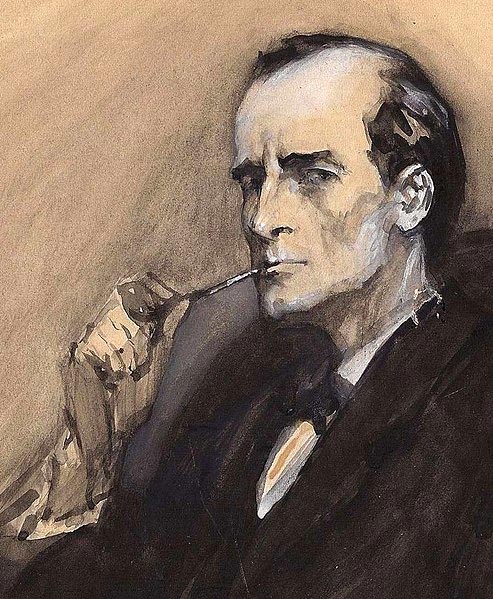
Sherlock Holmes in a 1904 portrait by Sidney Paget

Click to see Vol. I, Issue 2 of the newsletter in which this article first appeared.

Listen to the audio of this article! (3:36)

Someone's missing? You've misplaced your boss's money? Received five orange seeds in the mail without explanation?

This sounds like a case for... Sherlock Holmes!

In Mr. Holmes, the author Arthur Conan Doyle has created a character so vivid that many have mistaken him for a real person. The first Holmes stories appeared in 1887; by 1927, Doyle had written four novels and 56 short stories starring his "consulting detective."

Holmes uses highly scientific methods to untie the knottiest of problems--for a fee. Sometimes his powers of observation, logical deduction, and forensic science appear almost mystical, especially to his friend, biographer, and sometimes roommate Dr. John Watson.

With Watson, Holmes lives upstairs from his landlady, Mrs. Hudson, at 221B Baker Street, London. Watson writes down most of the stories, but Holmes claims that actual events were never nearly as sensational as Watson makes them out to be. Still, Watson is his only real friend. The relationship reveals to Watson that Holmes possesses "a great heart as well as... a great brain."

Holmes usually works for private clients, but he sometimes consults with Scotland Yard, and has been hired by high government officials in and out of England (including even the Vatican!). Sherlock admits that his brother, Mycroft, a government official, is the smarter of the two, but Mycroft is not interested in investigation.

In 1893, wishing to turn his attention to other projects, Doyle "killed off" Holmes in a struggle with his archnemesis, Professor James Moriarty. However, after 20,000 people cancelled their subscription to "The Strand," the magazine in which the stories had been published, Doyle was compelled to find an ingenious way to bring him back.

Holmes had "died" after a scuffle and fall near a waterfall; but as it turned out, he had faked his death to fool his enemies. (No body had ever been recovered.) This period is now known among fans (usually called "Holmesians" in the U.K. and "Sherlockians" in the U.S.) as "the Great Hiatus."

Sherlock Holmes was not the first fictional detective, but he is the best known. Stage, television, film, and print appearances--beyond those by Doyle--number in the tens of thousands, and no one who writes crime fiction today can ignore the character or the principles he practiced, including this one:

"When you have eliminated the impossible, whatever remains, however improbable, must be the truth."

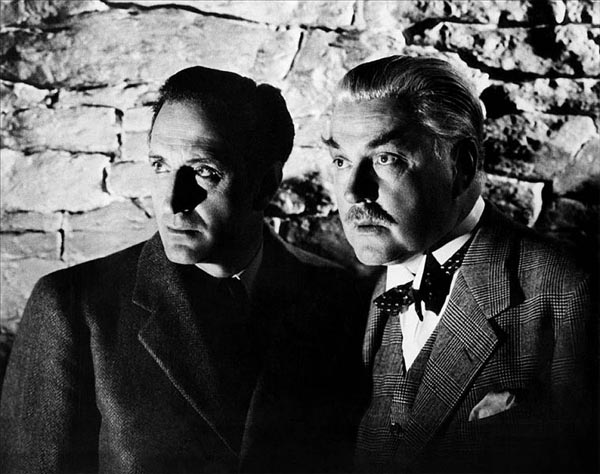
Sherlock Homes (Basil Rathbone) and John Watson (Nigel Bruce), in a 1943 film


Activities


Vocabulary Exercise

Match the words to their meaning. Answers in the first comment.

  1. archnemesis
  2. compelled
  3. consults
  4. deduction
  5. forensic
  6. hiatus
  7. ingenious
  8. knottiest
  9. sensational
  10. vivid
  1. break; interruption
  2. gives advice
  3. most difficult
  4. exaggerated for dramatic effect
  5. lively; realistic
  6. greatest enemy
  7. forced
  8. working from facts to a conclusion
  9. clever; brilliant
  10. for use in solving crimes

Questions

Answer the following questions in your own words. Suggested answers in the first comment.
  1. Is Sherlock Holmes a real person?
  2. What sorts of techniques does Holmes use to solve crimes?
  3. What character supposedly "wrote" the Holmes stories? How is he related to Holmes?
  4. What caused trouble for Arthur Conan Doyle and his publishers? How did Doyle fix the problem?
  5. What does this mean: "When you have eliminated the impossible, whatever remains, however improbable, must be the truth."