Showing posts with label Vol. I Issue 8. Show all posts

Saturday, December 18, 2021

Vocabulary Builder: method

Click to see Vol. I, Issue 8 of the newsletter in which this article first appeared.

method (noun)

  • Meaning: a procedure, technique, or way of doing something, usually by following a definite plan

    • Some methods--such as the Stanislavsky Method of acting--might be referred to in context as "the Method."

  • Plural: methods

  • Verb Forms: methodize, methodizes, methodized, methodizing

    • Meaning: create a method for doing something
  • Noun Forms:

    • methodology (plural: methodologies): a system of methods, as used in the arts or sciences, or the study of such methods: "the specific methodology for repairing ecosystems"

    • antimethod (rare) (plural: antimethods): a method that goes against the one usually used: "When western medicine didn't cure her, she turned to the antimethod of Chinese herbalism." OR an approach that avoids using a method entirely: "Despite his use of antimethod, he still managed to arrive at solution."

    • antimethodology (rare) (plural: antimethodologies): a system of antimethods.

  • Adjective Forms:

    • methodical: systematic; orderly; carefully following a method

    • methodological: related to a methodology: "a methodological foundation for repairing ecosystems"

    • methodless: without a method; random. "A methodless approach seldom gets the desired results."

  • Adverb Forms:

    • methodically: carefully following a method: "He cleaned the windows methodically, left to right, top to bottom."

    • methodologically: in a methodological way: "Her research project was methodologically sound."

  • BONUS: In the 18th century, Church of England minister John Wesley developed a "method" of spiritual practice that evolved into the Methodist Church. Adherents are called "Methodists" (singular: Methodist); the theology is called "Methodism."

    PRACTICE:

    Place the correct form of "method" in each sentence. Correct answers are in the first comment below.

    1. antimethod
    2. method
    3. methodical
    4. methodically
    5. Methodist
    6. methodize
    7. methodized
    8. methodizing
    9. methodless
    10. methodological
    11. methodologically
    12. methodologies
    13. methodology
    14. methods

    1. Thinking ________ is the key to success.
    2. Various ________ have been tried in accounting, but the profession has settled on a few surefire systems.
    3. If you need to perform a task numerous times, it's best to ________ your work flow.
    4. You might not see it, but there's ________ in his madness.
    5. ________ your work may take a few minutes time, but you'll save hours in the long run.
    6. Working ________ improves a team's efficiency.
    7. His ________ work habits cost his company hundreds of dollars a month.
    8. Her team worked faster after they ________ their system.
    9. When the usual way of doing things failed to work, Reggie used an ________ that did the trick.
    10. Modern ________ of sanitation are improving public health worldwide.
    11. My mother never goes to church, but she still considers herself a ________.
    12. ________ studies of efficiency can help your company increase its profits.
    13. If you're going to work with chemicals in a laboratory, you need to be ________.
    14. I think your hypothesis is sound, but your ________ is preventing you from getting the best results.

"The House That Jack Built": A Read-Aloud-Rhyme

Click to see Vol. I, Issue 8 of the newsletter in which this article first appeared.

Listen to the audio of this article!

Parents and teachers can read these rhymes aloud, and encourage little ones to repeat and even memorize them (I did when I was a kid!)

Okay, this one is long, but so much fun! It's what we call a cumulative or progressive tale: one that starts with a simple scene, then builds scene upon scene.

See the "Activities" below for some ways to have fun with this.

This is the house that Jack built.

This is the cheese
That sat in the house that Jack built.

This is the rat,
That ate the cheese
That sat in the house that Jack built.

This is the cat,
That caught the rat,
That ate the cheese
That sat in the house that Jack built.

This is the dog,
That barked at the cat,
That caught the rat,
That ate the cheese
That sat in the house that Jack built.

This is the cow with the crumpled horn,
That chased the dog,
That barked at the cat,
That caught the rat,
That ate the cheese
That sat in the house that Jack built.

This is the maiden all forlorn,
That milked the cow with the crumpled horn,
That chased the dog,
That barked at the cat,
That caught the rat,
That ate the cheese
That sat in the house that Jack built.

This is the man all tattered and torn,
That kissed the maiden all forlorn,
That milked the cow with the crumpled horn,
That chased the dog,
That barked at the cat,
That caught the rat,
That ate the cheese
That sat in the house that Jack built.

This is the priest all shaven and shorn,
That married the man all tattered and torn,
That kissed the maiden all forlorn,
That milked the cow with the crumpled horn,
That chased the dog,
That barked at the cat,
That caught the rat,
That ate the cheese
That sat in the house that Jack built.

This is the cock that crowed in the morn,
That waked the priest all shaven and shorn,
That married the man all tattered and torn,
That kissed the maiden all forlorn,
That milked the cow with the crumpled horn,
That chased the dog,
That barked at the cat,
That caught the rat,
That ate the cheese
That sat in the house that Jack built.

This is the farmer sowing the corn,
That kept the cock that crowed in the morn,
That waked the priest all shaven and shorn,
That married the man all tattered and torn,
That kissed the maiden all forlorn,
That milked the cow with the crumpled horn,
That chased the dog,
That barked at the cat,
That caught the rat,
That ate the cheese
That sat in the house that Jack built.

--------

Some words to talk about:

  • cock: rooster; male chicken
  • crowed: went "cock-a-doodle-dooo!"
  • crumpled: bent; wrinkled up
  • forlorn: sad
  • maiden: girl; young woman
  • morn: morning
  • shaven and shorn: smooth-faced and with a haircut
  • sowing: planting in the ground
  • tattered: in pieces; torn up


ACTIVITIES

To start with, look at the last verse, and be sure your kid understands the connections from one step to the next. Start with new words; then actions; then the "link" between lines ("How is the farmer connected to the rooster?" etc.)

Now you're ready to start memorizing from the top. Start with the house and the cheese, and have your kid "pretend" like we did with "One, Two, Buckle My Shoe": "sit" like the cheese, "eat" like the rat, and so on. With each verse, add another action until you've learned them all.

If there is more than one kid available, have them take different parts: one kid (the cow holding fingers up like horns, and one is "crumpled") chases the dog, and so on.

When your kid (and you!) get good at reciting it, speed it up. 

Discussion: This would be a good rhyme to use for a discussion of connections between people, animals, plants, the earth, and so on--Beginning Ecology. You could also trace the "chain" of everyday things in your house: Where does cheese come from? Start with milk, then cows, then grain, farmers, the soil, and all the way up to rain!

"For want of a nail the kingdom was lost"

Click to see Vol. I, Issue 8 of the newsletter in which this article first appeared.

Proverb: "For want of a nail the kingdom was lost"

  • This is actually a summation of a longer "poem":
"For want of a nail the shoe was lost.
"For want of a shoe the horse was lost.
"For want of a horse the rider was lost.
"For want of a rider the battle was lost.
"For want of a battle the kingdom was lost.
"And all for the want of a nail."

Meaning: Seemingly-small events--or even mistakes--can have big consequences.

  • "Want" here means "lack" or "absence"; that is, the named thing (nail, shoe, horse, etc.) is missing.
  • This is something like the modern idea known as the "Butterfly Effect," where the small air motion made when a butterfly flaps its wing contributes to the formation of a hurricane.

Dialogue: Josh looks upset; Sarah asks why.

Sarah: Hey, Josh. What's wrong?
Josh: Well, I was supposed to have a big meeting with my adviser today, to file my graduation papers. I've missed the meeting a couple of times before, and today was the last chance before the deadline. But I missed the appointment!
Sarah: How did that happen?
Josh: Well, to get here on time, I have to catch a 7:40 bus.
Sarah: Yeah...
Josh: My sister was supposed to wake me up, and she didn't.
Sarah: Why not?
Josh: Because she was so tired when she went to bed last night that she forgot to set her alarm.
Sarah: Why was she so tired?
Josh: She was up late working on a big project for school.
Sarah: Why didn't she do it earlier in the evening?
Josh: Because she had to fix dinner. My mom couldn't do that because she got home too late.
Sarah: OK, why was your mom so late?
Josh: Because she had a flat tire. She ran over a nail. And because of that, I might not graduate on time, and I might not get the college of my choice, and I might be a total failure in life!
Sarah: And all because of a nail? Hmmm... That reminds me of a poem...


QUESTION:

  1. In which situation would you use the proverb, "For want of a nail the kingdom was lost"? The correct answer is in the first comment below.
    A. Michelle forgot to get a flu shot, but fortunately she never caught the flu from anyone.
    B. Bob couldn't find his keys; was late to work; lost his job; and so on; and now he's homeless.
    C. Terry took the wrong exit and ended up in a strange neighborhood, but finally returned to the freeway and reached his destination.

Friday, December 17, 2021

"Rabbit Tricks Coyote" from Native American Stories

Coyote pushed his paws against the cliff...

Click to see Vol. I, Issue 8 of the newsletter in which this article first appeared.

Listen to the audio of this article!

This article is designed for younger readers, with activities more suitable for children. It is from Native American stories.

A coyote is a kind of small wolf or wild dog that lives in the western United States. In Native American stories, Coyote is a kind of "trickster" who tries to play jokes on others. But he's not very good at it and often, Rabbit tricks him instead!

Here's a story about them.

One day Coyote saw Rabbit eating some grass and said, "I'm hungry! I'm going to eat you!"

"Oh," Rabbit said, "you don't want to eat me! I'm too skinny! But some people over at that ranch are cooking a juicy chicken. Let me bring you some!"

So Coyote waited as Rabbit ran toward the hills. But when Rabbit didn't come back, Coyote followed Rabbit's tracks. When Coyote found him, Rabbit was standing by the wall of a cliff, leaning on it with his front feet.

"What are you doing?" Coyote asked.

"I am holding up this cliff," Rabbit replied. "Come help me and hold it up while I go get the food I told you about." So, Coyote pushed his paws against the cliff as Rabbit ran off. After a while he grew tired, and he was still hungry. Finally, he let go of the cliff and jumped back--but of course nothing happened! Once again, he followed Rabbit's tracks.

When he caught him, Coyote said, "This time I really am going to eat you!"

But again Rabbit promised him that he would bring the food, and again he ran off. Coyote waited.

Instead of bringing the food, Rabbit started a fire that burned all the brush around Coyote. He ran back and said, "The party's a lot of fun! Do you hear the fireworks, and smell them burning? The food will just be a few more minutes!" And he ran off again.

Coyote danced and sang as he waited, until at last the fire came to him and burned him up.

--------

Some words to talk about:

  • cliff: like a wall made of rock
  • fireworks: something that explodes, usually in the sky, with bright colors for people to watch
  • leaning: resting one's body against
  • paws: an animal's feet
  • ranch: a place where cows or horses are raised


QUESTIONS TO ANSWER:

Choose the best answer. Correct answers are in the first comment below.

1. What did Rabbit promise Coyote at the beginning of the story?
   A. Rabbit promised he would bring Coyote some fireworks.
   B. Rabbit promised he would let Coyote eat him.
   C. Rabbit promised he would bring Coyote some chicken to eat.

2. Why was Rabbit leaning on the cliff?
   A. Rabbit wanted Coyote to bring him some fireworks.
   B. Rabbit wanted Coyote to think the cliff was falling.
   C. Rabbit wanted Coyote to bring him some chicken.

3. What did Coyote do when he got tired of pushing on the cliff?
   A. Coyote let Rabbit help him hold up the cliff.
   B. Coyote let the cliff fall on him.
   C. Coyote let go of the cliff and jumped back.

4. When Rabbit lit the brush on fire, what did he tell Coyote?
   A. Rabbit told Coyote there were fireworks.
   B. Rabbit told Coyote he smelled chicken.
   C. Rabbit told Coyote to go back to the cliff.

5. What happened to Coyote at the end of the story?
   A. At the end of the story, Coyote went back to the cliff.
   B. At the end of the story, Coyote burned up and died.
   C. At the end of the story, Coyote ate some chicken.

QUESTIONS TO THINK ABOUT:

These questions do not have "right" or "wrong" answers. They only ask your opinion.

  1. Why does Coyote keep telling Rabbit he's going to eat him, instead of sneaking up on him and tricking him?
  2. Why do you think Coyote keeps trying to catch Rabbit, even when Rabbit is clearly smarter than he is?
  3. Do you think it's right for Rabbit to kill Coyote?

Mr. Newton's Universe

Sir Isaac Newton

Click to see Vol. I, Issue 8 of the newsletter in which this article first appeared.

Listen to the audio of this article!

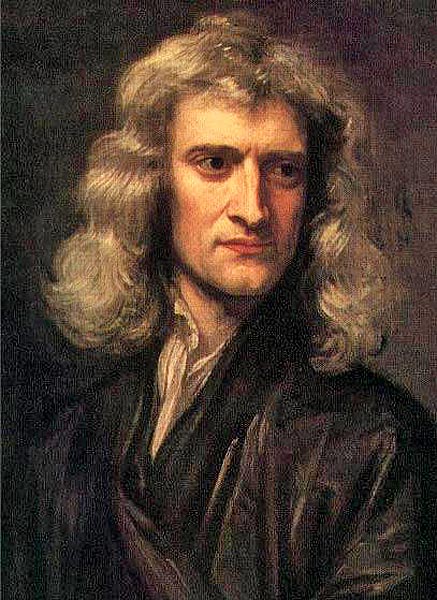
The English scientist Sir Isaac Newton (1642-1727) is famous, and for good reason--after all, not many people have had a universe named after them!

According to the Julian calendar, which England used at the time, Newton was born on Christmas Day. Although many countries were using the Gregorian calendar by the time he was born, England did not make the change until 1752--nearly a quarter of a century after he was born. We use the designation "O.S." or "Old Style" to refer to Julian dates; "N.S." or "New Style" means Gregorian dates. So Sir Isaac was born December 25, 1642 O.S., and January 4, 1643 N.S.

His father, a farmer also named Isaac, died three months before the boy was born. Young Isaac was born prematurely, and--after his mother remarried when the boy was just three years old--was raised by his grandmother. (He despised his mother's new husband, and wrote in a journal that he had once threatened to burn them both "and the house over them"!)

As a young man, Newton may once have been engaged, but he never married. He studied Latin--but not mathematics--until age 17, when his now-widowed mother tried to get him to become a farmer, a job which he hated. He returned to school and became a top student, partly to compensate for bullying by another boy.

Studying at Cambridge from age 19, he soon received scholarships and was able to complete a master's degree, studying Aristotle as well as "modern" philosophers like Descartes and the astronomers Galileo and Kepler.

Among his many accomplishments, Newton is best-known today for a few ideas, such as discovering the mathematical study of change known as calculus. (This happened at about the same time as the German scholar Leibniz discovered the same ideas, independently of Newton). Newton wrote about calculus in his best-known work, the Principia Mathematica (1687).

Another field he studied was optics. Newton determined the names we use for the seven colors in the rainbow: red, orange, yellow, green, blue, indigo, and violet (remembered by the mnemonic ROY G. BIV).

Interestingly, Newton was something of a mystic. He believed that, despite its natural and knowable laws, the universe was dependent on God at its root. It is ironic, then, that the mechanical view of the world came to be referred to as "the Newtonian universe," an idea that held until Einstein presented a new model in the 20th century.

Now about that apple…

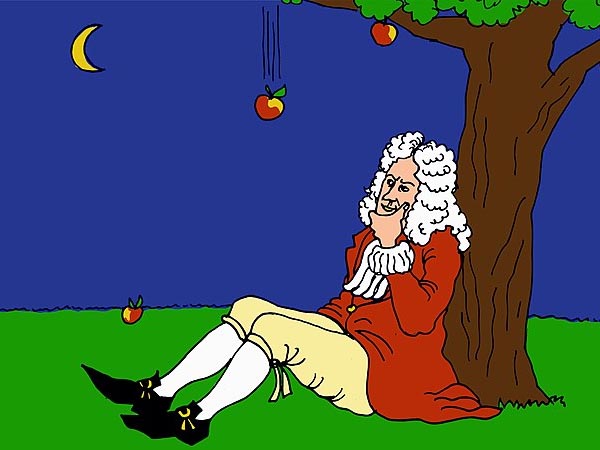
It's commonly said that one day Newton was sitting under an apple tree when a piece of fruit fell and bonked him on the head. Inspired by this, he invented gravity.

But is this story true?

Well, first, gravity cannot have been "invented" by anyone, since it is a natural property of physical things and inheres in matter. Newton called it "an attractive force."

Well, then, perhaps it was "discovered"? No. People have known from time immemorial that if you step off a high place, you will fall. The old saying is, "What goes up, must come down"!

Instead, as he himself told the story, Newton saw an apple fall (it did not hit him on the head!), and asked himself, "Why should that apple always descend perpendicularly to the ground"--that is, fall straight down--"Why should it not go sideways, or upwards? But constantly to the earth's center?" [Unless, of course, it was acted on by another force, like wind, or someone hitting it with a stick.] "Assuredly, the reason is, that the earth draws it." This observation inspired him to formulate the laws of gravity.

Something, he thought, was pulling the apple toward the very center of the earth! His exploration of this phenomenon led him to formulate what is now called "Newton's Law of Universal Gravitation." More important to his studies than an apple was the behavior of the moon, which by logic--since it is traveling at a great speed--ought to fly off into space. What is keeping it from doing so? The answer is, the attraction between the moon and the earth--that is, gravity.

His law is best expressed as a complex mathematical formula, but let's try to put it into words:

"Every particle attracts every other particle in the universe with a force [gravity] that is directly proportional to the product of their masses and inversely proportional to the square of the distance between their centers."

Oversimplifying, the greater the mass of an object, the greater its attraction to other objects; and the farther apart two objects are, the weaker the gravitational pull between them.

Let's just leave it at that!


PRACTICE:

Vocabulary: Match the words to their meaning. Correct answers are in the first comment below.

  1. astronomers
  2. attraction
  3. bullying
  4. designation
  5. despised
  6. gravity
  7. inheres (in)
  8. inversely
  9. mass
  10. mechanical
  11. mystic
  12. optics
  13. particle
  14. perpendicularly
  15. square
  1. like a machine; operating without intelligent choices being made
  2. the study of light
  3. exists permanently and inseparably in
  4. hated
  5. drawing power
  6. a small bit of matter
  7. the force that keeps us on earth
  8. the quantity of matter in something
  9. a name; a description
  10. at right angles to; straight up and down when compared to the earth
  11. people who study the stars and planets
  12. being pushed around; being picked on
  13. a number times itself
  14. oppositely
  15. a person who has unusual, unscientific experiences of the "other world"

Questions to Answer: Answer the following questions in your own words. Suggested answers are in the first comment below.

  1. Which type of calendar do we use today, the Julian or the Gregorian?
  2. What did Newton's mother want him to do?
  3. What did Newton discover at about the same time as the German scholar Leibniz?
  4. What was one of Newton's achievements in the field of optics?
  5. Did Newton discover gravity?

Questions to Think About: These questions do not have "right" or "wrong" answers. They only ask your opinion.

  1. Are you surprised to learn that Newton was a mystic? Is it strange for someone to believe in unscientific experiences and scientific principles at the same time?
  2. Why do you think people like to say that Newton got bonked on the head by an apple?
  3. Newton seems to have had a difficult family life. How do you think this may have affected his success as a scholar?

A Christmas Carol

Marley's ghost visits Scrooge

Click to see Vol. I, Issue 8 of the newsletter in which this article first appeared.

Listen to the audio of this article!

No modern story says as much about the spirit of Christmas--in a non-religious way--as 1843's A Christmas Carol by the English novelist Charles Dickens. It tells the story of a mean old miser, Ebenezer Scrooge, and his transformation into a kind, loving person.

The story falls neatly into five parts or chapters, which Dickens called "Staves."

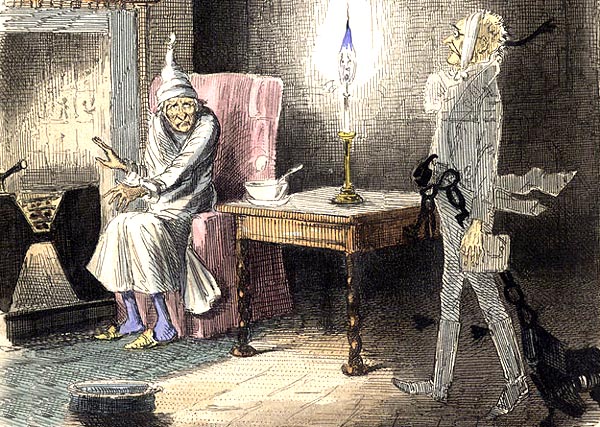
In the first Stave, Scrooge is visited by the ghost of his late partner Jacob Marley on Christmas Eve--the seventh anniversary of Marley's death. Marley wears heavy chains and metal money boxes which he says were forged by greed during his lifetime. He has come to warn Scrooge that his cruelty to the poor and his dislike of Christmas will lead to the same dire consequences if he doesn't change his ways. Scrooge scoffs at his warning.

He also warns Scrooge that he will be visited by three "spirits," and that he must listen to their warnings.

In Stave Two, the Ghost of Christmas Past appears, and shows Scrooge scenes from earlier Christmases in which Scrooge was younger, and had not yet become as hardened. His loneliness at boarding school, his happiness as a young clerk working for a kind boss, his fiancée Belle (who finally rejects him because of his love of money), and other scenes bring forth in Scrooge a nostalgia for the man he could have been.

In Stave Three Scrooge meets the Ghost of Christmas Present. The spirit takes him out to see people preparing to celebrate this Christmas. He sees his clerk, Bob Cratchit--whom Scrooge treats very unkindly--and sees Bob's youngest boy, Tiny Tim, who is extremely cheerful despite suffering from a handicap. The spirit tells Scrooge that if things continue as they are, Tiny Tim will die.

They then visit Christmas celebrations in other places--a miner's cottage, a lighthouse, and a ship at sea--before dropping in on a party at the home of Fred, Scrooge's nephew. Fred had invited Scrooge to the party, but with a "Bah! Humbug!" he had refused to attend.

At last, the spirit reveals under his long robe two horrible, emaciated children named Ignorance and Want--the hidden side of these celebrations. When Scrooge expresses concern for them, the spirit mocks his sudden burst of compassion.

In Stave Four, Scrooge meets the third spirit, the Ghost of Christmas Yet to Come. On a Christmas Day in the future, Scrooge sees the mourning of Bob Cratchit's family at the death of Tiny Tim.

He also sees that a man deeply disliked by others has died, and no one mourns his passing: they want a lunch at his funeral; they steal his goods; they rejoice that his passing will give them more time to pay their debts to his business.

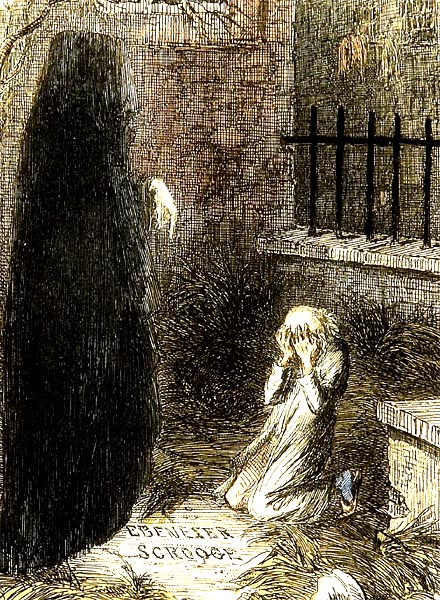
When Scrooge asks who the unpopular dead man was, the silent spirit points to a neglected grave with a tombstone that reads "Ebenezer Scrooge." Sobbing now, Scrooge pledges to change his ways.

Stave Five opens on Christmas morning of the same year in which the story began. Scrooge has indeed changed: he sends a large turkey to the Cratchits, and spends the afternoon enjoying the company of Fred and his family. The next day, at work, he gives Bob Cratchit a pay raise, and he becomes like a second father to Tiny Tim, who grows stronger every day.

And "it was always said of him," we are told, "that he knew how to keep Christmas well, if any man alive possessed the knowledge."

Scrooge sees his end (if he doesn't change his ways)

PRACTICE:

Vocabulary: Match the words to their meaning. Correct answers are in the first comment below.

  1. dire
  2. emaciated
  3. forged
  4. greed
  5. handicap
  6. hardened
  7. humbug
  8. miser
  9. mocks
  10. mourns
  11. neglected
  12. nostalgia
  13. pledges
  14. scoffs at
  15. transformation
  1. a change in appearance or character
  2. extremely thin
  3. not maintained; forgotten and ignored
  4. a physical disability
  5. promises
  6. created; formed
  7. makes fun of
  8. a desire for the past
  9. dismisses; mocks
  10. a very stingy person
  11. a scam; also, nonsense
  12. pitiless; unfeeling
  13. feels sad about
  14. terrible; dreadful
  15. extreme love of and desire for money

Questions to Answer: Answer the following questions in your own words. Suggested answers are in the first comment below.

  1. What is the main point of A Christmas Carol?
  2. What unusual things is Marley's ghost wearing, and what do they mean?
  3. Aside from Marley's ghost, who are the "three spirits" that visit Scrooge?
  4. Who are the children under the robe of the Ghost of Christmas Present? How are they related to Christmas?
  5. How do we know that Scrooge has really had a "change of heart"?

Questions to Think About: These questions do not have "right" or "wrong" answers. They only ask your opinion.

  1. As the Ghosts show things, is Scrooge responsible for the death of Tiny Tim?
  2. What responsibility do we have to help the people around us? How much of our own desires should we give up to meet those needs?
  3. Is Scrooge right to think that Christmas (as most people celebrate it today) is a "humbug"?