Showing posts with label TJBL History. Show all posts

Monday, March 7, 2022

Julius Caesar, Roman Emperor

Julius Caesar (Wikipedia)

Most of us remember Julius Caesar (100-44 BCE) as that unfortunate Roman guy who was murdered by his friends on the "Ides of March." But there was more to him than this.

To begin with, Caesar was a first-rate general. By conquering much of England and the intervening countries between there and Rome, he expanded the Roman Empire in ways that are still felt today. Spain, France, and Portugal speak Latin-derived languages, and Caesar's conquests led to the founding of Londinium--modern London.

In addition to his military genius, Caesar was an exceptional writer of Latin prose. Much is known of his military career through his works, The Gallic War and The Civil War. Every school boy used to be familiar with the opening of the former: "Gallia est omnis divisa in partes tres" ("All Gaul is divided into three parts"). Elsewhere he elegantly described his victory over the Persians in a trial of only five days: "Veni, vidi, vici" ("I came, I saw, I conquered").

This propensity for strategy combined with eloquence was the source of his success as a politician, a career that would have gone farther had it not been for that little incident in the Senate. So successful was he that his name, Caesar, was later used as a title for the Roman emperors. (It would be like calling the 46th American president "Joe Washington," for example.) Many other languages, too, used it to mean "King" or "Emperor," including the German title Kaiser and the Russian Czar.

Anyway, blind ambition was the cause of his death. After his military victories abroad, the law prohibited him from bringing his armies into Rome. Nevertheless, he left his home province and led a legion across the Rubicon River, committing him to successfully fighting a civil war. (Today "to cross the Rubicon" still means to pass a point of no return.) He followed up this action with further intrigues that led to his being named "dictator in perpetuity" (a position usually granted for only a limited period). At last, with his power increasing, the conspirators put a sudden stop to his career. His successor, Augustus Caesar, became the first Roman Emperor, though some historians ascribe this honor to Julius Caesar himself.

--------

PRACTICE:

Vocabulary: Match the words to their meaning. Correct answers are below.

  1. ambition
  2. ascribe
  3. conquests
  4. eloquence
  5. exceptional
  6. first-rate
  7. in perpetuity
  8. intervening
  9. propensity
  10. unfortunate

  1. located between
  2. different from (and usually better than) most
  3. forever
  4. assign; attribute
  5. victories
  6. unlucky
  7. tendency; inclination
  8. beautiful speech
  9. desire to succeed
  10. excellent; superb

QUESTIONS TO ANSWER:

Answer the following questions in your own words. Suggested answers are below.

  1. When was Julius Caesar murdered?
  2. How were Spain, France, and Portugal affected by the military career of Julius Caesar?
  3. What does "Veni, vidi, vici" mean?
  4. Where did we get the German title Kaiser and the Russian Czar?
  5. Why was Julius Caesar murdered?

QUESTIONS TO THINK ABOUT:

These questions do not have "right" or "wrong" answers. They only ask your opinion.

  1. How do you think Caesar's military abilities and his eloquence contributed to his success?
  2. How can the power of leaders be limited without assassinating them?
  3. Caesar was not officially an emperor. Why do you think some historians call him one?

--------

ANSWERS:

Practice: 1. I; 2. D; 3. E; 4. H; 5. B; 6. J; 7. C; 8. A; 9. G; 10. F

Questions to Answer: 

  1. He was murdered on the "Ides of March" in 44 BCE (March 15).
  2. He conquered those countries, and their modern languages come from Latin.
  3. "Veni, vidi, vici" means "I came, I saw, I conquered."
  4. We got those titles from the name "Caesar."
  5. Caesar was murdered because some of his colleagues felt he was too ambitious and pushed his power too far.

Questions to Think About do not have any single correct answer. However, any answers you give should be supported by what you read or by things you know ("I think... because...").

Monday, February 21, 2022

A. Lincoln

America's 16th president, Abraham Lincoln (1809-1865), was a larger-than-life figure.

Every American schoolchild learns the legend: how young Abe grew up first in Kentucky, and then Indiana, on what was then the American frontier; how he may have attended school for less than twelve months in total, and never went to college; how he would walk for miles to borrow--and later return--a book.

All of this is essentially true. Many of the books he read were what we would call "the classics," books like Aesop's Fables, the Holy Bible, The Pilgrim's Progress, and Robinson Crusoe. These must have helped shape the character of the man who became known as "Honest Abe."

Sunday, January 16, 2022

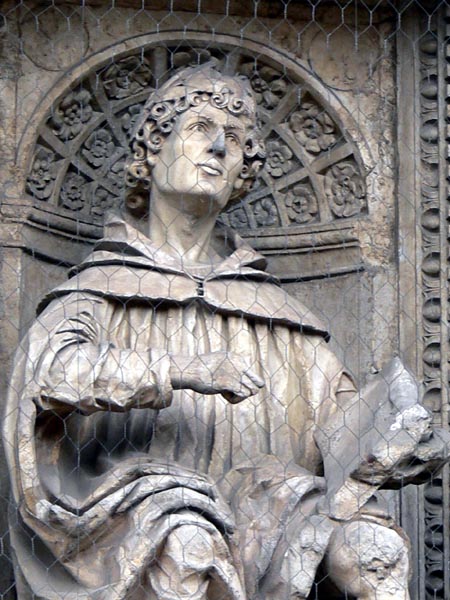
Pliny the Elder, an Early Scientist

Pliny the Elder (supposedly)

Click to see Vol. I, Issue 11 of the newsletter in which this article first appeared.

Listen to the audio of this article!

Gaius Plinius Secundus (23-79 CE), is usually called Pliny the Elder to distinguish him from his nephew (and adopted son), the lawyer and author Pliny the Younger (61-113).

The elder author was a naturalist and military commander, and a personal friend of the Roman emperor. His work is distinguished by his willingness to go out in the field and "get his hands dirty," making direct observations rather than just speculating on the nature of things, like many natural philosophers of his day.

Pliny was a single man, without children. At times he lived with his sister, mother of his nephew Pliny the Younger, whom he is said to have adopted. Certainly the younger man was familiar with his uncle's daily routine, describing his eating and working habits in letters to his contemporaries.

His greatest work is called the Natural History, similar to an encyclopedia that contained much of the current knowledge of his day. Its 37 books were completed within a few years of his death, and contain new materials as well as summaries of his earlier works and the works of others. It covers biology (both botany and zoology) as well as astronomy and geology. It is also a major source for understanding the art and artists of his time.

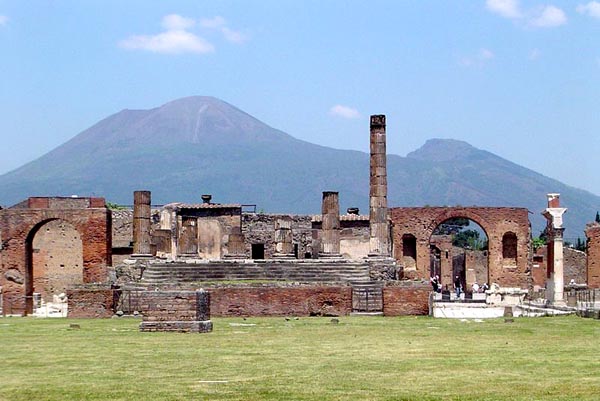
Pliny died as a result of one of the best-known events of classical times. As a naval commander, he was stationed at Misenum, across the Bay of Naples from Mount Vesuvius, which erupted spectacularly in the year 79. This was one of the volcano's many eruptions, and the one which buried the town of Pompeii.

Pliny was preparing to visit the shores near the blast to observe the phenomenon more closely when word came that some of his friends needed to be rescued. He sailed across the bay in a fast boat. Unable to leave again because the wind was against him, he dined with his friends, and was unable to stand up to leave. (One story says he was sitting in a bath, perhaps because he had asthma and he was trying to clear his lungs.) His friends left him behind, where he died, most probably from inhaling the bad air.


From The Natural History

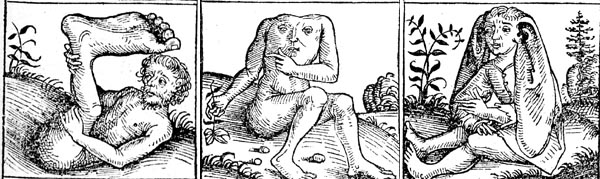
Creatures such as these are described by Pliny; learn more about them here.

As we mentioned, Pliny's Natural History covered essentially all of the knowledge of his day, but it also contained philosophical observations. Here's some of what he said about humankind's most fascinating subject--humankind--in Book VII, Chapter 1: "Man."

Humans are the only animals, Pliny says, that have to get their covering (i.e. clothes) by stealing it from other creatures; nature has given "shells, crusts, spines, hides, furs, bristles, hair, down, feathers, scales, and fleeces" to other forms of life, and even the trunks of trees are protected by bark. Humans alone, he says, "at the very moment of their birth" are "cast naked upon the naked earth" and "abandon[ed] to cries, to lamentations, and--a thing that is the case with no other animal whatever--to tears: this, too, from the very moment that he enters upon existence." And again, "The animal which is destined to command all the others, lies--bound tightly hand and foot [in swaddling bands], and weeping aloud! This is the penalty he has to pay on beginning life, for the sole fault of having been born."

He reflects further:

"How soon do humans gain the power of walking? How soon do they gain the faculty of speech? How soon are their mouths fitted for chewing?... While other animals have an instinctive knowledge of their natural powers--some, of their swiftness of pace, some of their rapidity of flight, and some again of their power of swimming--humans are the only ones that know nothing, that can learn nothing without being taught; they can neither speak, nor walk, nor eat*, and, in short, they can do nothing, at the prompting of nature only, but weep. For this reason, many have been of the opinion that it would be better not to be born, or if born, to be annihilated at the earliest possible moment." [Pliny is alluding to a common saying: "Those whom the gods love, die young."]

[*A footnote points out that Pliny has forgotten that infants do not need to be taught how to suck.]

Pompeii with Mount Vesuvius behind

PRACTICE:

Vocabulary: Match the words to their meaning. Correct answers are in the first comment below.

  1. annihilated
  2. asthma
  3. botany
  4. encyclopedia
  5. faculty
  6. geology
  7. i.e.
  8. inhaling
  9. instinctive
  10. naturalist
  11. phenomenon
  12. speculating
  13. swaddling bands
  14. volcano
  15. zoology
  1. guessing; imagining
  2. natural; innate; not learned
  3. the study of the earth
  4. the study of animals
  5. an ability; a capacity for something
  6. wiped out; destroyed
  7. a mountain that can explode and send out materials
  8. a disease of the lungs which makes breathing difficult
  9. an event; something that happens
  10. the study of plants
  11. that is; in other words
  12. an early kind of scientist
  13. a set of books that discusses every subject known to a culture
  14. long, narrow pieces of cloth wrapped around a baby to keep it from moving
  15. breathing in

Questions to Answer: Answer the following questions in your own words. Suggested answers are in the first comment below.

  1. Who was Pliny the Younger?
  2. What was Pliny the Elder's occupation, aside from being a naturalist?
  3. What was did Pliny's write about in his *Natural History?
  4. How and when did Pliny die?
  5. How does Pliny seem to feel about human beings?

Questions to Think About: These questions do not have "right" or "wrong" answers. They only ask your opinion.

  1. Could one person write a work covering all of the knowledge available to us today? Why do you think that was possible for Pliny?
  2. Why do you think other naturalists in Pliny's day were unwilling to "get their hands dirty"?
  3. Do you agree with Pliny's opinion of humankind? Why or why not?

Friday, December 17, 2021

The Gods, the Planets, and the Days of the Week

The Roman gods of the days of the week, starting with Diana the Moon Goddess (Monday)

Click to see Vol. I, Issue 8 of the newsletter in which this article first appeared.

Listen to the audio of this article!

The Chinese system of naming the days of the week is very sensible. It counts the days in order from 1-6, starting with Monday. But why isn't Sunday Number 7? It's easy to see that Sunday is Sun Day: It uses the Chinese symbol for the sun, 日, instead of a number. This tells us that the ancient Chinese seven-day week shares Babylonian roots with the western week.

Now, as for the days' names in English: just as Sunday is the Sun's Day, it's easy to see that Monday is "Moon Day" and Saturday is "Saturn's Day." But what about the other four days?

You may notice that Sun, Moon, and Saturn are things we see in the sky. In fact, the ancient Babylonians named seven visible "planets": the Sun, the Moon, Mars, Mercury, Jupiter, Venus, and Saturn.  (They were a little wrong, of course; only the last five are "planets." The Sun is a star, and the Moon is a satellite of the Earth. But we'll forgive them--they didn't have telescopes!) Uranus, Neptune, and the former planet Pluto were not discovered until the 18th, 19th, and 20th centuries respectively.

In fact, these words name not only days and planets, but also gods.

"Sun" and "Moon" are good Germanic words. The Romans called the Sun "Sol" and the Moon "Luna": these names survive in the adjectives "solar" and "lunar." But "sun" comes from the German "Sunne," the name of the Sun goddess in Germanic (or "Norse") mythology. And the German word for "Moon" actually came from the word "Mani," the name of the Norse Moon goddess. Saturn is the name of the sixth planet and its god in both English and German, and nearly the same in Latin (Saturnus).

With the other four days, we have to do some "comparative mythology."

Mars is the Roman god of war. His equivalent in German mythology was a god named Tyr. In Old English this became Tiw, so the day was Tiwes' Day--Tuesday. Notice that in Latin-derived languages, the name reveals its connection to Mars: in French, it's Mardi (think of "Mardi Gras"--Fat Tuesday!), and in Spanish, Martes.

Mercury was a messenger god. Unfortunately, things get a little confused here for English speakers. Wednesday is "Woden's Day," but the god Wodin (or Odin) is not a messenger: he's the king of the gods. Perhaps the confusion came because stories of Odin often include birds used as messengers. The French say Mercredi, and the Spanish Miercoles: both sound like "Mercury."

Thursday is more straightforward: Thor of the Germanic peoples is a thunder god with a bad temper, much like the hotheaded Roman Jupiter or Greek Zeus. (Though, in Greco-Roman mythology, he is the king of the gods.) The French call this Jeudi, and the Spanish say Jueves, both keeping the ju- sound of Jupiter.

Finally, everybody loves Friday! And that's fitting, because the Germanic goddess Frigg (also called Freya) is the goddess of love and fertility, like the Roman Venus. Friday is Frigg's Day. (Incidentally, she was the wife of Odin.) In French, this is Vendredi, and in Spanish, Viernes.

And so the Norse gods are hiding in the names of most of our days in English!

Visible (from left): Sun, Mercury, Venus, Earth, Mars, Jupiter, Saturn;
not visible to the ancients: Uranus, Neptune, Pluto.
Not shown: The Earth's Moon.

PRACTICE:

Which of the seven days: (Correct answers are in the first comment below).

  1. doesn't have a number in Chinese?
  2. is named for a god of war?
  3. would be Number 4 in Chinese?
  4. is named for the Norse king of gods?
  5. has a name in other languages related to the word "lunar"?
  6. is named for a Norse god parallel to Jupiter (Zeus)?
  7. is named for Odin's wife?
  8. is named for a god with virtually the same name in three languages?
  9. is named for a guy who used birds as messengers?
  10. is named for a star, not a planet?
  11. is named for someone named "Tyr"?
  12. is named for the love goddess?
  13. is named for a goddess named "Mani"?
  14. is named for a guy with a hammer?

Questions to Answer: Answer the following questions in your own words. Suggested answers are in the first comment below.

  1. What system do the modern Chinese mostly use to name the days of the week?
  2. What culture gave us (and the ancient Chinese) the system of naming the seven weekdays for planets?
  3. What are the so-called "Seven Visible Planets" after which the days of the week are named?
  4. Which modern languages (among others) use names for the weekdays that are very near those of the Roman gods?
  5. Aside from the Greco-Roman gods' names, what culture's mythology contributed names to the English days of the week?

Questions to Think About: These questions do not have "right" or "wrong" answers. They only ask your opinion.

  1. Why do you think the modern week has exactly seven days (even when just numbers are used)?
  2. Why do you think people named planets (and weekdays) for gods?
  3. Four (or five) cultures are mentioned in this article: the Babylonians, the Chinese, the Romans (and the Greeks), and the Norse. What other connections do you know of between these cultures?


Sunday, December 12, 2021

Charlemagne's "Mini-Renaissance"

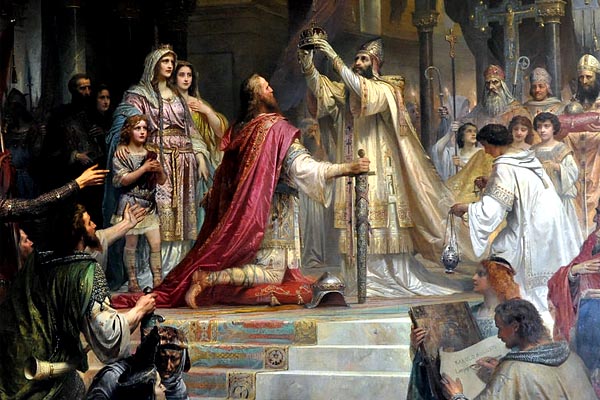
The Imperial Coronation of Charlemagne, by Friedrich Kaulbach, 1861

Click to see Vol. I, Issue 7 of the newsletter in which this article first appeared.

Listen to the audio of this article!

For nearly three years, I wrote my columns the Shenzhen Daily in the form of dialogues between college students meeting in the "Common Room" of their dormitory. Usually there was one "international student" (from another country) and one American student who explained things to them--although sometimes, the international student did the explaining! I thought it might be fun to share one of these with you. In this conversation, a Chinese boy named Ming talks with an American named Mark.

Ming: Hi, Mark. Can I ask you a question about the alphabet we use?

Mark: Sure!

Ming: I've heard you call the way we write letters "the Latin alphabet." Does that mean we write like the Romans did?

Mark: Sort of. But of course, they wrote two thousand years ago, so there have obviously been a few changes.

Ming: For example?

Mark: Well, at some point Roman writing lacked J, U, and W. These were added later.

Ming: I see.

Mark: You know, before the ease and speed of modern communication, and even travel, there were many regional ways of writing.

Ming: So the writing in, say, France, might be different from that in Holland?

Mark: Yes, though in the period I'm talking about, those countries didn't exist yet.

Ming: Okay. But how did writing become standardized?

Mark: That happened under a man named Charlemagne, who was born sometime in the 740s and died in 814.

Ming: He was a French king, right?

Mark: Almost! He was King of the Franks, a more-or-less German-speaking nation which gave rise to what are now both France and Germany. In fact, at one point Charlemagne ruled over most of Western Europe, and laid much of the foundation for modern Western civilization. People call him "The Father of Europe."

Ming: Cool!

Mark: The name we call him, Charlemagne, is based on the French form of the words "Charles the Great," and spoken in Latin Carolus Magnus. So the way we write today is based on something called Carolingian script, which began to be developed in his time.

Ming: Amazing! What else did he do?

Mark: His rule was sort of a "mini-Renaissance," because he organized and promoted learning. This ended the early part of the Middle Ages--the part we call the Dark Ages--but there were still a few more centuries of the Medieval Period before the real Renaissance got started in Italy.

Ming: I see. So, how did he "promote learning"? Was he, like, a teacher?

Mark: No. Interestingly, Charlemagne himself couldn't read or write until he was a grown man--and even then he wasn't too good at it. One of his teachers said that, because "he did not begin his efforts in due season, but late in life, they met with ill success."

Ming: That's too bad.

Mark: Nevertheless, he valued education. He brought a monk named Alcuin of York from England to his capital in Aachen, now in Germany, to organize his school and library.

Ming: Oh, I love libraries! So, he had a place where people could borrow books?

Mark: No, it wasn't that type of library. Actually, they called it a scriptorium. It's where they copied manuscripts, or hand-written books. That's how they used the new handwriting.

Ming: I see.

Mark: So, Charlemagne made the first steps toward a revival of learning, preserved a lot of Greco-Roman literature, and promoted a flowering of art and architecture. The Pope crowned him "Emperor of the Romans" in 800, the first to be recognized as such since the Western Roman Empire fell around three centuries earlier.

Ming: Wow! Thanks for teaching me about him, Mark!

Mark: It was my pleasure.

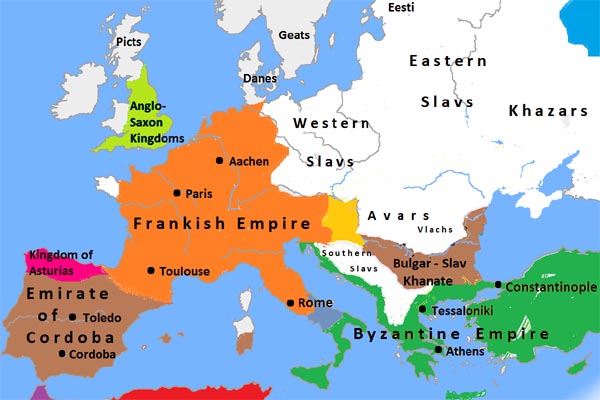
Europe around 814, when Charlemagne died. Note also the
Geats and Danes, featured in Beowulf, in the north.

PRACTICE:

Vocabulary: Match the words to their meaning. Correct answers are in the first comment below.

  1. civilization
  2. coronation
  3. dormitory
  4. emperor
  5. flowering
  6. foundation
  7. Greco-Roman
  8. Medieval Period
  9. revival
  10. standardized
  1. made the same for everyone
  2. the culture or society of a particular place, time, or group
  3. basis; groundwork; beginnings
  4. place where students or company employees sleep
  5. "king of kings," ruling over more than one country
  6. development; maturing; growth
  7. renewal; fresh start
  8. of the Greeks and Romans; classical
  9. another word for the Middle Ages, from the 5th to perhaps the 15th century (depending where)
  10. ceremony where a ruler is crowned

Questions to Answer: Answer the following questions in your own words. Suggested answers are in the first comment below.

  1. What is our alphabet called? Where did we get it?
  2. What is our alphabet based on?
  3. Who was Charlemagne?
  4. How did Charlemagne promote learning?
  5. How did the Pope reward Charlemagne?

Questions to Think About: These questions do not have "right" or "wrong" answers. They only ask your opinion.

  1. Did you ever think about where our alphabet came from? Do you know anything about other writing systems?
  2. Why do you think a king--who couldn't read or write for most of his life--was so interested in learning?
  3. Why was it important for Charlemagne's scholars to copy manuscripts?

Saturday, December 4, 2021

Galileo, the Father of Science

Portrait of Galileo Galilei (Justus Sustermans, 1636)
Note the telescope in his hand

Click to see Vol. I, Issue 6 of the newsletter in which this article first appeared.

Listen to the audio of this article!

Galileo Galilei (1564-1642) was an Italian scientist who worked in many fields: physics, math, engineering, astronomy, and philosophy. He was a true Renaissance Man. He gained many nicknames through the ages, but one of the greatest was simply: the Father of Science.

This is all the more surprising in that his main achievement was not his own thought, but confirmation of the idea of another person.

The Polish mathematician and astronomer Nicolaus Copernicus (1473-1543) had published a new theory in the year he died: that the earth goes around the sun, and not the other way around. This "Copernican Revolution" would shock the world: we were not at the center of things.

Copernicus died before his theory--based on mathematics--was proven. It was left for Galileo and Johannes Kepler (a student of Copernicus) to confirm his insight.

For this, Galileo used a "secret weapon": a telescope he had improved himself. With it he was able to view phases on Venus much like those of the moon, and observe four moons orbiting Jupiter. The former was only possible if Venus orbited the sun; the latter proved that not everything circled the earth.

The Roman Inquisition was a kind of religious court in the Roman Catholic Church, and in 1615 it said that any teaching of the earth going around the sun--including such teaching by Galileo--was forbidden.

But in 1632 Galileo wrote his most important work, the Dialogue Concerning the Two Chief World Systems. The older system was the Ptolemaic, known as "geocentrism" (putting the earth at the center). It was taught by Claudius Ptolemy, a Greek living in Alexandria, Egypt, around 90-168. The newer was, of course, the Copernican system of "heliocentrism" (putting the sun at the center).

For this act, Galileo was tried in court in 1633 and put under house arrest for the final nine years of his life, where he continued to work and write until his death.

The court also required Galileo to recant, or take back, his support of heliocentrism. Popular legend says that after standing up and recanting, he turned away and said quietly, "Eppur si muove"--in English, "Nevertheless, it moves"--where "it" refers to the earth's motion around the sun. Legend it may be, but the story shows the spirit of Galileo's stubbornness in support of scientific truth.

Galileo facing the Roman Inquisition (Cristiano Banti, 1857)


PRACTICE:

Vocabulary: Match the words to their meaning. Correct answers are in the first comment below.

  1. astronomy
  2. forbidden
  3. geo-
  4. helio-
  5. house arrest
  6. inquisition
  7. insight
  8. legend
  9. orbited
  10. recant
  1. withdraw a statement
  2. went around, circled (as the moon does the earth)
  3. the study of the stars and planets
  4. a made-up story that may contain some truth about a famous person
  5. not allowed
  6. an understanding, a discovery
  7. a prefix meaning "earth"
  8. having to stay in one's home, like in a prison
  9. an official investigation, especially one that's political or religious
  10. a prefix meaning "sun"

Questions to Answer: Answer the following questions in your own words. Suggested answers are in the first comment below.

  1. What "crime" did Galileo commit?
  2. Did Galileo make the discovery for which he was convicted?
  3. Why didn't Copernicus promote his own theory?
  4. Who else promoted Copernicus's theory?
  5. What "secret weapon" did Galileo use to support Copernicus's theory?
  6. What were the "two chief world systems" described in Galileo's work?

Questions to Think About: These questions do not have "right" or "wrong" answers. They only ask your opinion.

  1. Do you think the Church (or religion and religious people in general) should control the teachings of science? Does this still happen today?
  2. Copernicus, Kepler, Galileo: What can we learn about the process of science from the story of these three men?
  3. Copernicus was a theorist; Galileo supported his theories by observation. How important are these two sides of science, idea and evidence?

Monday, November 29, 2021

The Journals of Charles Darwin


Click to see Vol. I, Issue 5 of the newsletter in which this article first appeared.

Listen to the audio of this article!

[Introduction] Whenever we see someone who is an "overnight success," we need to ask ourselves how many years of work went into achieving that status.

Such is the case with Charles Darwin, the world's most famous biologist. He stunned the world in 1859 with the publication of On the Origin of Species by Means of Natural Selection, or the Preservation of Favoured Races in the Struggle for Life. That, and the follow-up The Descent of Man, and Selection in Relation to Sex in 1871, caused a furor that has never died down. But he actually had been publishing treatises and monographs for years, the earliest in 1829--fully thirty years before the Origin of Species, and even before his voyage on the ship HMS Beagle.

One of the most readable of his works, and the first of his books per se (after appearing in parts), was originally titled Journal and Remarks (1839), though we often call it The Voyage of the Beagle. It is a record of Darwin's voyage around the world aboard the Beagle (December 27, 1831, to October 2, 1836). As a geologist and naturalist, he was tasked with making observations and collecting specimens--work that led directly to his theory of evolution. He was also to serve as companion to the ship's arrogant and somewhat fundamentalist captain, Robert FitzRoy, with whom he often argued about theories.

The Voyage of the Beagle brought Darwin some fame (though it didn't cause anything like the stir created by Origin of Species). Furthermore, it gives us a glimpse into the workings of his mind in addition to observations of "untouched" places before they were affected by the long arm of "civilization."

Darwin once said, "The journey on the Beagle was, by far, the most important event in my life, and shaped my whole career."

Aside from his keen powers of observation, Darwin was also a superb writer (which I'm sure is responsible for no small measure of his success). Rather than attempt to summarize what he wrote in his journals, I'd rather share selected direct quotes, with just the minimum of commentary. Enjoy!

A note for readers: Darwin's writing, while elegant, is that of a well-educated person of the 19th century, and may be difficult for some modern readers. One way to approach this is to "slow read" one passage, again and again, until its full meaning sinks in, before moving on to the next one.

--------

[1] Early in the journey we experience some of the rich poetry in Darwin's writing. Here he reflects on the phenomenon called bioluminescence, and ties it in to the works of John Milton, author of Paradise Lost. (Milton's work was the only personal book Darwin brought along when he made land excursions away from the Beagle.)

The night was pitch dark, with a fresh breeze.-- The sea from its extreme luminousness presented a wonderful -- most beautiful appearance; every part of the water, which by day is seen as foam, glowed with a pale light. The vessel drove before her bows two billows of liquid phosphorus, -- in her wake was a milky train.-- As far as the eye reached, the crest of every wave was bright; -- from the reflected light, the sky just above the horizon was not so utterly dark as the rest of the Heavens.-- It was impossible to behold this plain of matter, as it were melted -- consuming by heat, without being reminded of Miltons description of the regions of Chaos and Anarchy. (Chapter V -- Bahia Blanca)

[2] Here Darwin reflects on the effect of colonists on what we would now call the "ecology" of South America:

...few countries have undergone more remarkable changes, since the year 1535, when the first colonist of La Plata landed with seventy-two horses. The countless herds of horses, cattle, and sheep, not only have altered the whole aspect of the vegetation, but they have almost banished the guanaco, deer, and ostrich. Numberless other changes must likewise have taken place; the wild pig in some parts probably replaces the peccari; packs of wild dogs may be heard howling on the wooded banks of the less-frequented streams; and the common cat, altered into a large and fierce animal, inhabits rocky hills. (Chapter VI -- Bahia Blanca to Buenos Aires)

[3] Darwin sees a natural connection between the dwindling population of a species and its extinction, pointing out that calling on the hand of an "extraordinary agent" is unnecessary:

To admit that species generally become rare before they become extinct--to feel no surprise at the comparative rarity of one species with another, and yet to call in some extraordinary agent and to marvel greatly when a species ceases to exist, appears to me much the same as to admit that sickness in the individual is the prelude to death--to feel no surprise at sickness--but when the sick man dies to wonder, and to believe that he died through violence. (Chapter VIII -- Banda Oriental and Patagonia)

[4a] In one of my favorite passages in the book, Darwin describes his experience in an earthquake in Valdivia, Chile, on February 20th, 1835 (known as "the 1835 Concepción earthquake"). Here is his full journal entry for that day:

This day has been memorable in the annals of Valdivia, for the most severe earthquake experienced by the oldest inhabitant. I happened to be on shore, and was lying down in the wood to rest myself. It came on suddenly, and lasted two minutes, but the time appeared much longer. The rocking of the ground was very sensible. The undulations appeared to my companion and myself to come from due east, whilst others thought they proceeded from south-west: this shows how difficult it sometimes is to perceive the directions of the vibrations. There was no difficulty in standing upright, but the motion made me almost giddy: it was something like the movement of a vessel in a little cross-ripple, or still more like that felt by a person skating over thin ice, which bends under the weight of his body. A bad earthquake at once destroys our oldest associations: the earth, the very emblem of solidity, has moved beneath our feet like a thin crust over a fluid;--one second of time has created in the mind a strange idea of insecurity, which hours of reflection would not have produced. In the forest, as a breeze moved the trees, I felt only the earth tremble, but saw no other effect. Captain Fitz Roy and some officers were at the town during the shock, and there the scene was more striking; for although the houses, from being built of wood, did not fall, they were violently shaken, and the boards creaked and rattled together. The people rushed out of doors in the greatest alarm. It is these accompaniments that create that perfect horror of earthquakes, experienced by all who have thus seen, as well as felt, their effects. Within the forest it was a deeply interesting, but by no means an awe-exciting phenomenon. The tides were very curiously affected. The great shock took place at the time of low water; and an old woman who was on the beach told me that the water flowed very quickly, but not in great waves, to high-water mark, and then as quickly returned to its proper level; this was also evident by the line of wet sand. The same kind of quick but quiet movement in the tide happened a few years since at Chiloe, during a slight earthquake, and created much causeless alarm. In the course of the evening there were many weaker shocks, which seemed to produce in the harbour the most complicated currents, and some of great strength. (Chapter XIV -- Chiloe and Concepcion: Great Earthquake)

[4b] The changes wrought by the quake helped Darwin realize that the prevailing theory of gradualism--the idea that the earth changed through processes over long periods of time--was not always so; change was sometimes quite sudden. Here's part of his next entry, for March 4th:

The island [of Quiriquina, up the coast from Valdivia] itself as plainly showed the overwhelming power of the earthquake, as the beach did that of the consequent great wave. The ground in many parts was fissured in north and south lines, perhaps caused by the yielding of the parallel and steep sides of this narrow island. Some of the fissures near the cliffs were a yard wide. Many enormous masses had already fallen on the beach; and the inhabitants thought that when the rains commenced far greater slips would happen. The effect of the vibration on the hard primary slate, which composes the foundation of the island, was still more curious: the superficial parts of some narrow ridges were as completely shivered as if they had been blasted by gunpowder. This effect, which was rendered conspicuous by the fresh fractures and displaced soil, must be confined to near the surface, for otherwise there would not exist a block of solid rock throughout Chile; nor is this improbable, as it is known that the surface of a vibrating body is affected differently from the central part. It is, perhaps, owing to this same reason, that earthquakes do not cause quite such terrific havoc within deep mines as would be expected. I believe this convulsion has been more effectual in lessening the size of the island of Quiriquina, than the ordinary wear-and-tear of the sea and weather during the course of a whole century. (Chapter XIV -- Chiloe and Concepcion: Great Earthquake)

[5] In a later chapter, we see Darwin's curious mind unable to fathom why others were not as curious about their world as he was:

My geological examination of the country generally created a good deal of surprise amongst the Chilenos: it was long before they could be convinced that I was not hunting for mines. This was sometimes troublesome: I found the most ready way of explaining my employment, was to ask them how it was that they themselves were not curious concerning earthquakes and volcanos? – why some springs were hot and others cold? – why there were mountains in Chile, and not a hill in La Plata? These bare questions at once satisfied and silenced the greater number; some, however (like a few in England who are a century behind hand), thought that all such inquiries were useless and impious; and that it was quite sufficient that God had thus made the mountains. (Chapter XVI -- Northern Chile and Peru)

[6] Darwin finds wonder in the mighty works of the smallest things: a coral reef is built by a colony of polyps just a few millimeters in diameter and a few centimeters high. Yet their work can stand against the eroding action of waves and be rebuilt after the destructive action of hurricanes:

It is impossible to behold these waves without feeling a conviction that an island, though built of the hardest rock, let it be porphyry, granite, or quartz, would ultimately yield and be demolished by such an irresistible power. Yet these low, insignificant coral-islets stand and are victorious: for here another power, as an antagonist, takes part in the contest. The organic forces separate the atoms of carbonate of lime, one by one, from the foaming breakers, and unite them into a symmetrical structure. Let the hurricane tear up its thousand huge fragments; yet what will that tell against the accumulated labour of myriads of architects at work night and day, month after month? [...] We feel surprise when travellers tell us of the vast dimensions of the Pyramids and other great ruins, but how utterly insignificant are the greatest of these, when compared to these mountains of stone accumulated by the agency of various minute and tender animals! This is a wonder which does not at first strike the eye of the body, but, after reflection, the eye of reason. (Chapter XX -- Keeling Island: Coral Formations)

[7] In this passage Darwin turns his formidable intellect on one of the most pressing social problems of the day: slavery. Though his legacy appears complex through the lens of history--he regularly refers to aboriginal peoples as "savages," for example--he was an ardent abolitionist, as seen here ("palliate," by the way, means "excuse" or "lessen the effect of"):

It is often attempted to palliate slavery by comparing the state of slaves with our poorer countrymen: if the misery of our poor be caused not by the laws of nature, but by our institutions, great is our sin; but how this bears on slavery, I cannot see; as well might the use of the thumb-screw be defended in one land, by showing that men in another land suffered from some dreadful disease. Those who look tenderly at the slave owner, and with a cold heart at the slave, never seem to put themselves into the position of the latter; what a cheerless prospect, with not even a hope of change! picture to yourself the chance, ever hanging over you, of your wife and your little children -- those objects which nature urges even the slave to call his own -- being torn from you and sold like beasts to the first bidder! And these deeds are done and palliated by men, who profess to love their neighbours as themselves, who believe in God, and pray that his Will be done on earth! It makes one's blood boil, yet heart tremble, to think that we Englishmen and our American descendants, with their boastful cry of liberty, have been and are so guilty... (Chapter XXI -- Mauritius to England)

[8] Darwin was on the path to become a minister when he took ship on the Beagle, and Christians have made claims of a "deathbed" recanting of his theories (he did not do so). The Voyage makes frequent reference to "God," but in this passage we see that there is something else at work here--"the God of Nature"--although he affirms that humans are more than just material beings:

Among the scenes which are deeply impressed on my mind, none exceed in sublimity the primeval forests undefaced by the hand of man; whether those of Brazil, where the powers of Life are predominant, or those of Tierra del Fuego, where Death and decay prevail. Both are temples filled with the varied productions of the God of Nature: -- no one can stand in these solitudes unmoved, and not feel that there is more in man than the mere breath of his body. (Chapter XXI -- Mauritius to England)

[9] A final thought on our "small world," from the concluding paragraphs of the book:

There are several other sources of enjoyment in a long voyage, which are of a more reasonable nature. The map of the world ceases to be a blank; it becomes a picture full of the most varied and animated figures. Each part assumes its proper dimensions: continents are not looked at in the light of islands, or islands considered as mere specks, which are, in truth, larger than many kingdoms of Europe. Africa, or North and South America, are well-sounding names, and easily pronounced; but it is not until having sailed for weeks along small portions of their shores, that one is thoroughly convinced what vast spaces on our immense world these names imply. (Chapter XXI -- Mauritius to England)

--------

The Voyage of the Beagle is easily found online; I encourage you to locate it and read large portions. It's a delight.

The H.M.S. Beagle

PRACTICE:

Vocabulary: Match the words to their meaning. Correct answers are in the first comment below.

  1. accumulated
  2. bows
  3. conviction
  4. displaced
  5. glimpse
  6. horizon
  7. overwhelming
  8. preservation
  9. prevail
  10. reflection
  11. rendered
  12. tender
  13. utterly
  14. vessel
  15. yield
  1. soft; delicate
  2. a brief look
  3. made (sometimes, made visible)
  4. the front end of a ship
  5. a firm belief
  6. careful consideration; deep thinking
  7. unable to be withstood
  8. moved from its proper place
  9. give way; submit
  10. " win"; appear widely
  11. the act of keeping something in existence
  12. taken together; total
  13. boat; ship
  14. the seeming line between the earth and sky
  15. completely; absolutely

Questions to Answer: Answer the following questions. Correct answers are in the first comment below. Each question is labeled to match a passage above.

[Introduction] Which of these was Darwin's first book?

A. On the Origin of Species
B. The Voyage of the Beagle
C. The Descent of Man
D. Paradise Lost

[1] What reminds Darwin of "the regions of Chaos and Anarchy"?

A. the bow of his ship
B. the horizon
C. the crest of every wave
D. shining organisms in the water

[2] Which is NOT one of the animals introduced to the ecology of South America by the colonists?

A. horses
B. sheep
C. deer
D. pigs

[3] Darwin says extinction is like:

A. a sick man dying of illness.
B. one species being rarer than another.
C. an extraordinary agent.
D. a sick man dying through violence.

[4a] Which of these did Darwin NOT experience in the earthquake in Valdivia?

A. the rocking of the ground
B. difficulty in standing upright
C. feeling almost giddy
D. a breeze moving the trees

[4b] What conclusion did Darwin reach about the earthquake after visiting Quiriquina Island?

A. It had been blasted by gunpowder.
B. The surface was affected more than the deeper layers of rock.
C. There were fissures in the yard.
D. They caused terrific havoc in deep mines.

[5] What did Darwin notice about the "Chilenos" (the people of Chile)?

A. They preferred hot springs to cold.
B. They there were mountains in Chile.
C. They were hunting for mines.
D. They were not curious about their world.

[6] Darwin was amazed that:

A. tiny, soft creatures could build something that withstood the power of waves.
B. hurricanes could tear up a coral reef.
C. islands made of rock could be destroyed by waves.
D. travelers talked about the size of the Pyramids.

[7] Darwin was opposed to slavery. He felt slavery was:

A. appropriately compared to poverty.
B. the right thing for Christians to do.
C. something to get angry about.
D. caused by the laws of nature.

[8] True or False: Darwin felt that humans were just breathing machines.

[9] Darwin felt that:

A. islands were bigger than continents.
B. only by travelling can you realize how big the world is.
C. the kingdoms of Europe were the biggest things on earth.
D. the map of the world is blank.

Questions to Think About: These questions do not have "right" or "wrong" answers. They only ask your opinion.

  1. Do you think Darwin was a "religious" man?
  2. How do you think Darwin felt about the colonizing of South America? 
  3. Why were people so upset at the idea that humans descended from other forms of life on earth?

Alexander the Great


Click to see Vol. I, Issue 5 of the newsletter in which this article first appeared.

Listen to the audio of this article!

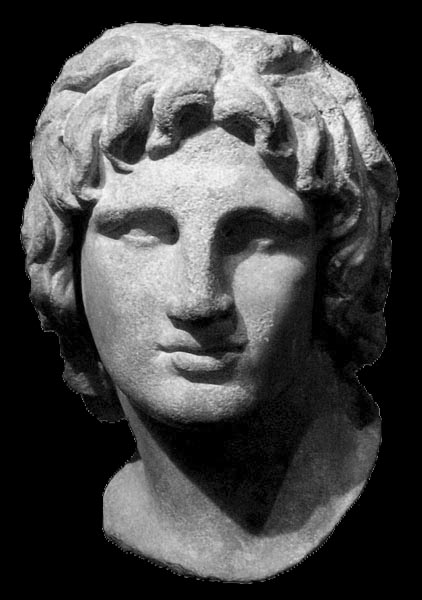
Though you may not realize it, you have certainly heard of Alexander III of Macedon (356 BCE-323 BCE), but it was probably under his sobriquet: "Alexander the Great."

Much is known of this regional king who came to conquer much of the known world, from Greece to India and modern Pakistan, creating one of the largest empires in the ancient world that included parts of three continents (Europe, Asia, and Africa). But what is not known has been filled in by colorful legends, many of them developed in the Middle Ages.

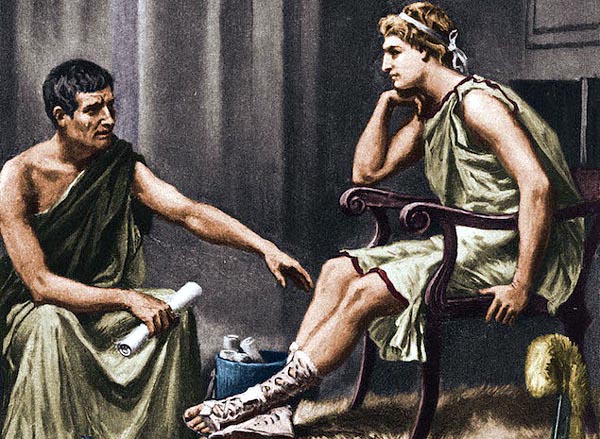
We know that he was the son of Philip II (whose grave was discovered in recent years). After being tutored until age 16 by the philosopher Aristotle, Alexander became king at age 20, upon his father's death. By age 30 he had completed his conquests, remaining undefeated; legend says that he wept that "there were no more worlds to conquer." (Julius Caesar, in turn, is said to have wept when he saw a statue of Alexander, because Caesar had not matched up to Alexander's achievements.)

Alexander turned back toward Greece only when his troops refused to go any farther, and died at age 32 in Babylon, where he would have established his capital. After his death, the empire rather quickly broke up, but the influence of Greek culture was to last for centuries. For example, although Palestine in the time of Jesus was a Roman colony, the Christian Bible is written in a dialect of Greek--a vestige of Alexander's influence. The style of Greek sculpture can be seen in Buddhist images from central Asia. And Alexandria in Egypt (where Euclid was born) is but one of around 20 cities named for the young conqueror.

Beginning shortly after Alexander's death, a collection of legends began to coalesce, culminating in The Alexander Romance. It was first written down in Greek sometime before 338 CE (long after Alexander's demise), and embroidered through the ages as late as the 16th century in numerous languages, from Greek and Latin through the vernaculars of Western Europe, as well as Slavonic, Hungarian, Arabic, Persian, Ethiopic, Hebrew, Turkish, and even Mongolian. It purported to be a "true" account of Alexander's exploits. In fact, it was just a framework on which was hung a number of traditional tales, some of them based on more genuine works.

The Romance contains, for example, a "first person account" of Alexander's (fictional) meeting with the "King of China." This potentate schooled the young conqueror in the virtue of humility, saying, "If your own luck turns against you, your name and power will perish. Fortune never settles in one place; instead, men make plans and seize countries, but, in the end, everything is taken from us by death. All we have left is a plot of land the size of this cloak," at which he handed Alexander a cloak he had had made, along with jewels and silks.

It's too bad that this vast body of stories is not popular today, like those of King Arthur, or the Germanic sagas popularized by Wagner and Tolkien.

Aristotle tutors Alexander

PRACTICE:

Vocabulary: Match the words to their meaning. Correct answers are in the first comment below.

  1. coalesce
  2. conquests
  3. culminating
  4. empires
  5. regional
  6. sculpture
  7. sobriquet
  8. troops
  9. undefeated
  10. wept
  1. victories; also, things which have been conquered
  2. soldiers
  3. the art of making statues
  4. cried
  5. reaching the highest point of development
  6. nickname
  7. groups of nations ruled over by one person
  8. come together; develop into a single thing
  9. not beaten; having never lost
  10. of a relatively small area

Questions to Answer: Answer the following questions in your own words. Suggested answers are in the first comment below.

  1. In what century did Alexander the Great live?
  2. What did Alexander accomplish?
  3. Who was Alexander's tutor?
  4. Why did Alexander decide to turn back toward Greece?
  5. Does The Alexander Romance give us an accurate biography of Alexander?

Questions to Think About: These questions do not have "right" or "wrong" answers. They only ask your opinion.

  1. Do you think being taught by a great philosopher helped Alexander be successful?
  2. Why do you think various legends are often "attached" to famous people like Alexander the Great?
  3. How would you express the point of the story about Alexander's meeting the "King of China"?

Monday, November 22, 2021

The "Legend" of Wyatt Earp


Click to see Vol. I, Issue 4 of the newsletter in which this article first appeared.

Listen to the audio of this article!

When I was a kid, one of the most popular TV shows amongst us boys was called The Life and Legend of Wyatt Earp. Centered on a supposed "hero" of that name, the show--and much of what we think about Wyatt--was more "legend" than "life" or solid biography.

Ask most people familiar with the name, and they'll tell you something like this: He was a "lawman" and the hero of the famous Shootout at the O.K. Corral in Tombstone, Arizona (which has made that virtual ghost town one of the most famous pilgrimage sites for fans of Westerns). The event was built up through the publication of "dime novels," cheap pamphlets read by daydreaming boys, followed later by films and TV shows. Later in life, Earp actively participated in the forging of his "legend."

The truth is a little seamier. Aside from his occasional work as a "lawman"--usually as an assistant to someone else--Earp derived much of his income from gambling and the operation of "bordellos"--houses of prostitution. He moved from one boomtown to another seeking jobs without much concern for which side of the law he was on.

Even the details of his most famous battle are shrouded in misunderstanding.

Wyatt was not the leader of the forces of "law and order" that day. Rather, the Clanton gang had caught the attention of City Marshal Virgil Earp, Wyatt's brother. They were a group of outlaw "Cowboys" who rustled Mexican cattle--Tombstone is only 30 miles (48 kilometers) from the border.

At 3 p.m. on October 26, 1881, after months of tension, three of the Earps (Wyatt and brother Morgan had been deputized) along with Wyatt's friend, a gambler and dentist named John Henry "Doc" Holiday, faced five (or six) members of the gang. (There are conflicting reports of what happened during and after the fight.) After 30 seconds of shooting near (but not at) the famed Corral, three of the Cowboys were dead, and Morgan and Virgil were wounded. Doc Holliday was grazed by a bullet, but Wyatt was unharmed.

This set off a vendetta in which, two months later, Virgil was ambushed, shot and crippled by unknown assailants. Nearly three months after that, in March of 1882, Morgan was fatally shot through the glass door of a saloon.

Wyatt was now a newly-minted deputy marshal, and set out to even the score. In the end, all the Clanton members were dead--and Wyatt was fleeing from a warrant on charges of murder. Leaving Tombstone for good, he continued his wandering life until settling down in Los Angeles, California, where he died at home at the age of 80 in January of 1929.


PRACTICE:

Vocabulary: Match the words to their meaning. Correct answers are in the first comment below.

  1. crippled
  2. deputized
  3. forging
  4. grazed
  5. newly-minted
  6. prostitution
  7. rustled
  8. seamier
  9. shrouded in
  10. vendetta

  1. hidden in; covered by
  2. sex trade
  3. stole (cows, horses, etc.)
  4. appointed as a kind of assistant
  5. recently created
  6. creation
  7. campaign of revenge
  8. more sordid; of lower morals
  9. incapacitated; disabled
  10. scraped lightly

Questions to Answer: Answer the following questions in your own words. Suggested answers are in the first comment below.

  1. What helped create the "legend" of Wyatt Earp?
  2. How did Earp make much of his money?
  3. Who was the leader of the "lawmen" at the O.K. Corral?
  4. What was the immediate outcome of the shootout?
  5. What happened in the months after the shootout?

Questions to Think About: These questions do not have "right" or "wrong" answers. They only ask your opinion.

  1. Was Wyatt Earp a "hero"? What makes a person a hero?
  2. Why do you think people love to hear legends, even when they're not true?
  3. Can you think of other famous "heroes" who are not as great as many people believe?