Showing posts with label TJBL Science. Show all posts

Friday, March 18, 2022

John James Audubon, Ornithological Artist

(Wikimedia)

There was a time, before photography, when scientific illustration rose to the level of fine art. For example, before she became the "mother" of Peter Rabbit, Beatrix Potter did scientific drawings, especially of mushrooms.

But few made as big a splash in the borderlands between art and science as did the Haitian-born American ornithologist John James Audubon (1785-1851).

His major work, The Birds of America (1827–1839), depicted his subjects in their natural habitats, and is considered one of the finest ornithological works ever completed. Audubon is also known for identifying 25 new species.

His father was a French landowner in what is now the country of Haiti; his mother was a servant in his father's house, and died when the baby was only a few months old. He returned to France around age four, where he was raised by his father's legal wife.

As he grew, he learned to ride and fence, and loved to walk in the fields, returning home to sketch the birds' eggs and nests he had collected. His father encouraged these artistic leanings. At age 18, the lad who had been known as Jean-Jacques Anglicized his name to John James and set off for the United States.

He became a U.S. citizen and attempted to establish himself in business, but his true passion was studying and painting birds. He wrote later: "I felt an intimacy with them...bordering on frenzy..." At some point he conceived a project which was to consume the rest of his life, and become his legacy: he planned to find and paint every bird in North America, a monumental undertaking which resulted in his gargantuan The Birds of America.

The book was printed over a period of 12 years, consisting of 435 engraved and hand-painted plates measuring 39 by 26 inches--that's a book over a yard tall! It was originally issued as separate plates, and different subscribers bound it in different ways. The book includes illustrations of six species which are extinct today. It is estimated that not more than 200 complete sets were ever compiled; only 120 copies are known to still exist, and they fetch record prices when sold: Sotheby's sold one for approximately $11.5 million in 2010, a record auction price for a printed book.

The National Audubon Society was started and named for John James Audubon a half-century after his death. It is the oldest conservation organization in the world, educating the public through its 500 chapters.

--------

PRACTICE:

Vocabulary: Match the words to their meaning. Correct answers are in the first comment below.

1. Anglicized
2. extinct
3. fetch
4. frenzy
5. gargantuan
6. intimacy
7. leanings
8. legacy
9. ornithologist
10. splash

A. tendencies; inclinations
B. huge; gigantic
C. bring
D. familiarity; closeness
E. a person who studies birds
F. craziness
G. an impression
H. changed to English
I. something that someone leaves behind for future generations
J. no longer in existence; not found alive anymore

QUESTIONS TO ANSWER:

Answer the following questions in your own words. Suggested answers are in the first comment below.

  1. Where was Audubon born? Where did he grow up?
  2. What distinction did Audubon have as a scientist?
  3. How large is The Birds of America?
  4. How rare is The Birds of America?
  5. What distinction does The Birds of America hold in the art market?

QUESTIONS TO THINK ABOUT:

These questions do not have "right" or "wrong" answers. They only ask your opinion.

  1. Do you think it's possible for a scientific illustration to be both beautiful and accurate?
  2. Do think it's important for a person to have a passion for his work, as Audubon describes?
  3. Based on hints in the text, why do you think there are so few copies of Audubon's book in the world?

Monday, February 28, 2022

All the Colors of the Rainbow


We sometimes talk about "all the colors of the rainbow," meaning every possible color. And it's true: When we see an actual rainbow, the colors blend from one to the next and we see virtually all the colors (except maybe black, gray, white, brown, and--purple! Violet will have to do.)

But the English scientist Sir Isaac Newton divided the rainbow into seven bands: The colors he named are red, orange, yellow, green, blue, indigo (a kind of dark blue), and violet.

We can remember these colors using this mnemonic that sounds a little like a man's name: ROY G BIV. Of course, this is nonsense; but some English people use the more logical (but harder to remember) phrase, "Richard of York gave battle in vain."

If you don't like either of these, make up one of your own!

Monday, February 14, 2022

The Parts of a Cell

Image derived from one on Wikipedia

The living cell is an amazing structure! All living things are made up of cells, the smallest units of life. (For this reason--and because they cannot reproduce without a host--viruses, smaller than cells, are not properly considered "alive.") Plant and animal cells exhibit some differences (most notably, plant cells have a rigid cell wall, and their chloroplasts can convert light energy into chemical energy through photosynthesis). But let's look at the very basic parts of an animal cell, moving generally from the outside to the inside. (There are many more details, but these are the main things.)

  • the cell membrane: a layer of plasma that works like a "skin" to surround and contain the contents of the cell. In plant cells, the cell wall would be outside of this. The cell membrane has mechanisms that allow things like oxygen, water, and nutrients to enter the cell, and waste products and carbon dioxide to leave it, but larger molecules are strictly controlled. Thus, the cell membrane referred to as semipermeable.
  • cytoplasm: the "stuff" in the cell; the substance within which the cell's other components are contained.
  • ribosomes: These tiny organelles (meaning "small organs") contain the cell's ribosomal RNA (rRNA). They serve to produce protein within the cell.
  • mitochondria (singular mitochondrion): the cell's "power plant," which helps in producing energy within the cell
  • the nucleus: This important organelle contains the cell's DNA, and serves as a sort of "control center" for the cell's activities (such as growth, protein synthesis, and reproduction/division).
  • the nucleolus: located inside the nucleus, its main function is to assist in the production of ribosomes

Sunday, January 16, 2022

Pliny the Elder, an Early Scientist

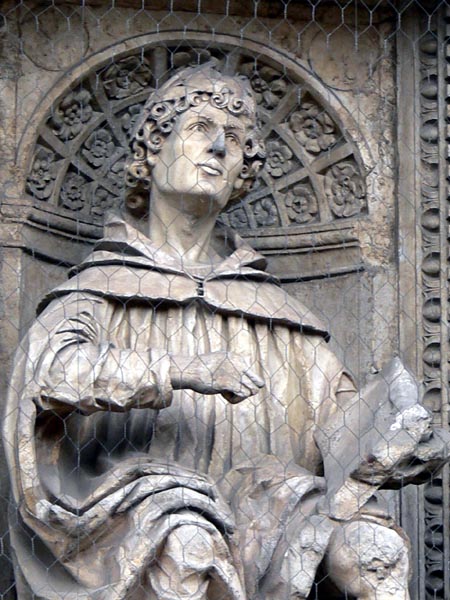
Pliny the Elder (supposedly)

Click to see Vol. I, Issue 11 of the newsletter in which this article first appeared.

Listen to the audio of this article!

Gaius Plinius Secundus (23-79 CE), is usually called Pliny the Elder to distinguish him from his nephew (and adopted son), the lawyer and author Pliny the Younger (61-113).

The elder author was a naturalist and military commander, and a personal friend of the Roman emperor. His work is distinguished by his willingness to go out in the field and "get his hands dirty," making direct observations rather than just speculating on the nature of things, like many natural philosophers of his day.

Pliny was a single man, without children. At times he lived with his sister, mother of his nephew Pliny the Younger, whom he is said to have adopted. Certainly the younger man was familiar with his uncle's daily routine, describing his eating and working habits in letters to his contemporaries.

His greatest work is called the Natural History, similar to an encyclopedia that contained much of the current knowledge of his day. Its 37 books were completed within a few years of his death, and contain new materials as well as summaries of his earlier works and the works of others. It covers biology (both botany and zoology) as well as astronomy and geology. It is also a major source for understanding the art and artists of his time.

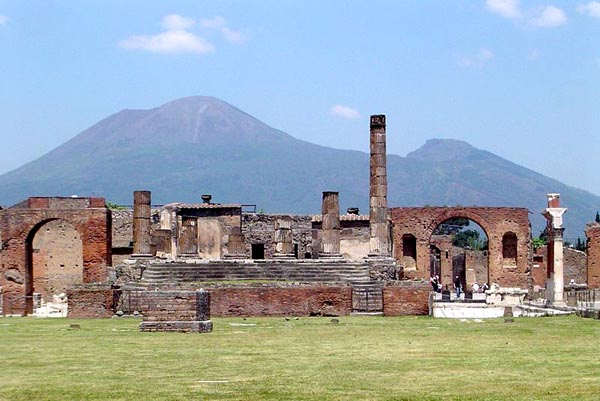
Pliny died as a result of one of the best-known events of classical times. As a naval commander, he was stationed at Misenum, across the Bay of Naples from Mount Vesuvius, which erupted spectacularly in the year 79. This was one of the volcano's many eruptions, and the one which buried the town of Pompeii.

Pliny was preparing to visit the shores near the blast to observe the phenomenon more closely when word came that some of his friends needed to be rescued. He sailed across the bay in a fast boat. Unable to leave again because the wind was against him, he dined with his friends, and was unable to stand up to leave. (One story says he was sitting in a bath, perhaps because he had asthma and he was trying to clear his lungs.) His friends left him behind, where he died, most probably from inhaling the bad air.


From The Natural History

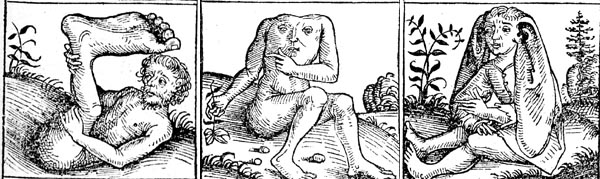
Creatures such as these are described by Pliny; learn more about them here.

As we mentioned, Pliny's Natural History covered essentially all of the knowledge of his day, but it also contained philosophical observations. Here's some of what he said about humankind's most fascinating subject--humankind--in Book VII, Chapter 1: "Man."

Humans are the only animals, Pliny says, that have to get their covering (i.e. clothes) by stealing it from other creatures; nature has given "shells, crusts, spines, hides, furs, bristles, hair, down, feathers, scales, and fleeces" to other forms of life, and even the trunks of trees are protected by bark. Humans alone, he says, "at the very moment of their birth" are "cast naked upon the naked earth" and "abandon[ed] to cries, to lamentations, and--a thing that is the case with no other animal whatever--to tears: this, too, from the very moment that he enters upon existence." And again, "The animal which is destined to command all the others, lies--bound tightly hand and foot [in swaddling bands], and weeping aloud! This is the penalty he has to pay on beginning life, for the sole fault of having been born."

He reflects further:

"How soon do humans gain the power of walking? How soon do they gain the faculty of speech? How soon are their mouths fitted for chewing?... While other animals have an instinctive knowledge of their natural powers--some, of their swiftness of pace, some of their rapidity of flight, and some again of their power of swimming--humans are the only ones that know nothing, that can learn nothing without being taught; they can neither speak, nor walk, nor eat*, and, in short, they can do nothing, at the prompting of nature only, but weep. For this reason, many have been of the opinion that it would be better not to be born, or if born, to be annihilated at the earliest possible moment." [Pliny is alluding to a common saying: "Those whom the gods love, die young."]

[*A footnote points out that Pliny has forgotten that infants do not need to be taught how to suck.]

Pompeii with Mount Vesuvius behind

PRACTICE:

Vocabulary: Match the words to their meaning. Correct answers are in the first comment below.

  1. annihilated
  2. asthma
  3. botany
  4. encyclopedia
  5. faculty
  6. geology
  7. i.e.
  8. inhaling
  9. instinctive
  10. naturalist
  11. phenomenon
  12. speculating
  13. swaddling bands
  14. volcano
  15. zoology
  1. guessing; imagining
  2. natural; innate; not learned
  3. the study of the earth
  4. the study of animals
  5. an ability; a capacity for something
  6. wiped out; destroyed
  7. a mountain that can explode and send out materials
  8. a disease of the lungs which makes breathing difficult
  9. an event; something that happens
  10. the study of plants
  11. that is; in other words
  12. an early kind of scientist
  13. a set of books that discusses every subject known to a culture
  14. long, narrow pieces of cloth wrapped around a baby to keep it from moving
  15. breathing in

Questions to Answer: Answer the following questions in your own words. Suggested answers are in the first comment below.

  1. Who was Pliny the Younger?
  2. What was Pliny the Elder's occupation, aside from being a naturalist?
  3. What was did Pliny's write about in his *Natural History?
  4. How and when did Pliny die?
  5. How does Pliny seem to feel about human beings?

Questions to Think About: These questions do not have "right" or "wrong" answers. They only ask your opinion.

  1. Could one person write a work covering all of the knowledge available to us today? Why do you think that was possible for Pliny?
  2. Why do you think other naturalists in Pliny's day were unwilling to "get their hands dirty"?
  3. Do you agree with Pliny's opinion of humankind? Why or why not?

Saturday, December 25, 2021

Albert Einstein, THE Scientist of the 20th Century

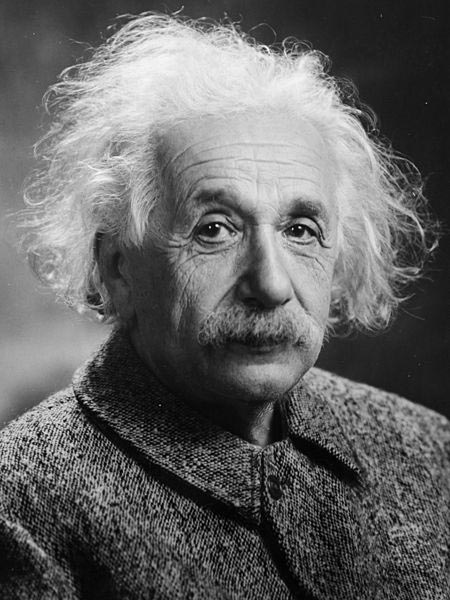
Dat mug

Click to see Vol. I, Issue 9 of the newsletter in which this article first appeared.

Listen to the audio of this article!

Perhaps no scientist in history has achieved the public recognition of the German Albert Einstein (1879-1955). His name and face (not to mention his hairstyle) seem to be known around the world.

As familiar as his face is, though, few of us really understand his insights. That is, although "the world's most famous equation"--E=mc2--is almost as well-known as his appearance, being able to recite it without grasping it is about as far as most of us can go.

The formula is part of Einstein's famous "theory of relativity." It demonstrates the equivalence of energy (E) to mass (m) in any quantity of matter, saying that the amount of energy (in Joules) in matter is equal to the amount of matter (in kilograms) times the speed of light (c) squared (expressed in meters per second). (A Joule is a measure of energy, basically the amount needed to move something one meter.)

Again:

  • E: Energy
  • =: is equivalent to
  • m: mass
  • c: the speed of light
  • 2: (written as a superscript) squared, or times itself

"Energy = mass times the speed of light squared."

Or, the amount of energy in any "thing" is equivalent to the amount of mass in that thing times the speed of light squared. (One needs to use the correct units for each value to make this work: Joules, kilograms, and meters per second.)

The theory remained controversial for many years; his 1921 Nobel Prize in Physics did not include any citation to relativity at all.

Einstein was born in what was then the Kingdom of Württemberg. His father was a businessman and engineer, who made electrical equipment in Munich. Though a non-observant Jew, Einstein attended Catholic school for three years, and then a public primary and secondary school for seven more years.

After his father's business failed, the family moved to Italy. Albert stayed on in Germany a little longer to finish at the German school, but noted later that he hated the "rote learning" there. He joined his family in Italy at the end of 1894.

At age 16, he entered a polytechnic school in Zurich, Switzerland, where his grades were good but he did poorly on examinations. There he met his future wife.

After having two children with his first wife, he divorced her in 1919. He remarried almost immediately (to a woman he had had an affair with since 1912) and in 1933, the couple immigrated to America. His second wife died there in 1936.

During World War II, Einstein contributed to the Manhattan Project, which developed the atomic bomb for America. Some of his public reputation is based on his later opposition to nuclear weapons.

Surprisingly, he was offered the presidentship of the then-new nation of Israel after the death of the first president. He regretfully turned it down.

Much has been made of Einstein's thoughts on religion and philosophy. Like Mark Twain and Abraham Lincoln, he often has things attributed to him that he never said. But he did in fact say some things on subjects outside of science, and his thoughts are well worth reading. Try The World as I See It for starters.

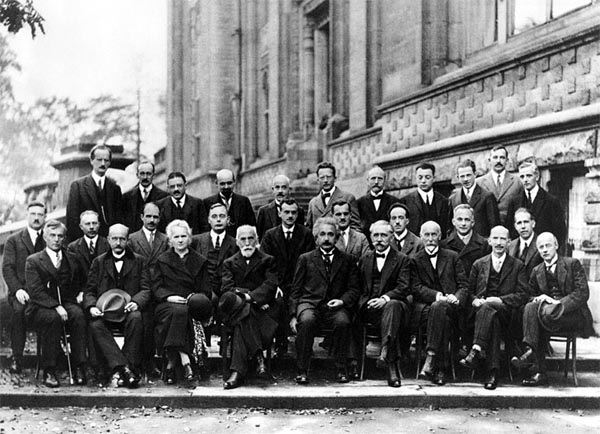
A--pack? gaggle? bevy?--of physicists at the Solvay Conference, 1927. Einstein is at center.

PRACTICE:

Vocabulary: Match the words to their meaning. Correct answers are in the first comment below.

  1. attributed
  2. controversial
  3. equation
  4. equivalence
  5. formula
  6. immigrated
  7. insights
  8. non-observant
  9. opposition
  10. rote
  1. not following the practice of a religion
  2. condition of being the same
  3. by memorization, without understanding
  4. assigned to; credited to
  5. not accepted by all; causing disagreement
  6. a symbolic expression of a rule or principle
  7. objection to; antagonism toward
  8. moved into another country
  9. ideas; discoveries
  10. a mathematical sentence in which both sides are balanced

Questions to Answer: Answer the following questions in your own words. Suggested answers are in the first comment below.

  1. What is Einstein's formula (E=mc2) meant to tell us?
  2. What do the three letters (E, m, and c) mean in Einstein's famous formula?
  3. Did Einstein's Theory of Relativity make him famous?
  4. What famous project did Einstein work on in America, and what was its purpose?
  5. How did Einstein feel about nuclear weapons later in life?

Questions to Think About: These questions do not have "right" or "wrong" answers. They only ask your opinion.

  1. What would cause a person like Einstein to change his mind about something like nuclear weapons?
  2. Many people thought Einstein was "wise" about religion and philosophy. Does being good at one thing mean you're automatically good at everything?
  3. Einstein had an affair in his 30s, then divorced his wife and married his lover. How should a person be judged for something like that, no matter his accomplishments otherwise?

Friday, December 17, 2021

The Gods, the Planets, and the Days of the Week

The Roman gods of the days of the week, starting with Diana the Moon Goddess (Monday)

Click to see Vol. I, Issue 8 of the newsletter in which this article first appeared.

Listen to the audio of this article!

The Chinese system of naming the days of the week is very sensible. It counts the days in order from 1-6, starting with Monday. But why isn't Sunday Number 7? It's easy to see that Sunday is Sun Day: It uses the Chinese symbol for the sun, ę—„, instead of a number. This tells us that the ancient Chinese seven-day week shares Babylonian roots with the western week.

Now, as for the days' names in English: just as Sunday is the Sun's Day, it's easy to see that Monday is "Moon Day" and Saturday is "Saturn's Day." But what about the other four days?

You may notice that Sun, Moon, and Saturn are things we see in the sky. In fact, the ancient Babylonians named seven visible "planets": the Sun, the Moon, Mars, Mercury, Jupiter, Venus, and Saturn.  (They were a little wrong, of course; only the last five are "planets." The Sun is a star, and the Moon is a satellite of the Earth. But we'll forgive them--they didn't have telescopes!) Uranus, Neptune, and the former planet Pluto were not discovered until the 18th, 19th, and 20th centuries respectively.

In fact, these words name not only days and planets, but also gods.

"Sun" and "Moon" are good Germanic words. The Romans called the Sun "Sol" and the Moon "Luna": these names survive in the adjectives "solar" and "lunar." But "sun" comes from the German "Sunne," the name of the Sun goddess in Germanic (or "Norse") mythology. And the German word for "Moon" actually came from the word "Mani," the name of the Norse Moon goddess. Saturn is the name of the sixth planet and its god in both English and German, and nearly the same in Latin (Saturnus).

With the other four days, we have to do some "comparative mythology."

Mars is the Roman god of war. His equivalent in German mythology was a god named Tyr. In Old English this became Tiw, so the day was Tiwes' Day--Tuesday. Notice that in Latin-derived languages, the name reveals its connection to Mars: in French, it's Mardi (think of "Mardi Gras"--Fat Tuesday!), and in Spanish, Martes.

Mercury was a messenger god. Unfortunately, things get a little confused here for English speakers. Wednesday is "Woden's Day," but the god Wodin (or Odin) is not a messenger: he's the king of the gods. Perhaps the confusion came because stories of Odin often include birds used as messengers. The French say Mercredi, and the Spanish Miercoles: both sound like "Mercury."

Thursday is more straightforward: Thor of the Germanic peoples is a thunder god with a bad temper, much like the hotheaded Roman Jupiter or Greek Zeus. (Though, in Greco-Roman mythology, he is the king of the gods.) The French call this Jeudi, and the Spanish say Jueves, both keeping the ju- sound of Jupiter.

Finally, everybody loves Friday! And that's fitting, because the Germanic goddess Frigg (also called Freya) is the goddess of love and fertility, like the Roman Venus. Friday is Frigg's Day. (Incidentally, she was the wife of Odin.) In French, this is Vendredi, and in Spanish, Viernes.

And so the Norse gods are hiding in the names of most of our days in English!

Visible (from left): Sun, Mercury, Venus, Earth, Mars, Jupiter, Saturn;
not visible to the ancients: Uranus, Neptune, Pluto.
Not shown: The Earth's Moon.

PRACTICE:

Which of the seven days: (Correct answers are in the first comment below).

  1. doesn't have a number in Chinese?
  2. is named for a god of war?
  3. would be Number 4 in Chinese?
  4. is named for the Norse king of gods?
  5. has a name in other languages related to the word "lunar"?
  6. is named for a Norse god parallel to Jupiter (Zeus)?
  7. is named for Odin's wife?
  8. is named for a god with virtually the same name in three languages?
  9. is named for a guy who used birds as messengers?
  10. is named for a star, not a planet?
  11. is named for someone named "Tyr"?
  12. is named for the love goddess?
  13. is named for a goddess named "Mani"?
  14. is named for a guy with a hammer?

Questions to Answer: Answer the following questions in your own words. Suggested answers are in the first comment below.

  1. What system do the modern Chinese mostly use to name the days of the week?
  2. What culture gave us (and the ancient Chinese) the system of naming the seven weekdays for planets?
  3. What are the so-called "Seven Visible Planets" after which the days of the week are named?
  4. Which modern languages (among others) use names for the weekdays that are very near those of the Roman gods?
  5. Aside from the Greco-Roman gods' names, what culture's mythology contributed names to the English days of the week?

Questions to Think About: These questions do not have "right" or "wrong" answers. They only ask your opinion.

  1. Why do you think the modern week has exactly seven days (even when just numbers are used)?
  2. Why do you think people named planets (and weekdays) for gods?
  3. Four (or five) cultures are mentioned in this article: the Babylonians, the Chinese, the Romans (and the Greeks), and the Norse. What other connections do you know of between these cultures?


Mr. Newton's Universe

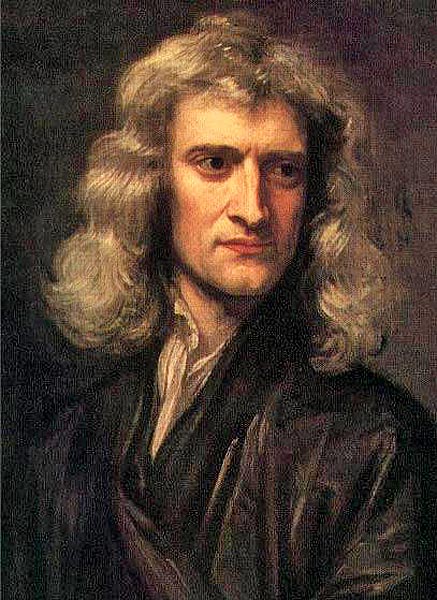
Sir Isaac Newton

Click to see Vol. I, Issue 8 of the newsletter in which this article first appeared.

Listen to the audio of this article!

The English scientist Sir Isaac Newton (1642-1727) is famous, and for good reason--after all, not many people have had a universe named after them!

According to the Julian calendar, which England used at the time, Newton was born on Christmas Day. Although many countries were using the Gregorian calendar by the time he was born, England did not make the change until 1752--nearly a quarter of a century after he was born. We use the designation "O.S." or "Old Style" to refer to Julian dates; "N.S." or "New Style" means Gregorian dates. So Sir Isaac was born December 25, 1642 O.S., and January 4, 1643 N.S.

His father, a farmer also named Isaac, died three months before the boy was born. Young Isaac was born prematurely, and--after his mother remarried when the boy was just three years old--was raised by his grandmother. (He despised his mother's new husband, and wrote in a journal that he had once threatened to burn them both "and the house over them"!)

As a young man, Newton may once have been engaged, but he never married. He studied Latin--but not mathematics--until age 17, when his now-widowed mother tried to get him to become a farmer, a job which he hated. He returned to school and became a top student, partly to compensate for bullying by another boy.

Studying at Cambridge from age 19, he soon received scholarships and was able to complete a master's degree, studying Aristotle as well as "modern" philosophers like Descartes and the astronomers Galileo and Kepler.

Among his many accomplishments, Newton is best-known today for a few ideas, such as discovering the mathematical study of change known as calculus. (This happened at about the same time as the German scholar Leibniz discovered the same ideas, independently of Newton). Newton wrote about calculus in his best-known work, the Principia Mathematica (1687).

Another field he studied was optics. Newton determined the names we use for the seven colors in the rainbow: red, orange, yellow, green, blue, indigo, and violet (remembered by the mnemonic ROY G. BIV).

Interestingly, Newton was something of a mystic. He believed that, despite its natural and knowable laws, the universe was dependent on God at its root. It is ironic, then, that the mechanical view of the world came to be referred to as "the Newtonian universe," an idea that held until Einstein presented a new model in the 20th century.

Now about that apple…

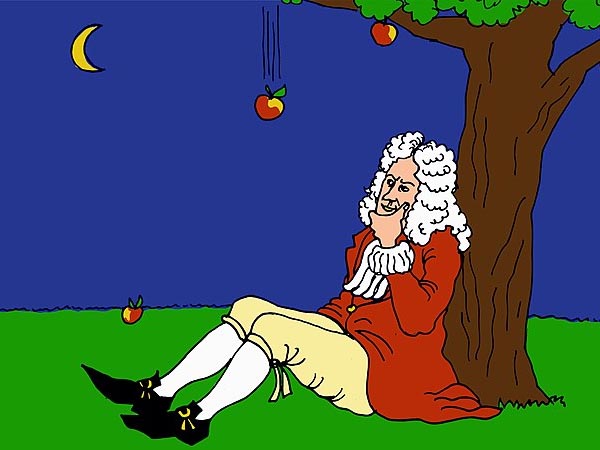
It's commonly said that one day Newton was sitting under an apple tree when a piece of fruit fell and bonked him on the head. Inspired by this, he invented gravity.

But is this story true?

Well, first, gravity cannot have been "invented" by anyone, since it is a natural property of physical things and inheres in matter. Newton called it "an attractive force."

Well, then, perhaps it was "discovered"? No. People have known from time immemorial that if you step off a high place, you will fall. The old saying is, "What goes up, must come down"!

Instead, as he himself told the story, Newton saw an apple fall (it did not hit him on the head!), and asked himself, "Why should that apple always descend perpendicularly to the ground"--that is, fall straight down--"Why should it not go sideways, or upwards? But constantly to the earth's center?" [Unless, of course, it was acted on by another force, like wind, or someone hitting it with a stick.] "Assuredly, the reason is, that the earth draws it." This observation inspired him to formulate the laws of gravity.

Something, he thought, was pulling the apple toward the very center of the earth! His exploration of this phenomenon led him to formulate what is now called "Newton's Law of Universal Gravitation." More important to his studies than an apple was the behavior of the moon, which by logic--since it is traveling at a great speed--ought to fly off into space. What is keeping it from doing so? The answer is, the attraction between the moon and the earth--that is, gravity.

His law is best expressed as a complex mathematical formula, but let's try to put it into words:

"Every particle attracts every other particle in the universe with a force [gravity] that is directly proportional to the product of their masses and inversely proportional to the square of the distance between their centers."

Oversimplifying, the greater the mass of an object, the greater its attraction to other objects; and the farther apart two objects are, the weaker the gravitational pull between them.

Let's just leave it at that!


PRACTICE:

Vocabulary: Match the words to their meaning. Correct answers are in the first comment below.

  1. astronomers
  2. attraction
  3. bullying
  4. designation
  5. despised
  6. gravity
  7. inheres (in)
  8. inversely
  9. mass
  10. mechanical
  11. mystic
  12. optics
  13. particle
  14. perpendicularly
  15. square
  1. like a machine; operating without intelligent choices being made
  2. the study of light
  3. exists permanently and inseparably in
  4. hated
  5. drawing power
  6. a small bit of matter
  7. the force that keeps us on earth
  8. the quantity of matter in something
  9. a name; a description
  10. at right angles to; straight up and down when compared to the earth
  11. people who study the stars and planets
  12. being pushed around; being picked on
  13. a number times itself
  14. oppositely
  15. a person who has unusual, unscientific experiences of the "other world"

Questions to Answer: Answer the following questions in your own words. Suggested answers are in the first comment below.

  1. Which type of calendar do we use today, the Julian or the Gregorian?
  2. What did Newton's mother want him to do?
  3. What did Newton discover at about the same time as the German scholar Leibniz?
  4. What was one of Newton's achievements in the field of optics?
  5. Did Newton discover gravity?

Questions to Think About: These questions do not have "right" or "wrong" answers. They only ask your opinion.

  1. Are you surprised to learn that Newton was a mystic? Is it strange for someone to believe in unscientific experiences and scientific principles at the same time?
  2. Why do you think people like to say that Newton got bonked on the head by an apple?
  3. Newton seems to have had a difficult family life. How do you think this may have affected his success as a scholar?

Sunday, December 12, 2021

Rachel Carson, Conservationist

Click to see Vol. I, Issue 7 of the newsletter in which this article first appeared.

Listen to the audio of this article!

Most of us today are aware of the need to take good care of the earth and the environment. This can be seen in today's emphasis on "envirotech" (environmental technology). In industry, businesses, and homes, "green technology" is almost a given, with heavy emphasis on renewable energy, purification of water and air, treatment of sewage and solid waste, and so on.

It was not always so.

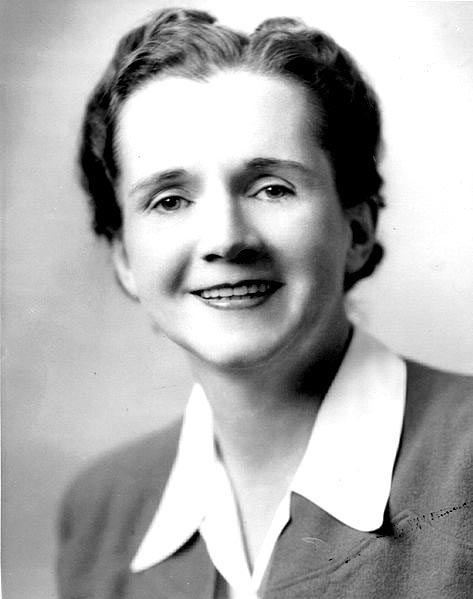
There was a time when the oceans and the sky seemed illimitable, capable of absorbing whatever we could throw into them. One of the harbingers of the change in our attitudes and understanding was a quiet little woman with a big "voice." Rachel Carson (1907-1964) was trained as a marine biologist, and her first three books, Under the Sea Wind, The Sea Around Us, and The Edge of the Sea, concentrated on that specialty.

The Sea Around Us won a U.S. National Book Award, making Carson financially secure. As a result, she was able to write about her passion: conservation, what we often today call "ecology." Her fourth book, Silent Spring, literally changed the course of history. One Carson scholar has said, "Silent Spring altered the balance of power in the world. No one since would be able to sell pollution as the necessary underside of progress so easily or uncritically."

The book describes the environmental effects of overusing synthetic pesticides such as DDT. Chemicals sprayed on plants, she found, got into the water system--streams, rivers, and lakes--and killed wildlife, especially birds--thus, the season of spring would be silent: without birdsong. (Birds exposed to DDT would produce eggs with shells so thin they would crack before they hatched, or not hatch at all.) She accused the chemical industry of lying about the effects of such chemicals, and she accused the government of accepting the industry's claims without sufficient attempts at independent verification.

Silent Spring caused an uproar, with fierce pushback by chemical companies. As a result of her work, the government banned DDT nationwide, and a movement began, especially amongst American youth, that led to the creation of the Environmental Protection Agency (EPA) in 1970, the same year as the first Earth Day celebration. Numerous schools, a bridge, a trail, two research vessels, conservation areas, science and research prizes, and more have been named in her honor.

President Jimmy Carter awarded Rachel Carson the Presidential Medal of Freedom posthumously in 1980.


PRACTICE:

Vocabulary: Match the words to their meaning. Correct answers are in the first comment below.

  1. absorbing
  2. financially secure
  3. a given
  4. harbingers
  5. illimitable
  6. marine biologist
  7. pesticide
  8. posthumously
  9. pushback
  10. renewable
  11. synthetic
  12. uncritically
  13. underside
  14. uproar
  1. unable to be limited; boundless
  2. without thinking about it
  3. one who studies life in the sea
  4. able to be replaced
  5. not worried about money
  6. taking in; accommodating
  7. poison used on insects and rodents
  8. unseen part
  9. sign of a future event; person who foretells something
  10. disturbance; clamor
  11. something everybody assumes
  12. resistance; opposition
  13. after [someone's] death
  14. made in a laboratory; not natural

Questions to Answer: Answer the following questions in your own words. Suggested answers are in the first comment below.

  1. What are some elements of "green technology"?
  2. What training did Rachel Carson have?
  3. What was the effect of Carson's book, *Silent Spring?
  4. How were pesticides affecting wildlife, especially birds?
  5. What honor did Rachel Carson receive posthumously from President Jimmy Carter?

Questions to Think About: These questions do not have "right" or "wrong" answers. They only ask your opinion.

  1. Why did people feel the world was "illimitable"?
  2. Why is "green technology" important? Can you think of examples you've seen of "green technology"?
  3. Why would industry fight against environmental policies? Is that still happening today?

Saturday, December 4, 2021

Galileo, the Father of Science

Portrait of Galileo Galilei (Justus Sustermans, 1636)
Note the telescope in his hand

Click to see Vol. I, Issue 6 of the newsletter in which this article first appeared.

Listen to the audio of this article!

Galileo Galilei (1564-1642) was an Italian scientist who worked in many fields: physics, math, engineering, astronomy, and philosophy. He was a true Renaissance Man. He gained many nicknames through the ages, but one of the greatest was simply: the Father of Science.

This is all the more surprising in that his main achievement was not his own thought, but confirmation of the idea of another person.

The Polish mathematician and astronomer Nicolaus Copernicus (1473-1543) had published a new theory in the year he died: that the earth goes around the sun, and not the other way around. This "Copernican Revolution" would shock the world: we were not at the center of things.

Copernicus died before his theory--based on mathematics--was proven. It was left for Galileo and Johannes Kepler (a student of Copernicus) to confirm his insight.

For this, Galileo used a "secret weapon": a telescope he had improved himself. With it he was able to view phases on Venus much like those of the moon, and observe four moons orbiting Jupiter. The former was only possible if Venus orbited the sun; the latter proved that not everything circled the earth.

The Roman Inquisition was a kind of religious court in the Roman Catholic Church, and in 1615 it said that any teaching of the earth going around the sun--including such teaching by Galileo--was forbidden.

But in 1632 Galileo wrote his most important work, the Dialogue Concerning the Two Chief World Systems. The older system was the Ptolemaic, known as "geocentrism" (putting the earth at the center). It was taught by Claudius Ptolemy, a Greek living in Alexandria, Egypt, around 90-168. The newer was, of course, the Copernican system of "heliocentrism" (putting the sun at the center).

For this act, Galileo was tried in court in 1633 and put under house arrest for the final nine years of his life, where he continued to work and write until his death.

The court also required Galileo to recant, or take back, his support of heliocentrism. Popular legend says that after standing up and recanting, he turned away and said quietly, "Eppur si muove"--in English, "Nevertheless, it moves"--where "it" refers to the earth's motion around the sun. Legend it may be, but the story shows the spirit of Galileo's stubbornness in support of scientific truth.

Galileo facing the Roman Inquisition (Cristiano Banti, 1857)


PRACTICE:

Vocabulary: Match the words to their meaning. Correct answers are in the first comment below.

  1. astronomy
  2. forbidden
  3. geo-
  4. helio-
  5. house arrest
  6. inquisition
  7. insight
  8. legend
  9. orbited
  10. recant
  1. withdraw a statement
  2. went around, circled (as the moon does the earth)
  3. the study of the stars and planets
  4. a made-up story that may contain some truth about a famous person
  5. not allowed
  6. an understanding, a discovery
  7. a prefix meaning "earth"
  8. having to stay in one's home, like in a prison
  9. an official investigation, especially one that's political or religious
  10. a prefix meaning "sun"

Questions to Answer: Answer the following questions in your own words. Suggested answers are in the first comment below.

  1. What "crime" did Galileo commit?
  2. Did Galileo make the discovery for which he was convicted?
  3. Why didn't Copernicus promote his own theory?
  4. Who else promoted Copernicus's theory?
  5. What "secret weapon" did Galileo use to support Copernicus's theory?
  6. What were the "two chief world systems" described in Galileo's work?

Questions to Think About: These questions do not have "right" or "wrong" answers. They only ask your opinion.

  1. Do you think the Church (or religion and religious people in general) should control the teachings of science? Does this still happen today?
  2. Copernicus, Kepler, Galileo: What can we learn about the process of science from the story of these three men?
  3. Copernicus was a theorist; Galileo supported his theories by observation. How important are these two sides of science, idea and evidence?

Monday, November 29, 2021

The Journals of Charles Darwin


Click to see Vol. I, Issue 5 of the newsletter in which this article first appeared.

Listen to the audio of this article!

[Introduction] Whenever we see someone who is an "overnight success," we need to ask ourselves how many years of work went into achieving that status.

Such is the case with Charles Darwin, the world's most famous biologist. He stunned the world in 1859 with the publication of On the Origin of Species by Means of Natural Selection, or the Preservation of Favoured Races in the Struggle for Life. That, and the follow-up The Descent of Man, and Selection in Relation to Sex in 1871, caused a furor that has never died down. But he actually had been publishing treatises and monographs for years, the earliest in 1829--fully thirty years before the Origin of Species, and even before his voyage on the ship HMS Beagle.

One of the most readable of his works, and the first of his books per se (after appearing in parts), was originally titled Journal and Remarks (1839), though we often call it The Voyage of the Beagle. It is a record of Darwin's voyage around the world aboard the Beagle (December 27, 1831, to October 2, 1836). As a geologist and naturalist, he was tasked with making observations and collecting specimens--work that led directly to his theory of evolution. He was also to serve as companion to the ship's arrogant and somewhat fundamentalist captain, Robert FitzRoy, with whom he often argued about theories.

The Voyage of the Beagle brought Darwin some fame (though it didn't cause anything like the stir created by Origin of Species). Furthermore, it gives us a glimpse into the workings of his mind in addition to observations of "untouched" places before they were affected by the long arm of "civilization."

Darwin once said, "The journey on the Beagle was, by far, the most important event in my life, and shaped my whole career."

Aside from his keen powers of observation, Darwin was also a superb writer (which I'm sure is responsible for no small measure of his success). Rather than attempt to summarize what he wrote in his journals, I'd rather share selected direct quotes, with just the minimum of commentary. Enjoy!

A note for readers: Darwin's writing, while elegant, is that of a well-educated person of the 19th century, and may be difficult for some modern readers. One way to approach this is to "slow read" one passage, again and again, until its full meaning sinks in, before moving on to the next one.

--------

[1] Early in the journey we experience some of the rich poetry in Darwin's writing. Here he reflects on the phenomenon called bioluminescence, and ties it in to the works of John Milton, author of Paradise Lost. (Milton's work was the only personal book Darwin brought along when he made land excursions away from the Beagle.)

The night was pitch dark, with a fresh breeze.-- The sea from its extreme luminousness presented a wonderful -- most beautiful appearance; every part of the water, which by day is seen as foam, glowed with a pale light. The vessel drove before her bows two billows of liquid phosphorus, -- in her wake was a milky train.-- As far as the eye reached, the crest of every wave was bright; -- from the reflected light, the sky just above the horizon was not so utterly dark as the rest of the Heavens.-- It was impossible to behold this plain of matter, as it were melted -- consuming by heat, without being reminded of Miltons description of the regions of Chaos and Anarchy. (Chapter V -- Bahia Blanca)

[2] Here Darwin reflects on the effect of colonists on what we would now call the "ecology" of South America:

...few countries have undergone more remarkable changes, since the year 1535, when the first colonist of La Plata landed with seventy-two horses. The countless herds of horses, cattle, and sheep, not only have altered the whole aspect of the vegetation, but they have almost banished the guanaco, deer, and ostrich. Numberless other changes must likewise have taken place; the wild pig in some parts probably replaces the peccari; packs of wild dogs may be heard howling on the wooded banks of the less-frequented streams; and the common cat, altered into a large and fierce animal, inhabits rocky hills. (Chapter VI -- Bahia Blanca to Buenos Aires)

[3] Darwin sees a natural connection between the dwindling population of a species and its extinction, pointing out that calling on the hand of an "extraordinary agent" is unnecessary:

To admit that species generally become rare before they become extinct--to feel no surprise at the comparative rarity of one species with another, and yet to call in some extraordinary agent and to marvel greatly when a species ceases to exist, appears to me much the same as to admit that sickness in the individual is the prelude to death--to feel no surprise at sickness--but when the sick man dies to wonder, and to believe that he died through violence. (Chapter VIII -- Banda Oriental and Patagonia)

[4a] In one of my favorite passages in the book, Darwin describes his experience in an earthquake in Valdivia, Chile, on February 20th, 1835 (known as "the 1835 Concepción earthquake"). Here is his full journal entry for that day:

This day has been memorable in the annals of Valdivia, for the most severe earthquake experienced by the oldest inhabitant. I happened to be on shore, and was lying down in the wood to rest myself. It came on suddenly, and lasted two minutes, but the time appeared much longer. The rocking of the ground was very sensible. The undulations appeared to my companion and myself to come from due east, whilst others thought they proceeded from south-west: this shows how difficult it sometimes is to perceive the directions of the vibrations. There was no difficulty in standing upright, but the motion made me almost giddy: it was something like the movement of a vessel in a little cross-ripple, or still more like that felt by a person skating over thin ice, which bends under the weight of his body. A bad earthquake at once destroys our oldest associations: the earth, the very emblem of solidity, has moved beneath our feet like a thin crust over a fluid;--one second of time has created in the mind a strange idea of insecurity, which hours of reflection would not have produced. In the forest, as a breeze moved the trees, I felt only the earth tremble, but saw no other effect. Captain Fitz Roy and some officers were at the town during the shock, and there the scene was more striking; for although the houses, from being built of wood, did not fall, they were violently shaken, and the boards creaked and rattled together. The people rushed out of doors in the greatest alarm. It is these accompaniments that create that perfect horror of earthquakes, experienced by all who have thus seen, as well as felt, their effects. Within the forest it was a deeply interesting, but by no means an awe-exciting phenomenon. The tides were very curiously affected. The great shock took place at the time of low water; and an old woman who was on the beach told me that the water flowed very quickly, but not in great waves, to high-water mark, and then as quickly returned to its proper level; this was also evident by the line of wet sand. The same kind of quick but quiet movement in the tide happened a few years since at Chiloe, during a slight earthquake, and created much causeless alarm. In the course of the evening there were many weaker shocks, which seemed to produce in the harbour the most complicated currents, and some of great strength. (Chapter XIV -- Chiloe and Concepcion: Great Earthquake)

[4b] The changes wrought by the quake helped Darwin realize that the prevailing theory of gradualism--the idea that the earth changed through processes over long periods of time--was not always so; change was sometimes quite sudden. Here's part of his next entry, for March 4th:

The island [of Quiriquina, up the coast from Valdivia] itself as plainly showed the overwhelming power of the earthquake, as the beach did that of the consequent great wave. The ground in many parts was fissured in north and south lines, perhaps caused by the yielding of the parallel and steep sides of this narrow island. Some of the fissures near the cliffs were a yard wide. Many enormous masses had already fallen on the beach; and the inhabitants thought that when the rains commenced far greater slips would happen. The effect of the vibration on the hard primary slate, which composes the foundation of the island, was still more curious: the superficial parts of some narrow ridges were as completely shivered as if they had been blasted by gunpowder. This effect, which was rendered conspicuous by the fresh fractures and displaced soil, must be confined to near the surface, for otherwise there would not exist a block of solid rock throughout Chile; nor is this improbable, as it is known that the surface of a vibrating body is affected differently from the central part. It is, perhaps, owing to this same reason, that earthquakes do not cause quite such terrific havoc within deep mines as would be expected. I believe this convulsion has been more effectual in lessening the size of the island of Quiriquina, than the ordinary wear-and-tear of the sea and weather during the course of a whole century. (Chapter XIV -- Chiloe and Concepcion: Great Earthquake)

[5] In a later chapter, we see Darwin's curious mind unable to fathom why others were not as curious about their world as he was:

My geological examination of the country generally created a good deal of surprise amongst the Chilenos: it was long before they could be convinced that I was not hunting for mines. This was sometimes troublesome: I found the most ready way of explaining my employment, was to ask them how it was that they themselves were not curious concerning earthquakes and volcanos? – why some springs were hot and others cold? – why there were mountains in Chile, and not a hill in La Plata? These bare questions at once satisfied and silenced the greater number; some, however (like a few in England who are a century behind hand), thought that all such inquiries were useless and impious; and that it was quite sufficient that God had thus made the mountains. (Chapter XVI -- Northern Chile and Peru)

[6] Darwin finds wonder in the mighty works of the smallest things: a coral reef is built by a colony of polyps just a few millimeters in diameter and a few centimeters high. Yet their work can stand against the eroding action of waves and be rebuilt after the destructive action of hurricanes:

It is impossible to behold these waves without feeling a conviction that an island, though built of the hardest rock, let it be porphyry, granite, or quartz, would ultimately yield and be demolished by such an irresistible power. Yet these low, insignificant coral-islets stand and are victorious: for here another power, as an antagonist, takes part in the contest. The organic forces separate the atoms of carbonate of lime, one by one, from the foaming breakers, and unite them into a symmetrical structure. Let the hurricane tear up its thousand huge fragments; yet what will that tell against the accumulated labour of myriads of architects at work night and day, month after month? [...] We feel surprise when travellers tell us of the vast dimensions of the Pyramids and other great ruins, but how utterly insignificant are the greatest of these, when compared to these mountains of stone accumulated by the agency of various minute and tender animals! This is a wonder which does not at first strike the eye of the body, but, after reflection, the eye of reason. (Chapter XX -- Keeling Island: Coral Formations)

[7] In this passage Darwin turns his formidable intellect on one of the most pressing social problems of the day: slavery. Though his legacy appears complex through the lens of history--he regularly refers to aboriginal peoples as "savages," for example--he was an ardent abolitionist, as seen here ("palliate," by the way, means "excuse" or "lessen the effect of"):

It is often attempted to palliate slavery by comparing the state of slaves with our poorer countrymen: if the misery of our poor be caused not by the laws of nature, but by our institutions, great is our sin; but how this bears on slavery, I cannot see; as well might the use of the thumb-screw be defended in one land, by showing that men in another land suffered from some dreadful disease. Those who look tenderly at the slave owner, and with a cold heart at the slave, never seem to put themselves into the position of the latter; what a cheerless prospect, with not even a hope of change! picture to yourself the chance, ever hanging over you, of your wife and your little children -- those objects which nature urges even the slave to call his own -- being torn from you and sold like beasts to the first bidder! And these deeds are done and palliated by men, who profess to love their neighbours as themselves, who believe in God, and pray that his Will be done on earth! It makes one's blood boil, yet heart tremble, to think that we Englishmen and our American descendants, with their boastful cry of liberty, have been and are so guilty... (Chapter XXI -- Mauritius to England)

[8] Darwin was on the path to become a minister when he took ship on the Beagle, and Christians have made claims of a "deathbed" recanting of his theories (he did not do so). The Voyage makes frequent reference to "God," but in this passage we see that there is something else at work here--"the God of Nature"--although he affirms that humans are more than just material beings:

Among the scenes which are deeply impressed on my mind, none exceed in sublimity the primeval forests undefaced by the hand of man; whether those of Brazil, where the powers of Life are predominant, or those of Tierra del Fuego, where Death and decay prevail. Both are temples filled with the varied productions of the God of Nature: -- no one can stand in these solitudes unmoved, and not feel that there is more in man than the mere breath of his body. (Chapter XXI -- Mauritius to England)

[9] A final thought on our "small world," from the concluding paragraphs of the book:

There are several other sources of enjoyment in a long voyage, which are of a more reasonable nature. The map of the world ceases to be a blank; it becomes a picture full of the most varied and animated figures. Each part assumes its proper dimensions: continents are not looked at in the light of islands, or islands considered as mere specks, which are, in truth, larger than many kingdoms of Europe. Africa, or North and South America, are well-sounding names, and easily pronounced; but it is not until having sailed for weeks along small portions of their shores, that one is thoroughly convinced what vast spaces on our immense world these names imply. (Chapter XXI -- Mauritius to England)

--------

The Voyage of the Beagle is easily found online; I encourage you to locate it and read large portions. It's a delight.

The H.M.S. Beagle

PRACTICE:

Vocabulary: Match the words to their meaning. Correct answers are in the first comment below.

  1. accumulated
  2. bows
  3. conviction
  4. displaced
  5. glimpse
  6. horizon
  7. overwhelming
  8. preservation
  9. prevail
  10. reflection
  11. rendered
  12. tender
  13. utterly
  14. vessel
  15. yield
  1. soft; delicate
  2. a brief look
  3. made (sometimes, made visible)
  4. the front end of a ship
  5. a firm belief
  6. careful consideration; deep thinking
  7. unable to be withstood
  8. moved from its proper place
  9. give way; submit
  10. " win"; appear widely
  11. the act of keeping something in existence
  12. taken together; total
  13. boat; ship
  14. the seeming line between the earth and sky
  15. completely; absolutely

Questions to Answer: Answer the following questions. Correct answers are in the first comment below. Each question is labeled to match a passage above.

[Introduction] Which of these was Darwin's first book?

A. On the Origin of Species
B. The Voyage of the Beagle
C. The Descent of Man
D. Paradise Lost

[1] What reminds Darwin of "the regions of Chaos and Anarchy"?

A. the bow of his ship
B. the horizon
C. the crest of every wave
D. shining organisms in the water

[2] Which is NOT one of the animals introduced to the ecology of South America by the colonists?

A. horses
B. sheep
C. deer
D. pigs

[3] Darwin says extinction is like:

A. a sick man dying of illness.
B. one species being rarer than another.
C. an extraordinary agent.
D. a sick man dying through violence.

[4a] Which of these did Darwin NOT experience in the earthquake in Valdivia?

A. the rocking of the ground
B. difficulty in standing upright
C. feeling almost giddy
D. a breeze moving the trees

[4b] What conclusion did Darwin reach about the earthquake after visiting Quiriquina Island?

A. It had been blasted by gunpowder.
B. The surface was affected more than the deeper layers of rock.
C. There were fissures in the yard.
D. They caused terrific havoc in deep mines.

[5] What did Darwin notice about the "Chilenos" (the people of Chile)?

A. They preferred hot springs to cold.
B. They there were mountains in Chile.
C. They were hunting for mines.
D. They were not curious about their world.

[6] Darwin was amazed that:

A. tiny, soft creatures could build something that withstood the power of waves.
B. hurricanes could tear up a coral reef.
C. islands made of rock could be destroyed by waves.
D. travelers talked about the size of the Pyramids.

[7] Darwin was opposed to slavery. He felt slavery was:

A. appropriately compared to poverty.
B. the right thing for Christians to do.
C. something to get angry about.
D. caused by the laws of nature.

[8] True or False: Darwin felt that humans were just breathing machines.

[9] Darwin felt that:

A. islands were bigger than continents.
B. only by travelling can you realize how big the world is.
C. the kingdoms of Europe were the biggest things on earth.
D. the map of the world is blank.

Questions to Think About: These questions do not have "right" or "wrong" answers. They only ask your opinion.

  1. Do you think Darwin was a "religious" man?
  2. How do you think Darwin felt about the colonizing of South America? 
  3. Why were people so upset at the idea that humans descended from other forms of life on earth?

Monday, November 22, 2021

You Are Here: Human Taxonomy


Click to see Vol. I, Issue 4 of the newsletter in which this article first appeared.

Listen to the audio of this article!

As I'm sure you're aware, you and I and every person we know is referred to scientifically as Homo sapiens, which can be translated as "the hominid who knows." (We'll get to "hominid" in a minute.) Others have translated it "knowledgeable man" or even "wise man." (But it seems to me that saying "man" here begs the question.)

These two words, Homo and sapiens, are the genus and species of humans. There are (or actually were) other species in our genus, but we are, as it were, the last men standing.

Carl Linnaeus, the Swedish scientist who came up with the original naming system on which the one we use today is based, declared that all living beings would be referred to by both genus and species (this is called binomial nomenclature, or "two-named naming), though taken together they are called "the species name." So the species name of

  • one kind of hummingbird is Topaza pella (topaz is a gemstone; pellus is Latin for "dark-colored");
  • a certain water buffalo, Bubalus bubalis (from Greek boubalos meaning "buffalo");
  • a type of orchid, Ophrys apifera (the "bee orchid"); and
  • the giant sequoia tree, Sequoiadendron giganteum (the "giant tree of Sequoia," also called the giant redwood, among other names).
Hummingbird, Water Buffalo, Orchid, Sequoia

(Not to confuse you, but sometimes another, third, word is added to describe a subspecies, but never mind.)

Notice also that the genus name is always capitalized, and the species (or subspecies) is not. In fact, the names of any members of ranks above genus are always capitalized. For example, the water buffalo is in the family Bovidae (which includes cows, sheep, antelopes, and the like). (All names of ranks, including the species, are customarily italicized.)

Okay, but how are we related to hummingbirds, buffaloes, orchids, and sequoias, let alone bacteria and whatnot? In a moment we'll begin our slow climb up the family tree, from the most specific grouping - us - to the largest, but first let's get a little background.


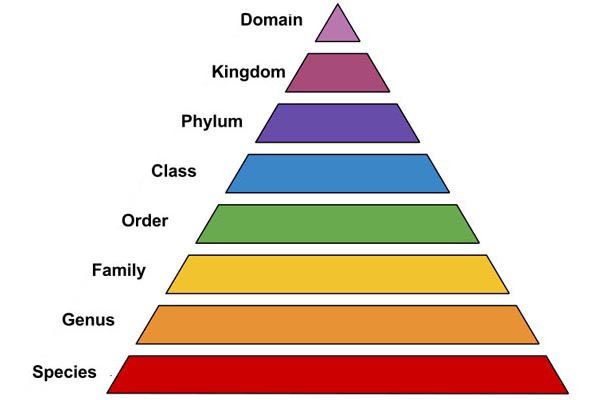
Taxonomic Ranks

For the moment, let's start at the top and climb down to us. The largest divisions of living things are the domains, of which there are only three. (There is in fact a category outside of any domain--the viruses--though some dispute that they are "living" in any full sense of the word. We'll get to that.)

By the way, taxonomy is the science of categorization or classification. The units of classification are called taxa (singular taxon); -nomy, or course, means the "laws" or "science" of something. The word can be used generally for classifying things like library books, but here we're talking about a "hierarchical classification of living things."

Next are the kingdoms, of which there are five (usually), though most of us only think of the animal and plant kingdoms.

Continuing downward, in zoology we have the phyla (singular phylum), which in botany are called divisions. In the five-kingdom system, there are something like 31 phyla of Animals and 14 divisions of plants. For completeness's sake, let me add that there are 8 of Fungi, 19 of Protista, and 29 of Bacteria. Again, more details later.

Below phylum on our Ladder of Life is class. Things start to get messy here; as we get up to larger and larger groups, there are more of what we might call "inter-ranks." For example, around "class" we have superclass above; then subclass, infraclass, subterclass, and parvclass below. We will not spend a lot of time on these details!

Let's speed on down the ranks. The lowest four categories are orders (which may have superorders and/or suborders), families (with superfamilies, subfamilies, tribes, and subtribes), and the genus and species we've already met, the latter of which (as mentioned) may have a subspecies.

Let me note here that nothing in the science of taxonomy is fixed. New knowledge brings new classifications, and taxonomists may even disagree on what belongs where at any given moment. The introduction of DNA, a more certain indicator than physical descriptions, has revolutionized this science.

If you're planning to memorize the eight ranks, here's one of the many mnemonics used by students:

"Dear King Philip Came Over For Good Soup."

Look at the initial letters: they'll remind you of:

Domain, Kingdom, Phylum, Class, Order, Family, Genus, and Species.

Right? By the way, botanists can use "Dear King David" (remember they have Divisions) for "Dear King Philip."

Now that you've learned the eight ranks (can you name them?), let's move on to us.


Human Taxonomy

We will now climb up our family tree, from the specific to the general.

Genus and Species: We have already discussed our full species name (genus + species), but let's take a closer look at the genus name Homo.

Homo is the Latin word for man, as seen in the Latin translation of Pontius Pilate's words "Behold the man": Ecce homo (which has become a motif in religious art). It should not be confused with the Greek root homo-. meaning "same," as in homogeneous and homosexual. Latin Homo is the source word for human, and in turn may have come from humus meaning "earth" or "soil."

We are the only extant example of the genus Homo; all others have gone extinct. The first emerged from the genus Australopithecus, let's say a couple of million years ago. The earliest known Homo was Homo habilis ("handy man"--heh heh). Others include Homo erectus ("upright man," who stood erect) and the famed Neanderthal Man, Homo neanderthalensis. All of these seem to have lived in groups whose lifestyles we might recognize; by the time of H. erectus we were probably living in societies of hunter-gatherers and using fire. (Everything this far back must be stated as "probable"; science itself evolves!)

Australopithecus went extinct not too long after Homo emerged. H. erectus may have gone "extinct" around a half a million years ago, probably by diverging into new species. H. habilis stuck around until around 1.65 million years ago, and H. neanderthalensis seems to have lived for quite some time side-by-side with us: they were here until around 40,000 years ago, and may have gone extinct through climate change, disease, or--very possibly--interbreeding with us.

The "chain" of our development looks like: Australopithecus --> H. erectus --> us. H. habilis and Neanderthal Man were on lateral branches.

We, the "anatomically modern humans," emerged roughly a quarter of a million years ago, probably in Africa. We then migrated into areas of Asia and Europe already occupied by Neanderthals.

A dictionary article describes us as "bipedal primates" characterized by

a large brain, a nearly vertical forehead, a skeletal build lighter and teeth smaller than earlier humans, and dependence upon language and the creation and utilization of complex tools.

(We'll talk more about primates in a minute.)

--------

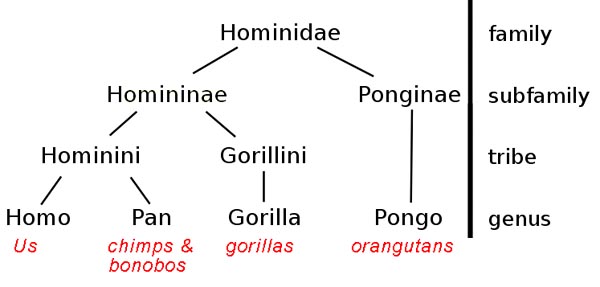
Family: Hominidae. These are the "great apes," sometimes called in English "hominids." Aside from our genus, Homo, there are three other genera (the plural of genus): the Pongos include three types of orangutan; there are two types of Gorillas; and two types of Pans (chimpanzees and bonobos).

Our family includes two sub-groups or "inter-ranks" into which we fall:

  • the subfamily Homininae and
  • the tribe Hominini.

Aside from our tribe, the subfamily Homininae includes the tribe Gorillini, the two species of gorillas (all tribes end in -ini).

And our tribe the Hominini has another genus besides us, the Pans (chimpanzees and bonobos). I hope this chart helps:

Don't trouble yourself too much about these details. I have included them here just to emphasize our close relatives. But in our long climb up the family tree, it's enough to know that we are of the Genus Homo and the family Hominidae.

--------

Order: Primates. Now here's a word you may have heard before. Along with the other Hominidae (the "great apes"), we belong with the gibbons, monkeys (New World and Old), tarsiers, lemurs, and lorises to the order of Primates. As the groups get larger (and our relationships get more remote), I'll give up trying to cover all the members. It's enough to say that we are in the suborder Haplorhini, along with all that I've named except the lemurs and lorises; and in the infraorder Simiiformes, which we call "simians": the "great apes" (the Hominidae plus gibbons), the monkeys, and us. No tarsiers, lemurs, or lorises; the simians are more humanoid.

--------

Class: Mammalia. Commonly known as "mammals," these are characterized by mammary glands for nursing the young with milk (mamma is the Latin word for "breast"), and are covered with hair or fur. We typically (but not always) have four limbs (the sea-going cetaceans, like dolphins and whales, have only two, modified into fins), and also typically (but not always) bear our young alive (the five species of monotremes, including the platypus, are egg-laying mammals).

Orders include rodents; bats; the Eulipotyphla (ground-dwellers like moles and shrews); Artiodactyla (including cetaceans and some hoofed animals); Carnivora (meat-eaters like big cats, wolves, and our mammalian companions, cats and dogs); and us Primates.

--------

Phylum: Chordata. This essentially means "critters that at some point in their development have a notochord," a structure along the back similar to a spine. If, as we do, that chordate has developed a backbone made up of vertebrae, it's called, as we are, a vertebrate. The vertebrates are a subphylum that includes about 69,963 species, from frogs to the blue whale, including all fish, amphibians, reptiles, birds, and mammals (that's us). There are other, invertebrate, chordates, mainly marine animals like sea squirts.

A sea squirt

--------

Kingdom: Animalia. Now here's a word we use all the time: animals. For most of us, that means "living things that aren't plants," but it's a little more complicated than that.

That, however, was the way the ancients saw things--before microscopes, anyway. With the introduction of new equipment, though, scientists could see little things that seemed to be neither plant nor animal (or maybe both/and). They called these protista, a third kingdom.

Then, once they recognized that some microscopic critters had cell nuclei and some didn't, they named those with "eukaryotes" (that includes us) and those without "prokaryotes." The prokaryotes are now called Monera, and include bacteria. Today the Monera rest in their own domain called Prokaryota; the rest of us, including the Protista, Plantae, and Animalia are in the domain Eukaryota.

Finally, the Fungi were recognized as fundamentally different from plants (they do not carry out photosynthesis, for example) and so we now have a "five-kingdom system."

There have been suggestions of systems of six, seven, or even eight kingdoms, but five is the standard. These are, again:

  • Animalia
  • Plantae
  • Fungi
  • Protista (microscopic with cell nuclei)
  • Monera (microscopic without cell nuclei)

As for the Animalia, we can be recognized by the following traits: we usually consume organic material ("food"); breathe oxygen ("air"); are able to move intentionally; and can reproduce sexually. For the most part, we know an animal when we see one.

--------

Domain: Eukaryotes. The first four of the kingdoms just listed belong to the domain of Eukaryota (creatures with cell nuclei); the last is in the domain Prokaryota (those lacking nuclei). We, of course, are Eukaryotes.

But here's a peculiar thing, that makes simple family trees difficult to draw: there are three domains. The Eukaryotes are all in one; that's easy. But the Prokaryotes are actually split into two domains: molecular analysis has shown that the RNA markers in Bacteria are significantly different from the Archaea (such as the methanogens, which produce methane gas), the third domain.

This leads the discussion in a whole new direction, one which may not be very useful for us. But while we're off-roading, let's add that no one knows quite where to place viruses. They cannot replicate outside of living hosts, so there is some speculation that they may not be "living things" at all. Are they a form of life? Or merely an organic molecule? It's hard to say, but it does point out that taxonomy, like all science, can be slippery.

--------

Above all the ranks we've examined is the realm of life, or "all living things." We can say that rocks are not alive, and butterflies are. But the viruses make that distinction harder to prove.

Sticking with what we know, and using only the eight main ranks, we can say that we humans are members of the following, from the top down again:

  • Domain: Eukaryotes (which have cell nuclei)
  • Kingdom: Animalia (which eat food, breathe oxygen, move independently, and reproduce sexually)
  • Phylum: Chordata (which have a notochord at some point in development)
  • Class: Mammalia (which feed babies from mammary glands, have hair or fur, and usually bear live young)
  • Order: Primates (the great apes plus gibbons, monkeys, tarsiers, lemurs, and lorises)
  • Family: Hominidae (the great apes only--orangutans, gorillas, chimpanzees and bonobos, and us)
  • Genus: Homo (only us now, but many closely-related extinct ancestors and relatives)
  • Species: Homo sapiens

If I were to add one "inter-rank," I'd say it's most important to point out that we are of the Subphylum Vertebrata--creatures with backbones.

--------

And that just about wraps things up. You should now be able to point to our particular twig on the "Great Tree of Life," and say: "I am here!"

Click here to see a HUGE version of Haeckel's Tree


PRACTICE:

Matching: Match the term for humans to its rank. Correct answers are in the first comment below.

  1. Domain
  2. Kingdom
  3. Phylum
  4. Class
  5. Order
  6. Family
  7. Genus
  8. Species

  1. Primates
  2. Animalia
  3. Homo
  4. Chordata
  5. Homo sapiens
  6. Mammalia
  7. Eukaryotes
  8. Hominidae

QUESTIONS TO ANSWER:

Choose the best answer. Correct answers are in the first comment below.

  1. A giraffe is a member of the Class:
    A. Mammals
    B. Plantae
    C. Prokaryotes
    D. Primates

  2. A duck is a member of the Kingdom:
    A. Plantae
    B. Mammalia
    C. Animalia
    D. Invertebrates

  3. Which rank is the highest (above the others)? Use the mnemonic!
    A. Class
    B. Family
    C. Phylum
    D. Order

  4. How many species of the genus Homo are alive today?
    A. one
    B. seven
    C. 69,963
    D. unknown

  5. Humans and orangutans belong to the same:
    A. family
    B. subfamily
    C. tribe
    D. genus

Questions to Think About: These questions do not have "right" or "wrong" answers. They only ask your opinion.

  1. Why do you think DNA is a more reliable guide to taxonomy than the observations of differences in organisms?
  2. Why do you think other species in the genus Homo have all gone extinct? Could the same thing happen to us?
  3. What practical value could there be in classifying every living organism on earth?