Showing posts with label British. Show all posts

Sunday, March 20, 2022

From "Auguries of Innocence" by William Blake

A mystic is a person who believes that there is another world outside of this one, and attempts to contact that world, or understand it in ways beyond the intellectual, or even be absorbed into it. Along the way she or he may have moments where they see, in this world, hints at what the other world may be like.

The Great English poet William Blake was such a person, and he wrote these four lines (part of a larger poem called "Auguries of Innocence") about such a moment: seeing the other world peeking through into this one.

To see a World in a Grain of Sand
And a Heaven in a Wild Flower,
Hold Infinity in the palm of your hand
And Eternity in an hour.

--------

SOME WORDS:

  • absorbed: taken into; dissolved into
  • auguries: predictions; indications
  • eternity: time without limit
  • infinity: space without limit

--------

QUESTION TO THINK ABOUT:

This question does not have a "right" or "wrong" answer. It only asks your opinion.

1. Why do you think Blake chose "a Grain of Sand" to represent the World, and "a Wild Flower" to represent Heaven?

Friday, March 11, 2022

Poem: "How Do I Love Thee?" (Sonnet 43) by Elizabeth Barrett Browning

Elizabeth Barrett Browning (Wikimedia)

The poem "How do I Love Thee?" was #43 in Elizabeth Barrett Browning's collection, Sonnets from the Portuguese (1850). The first line is very famous; a lot of people can recite the first four lines.

What is a sonnet, exactly? Not to get too technical, but basically a sonnet:

  • has 14 lines
  • is in iambic pentameter (has five beats like this: da-DA da-DA da-DA da-DA da-DA)
  • if Shakespearean, has three quatrains (groups of four lines) and a couplet (two lines) OR
  • if Petrarchan, like this one, has one octave of eight lines and a sestet, a more complex six lines.
  • The octave usually has an ABBA ABBA rhyme scheme, like the ones here:
    • ways - height - sight - grace - day's - light - right - praise
  • Here, the final sestet goes CD CD CD (other possibilities include CDE CDE and CDC CDC):
    • use - faith - lose - breath - choose - death.

Now, as for the meaning of this sonnet:

  • The first half of the octave tells how much the narrator ("I") loves the recipient of the poem ("thee"), basically as far as she can reach in any direction.
  • The second half of the octave elaborates on this: she loves him (presumably him) as much as she needs her greatest need, freely and purely.
  • The sestet says she lives him as much as she ever grieved, or as the faith she had as a child; she loves him like she used to love the saints before she lost faith in them; she loves him with all of her life's "breath, Smiles, [and] tears"; and if permitted she will love him even more after death than she did with all her life.

Whew!

--------

How do I love thee? Let me count the ways.
I love thee to the depth and breadth and height
My soul can reach, when feeling out of sight
For the ends of being and ideal grace.
I love thee to the level of every day's
Most quiet need, by sun and candle-light.
I love thee freely, as men strive for right.
I love thee purely, as they turn from praise.
I love thee with the passion put to use
In my old griefs, and with my childhood's faith.
I love thee with a love I seemed to lose
With my lost saints. I love thee with the breath,
Smiles, tears, of all my life; and, if God choose,
I shall but love thee better after death.

--------

SOME WORDS:

  • thee: an old-fashioned way to say "you"
  • depth and breadth and height: the three dimensions ("3D") that define all space

--------

PRACTICE:

Be sure you know these terms, defined above:

  • sonnet
  • iambic pentameter
  • couplet
  • quatrain
  • sestet
  • octave
  • rhyme scheme

Tuesday, March 8, 2022

Poem: "Invictus" by William Ernest Henley

William Ernest Henley (Wikimedia)

"Invictus" by William Ernest Henley (1849-1903)

The title "Invictus" means "unconquerable" or "undefeated" in Latin; this is the key to understanding the poem. The first stanza tells us that, despite dire circumstances (a black night), the narrator thanks the unknown gods for his "unconquerable soul." He has not given in no matter how bad things get, the second stanza says, summed up in the memorable phrase "My head is bloody, but unbowed." The third stanza says that this world and the next may be horrible, but he is unafraid.

And then comes the source of this strength: He is the "master of [his] fate" and "the captain of [his] soul," allowing no domination of his life from the outside.

Out of the night that covers me,
      Black as the pit from pole to pole,
I thank whatever gods may be
      For my unconquerable soul.

In the fell clutch of circumstance
      I have not winced nor cried aloud.
Under the bludgeonings of chance
      My head is bloody, but unbowed.

Beyond this place of wrath and tears
      Looms but the Horror of the shade,
And yet the menace of the years
      Finds and shall find me unafraid.

It matters not how strait the gate,
      How charged with punishments the scroll,
I am the master of my fate,
      I am the captain of my soul.

--------

SOME WORDS:

  • bludgeonings: beatings
  • clutch: grasp; grip
  • fell: fierce; deadly
  • looms: appears; takes shape and hangs over a scene
  • menace: threat; danger
  • scroll: a written document, here probably a document with a record of one's wrongdoings
  • strait: narrow; hard to enter
  • winced: flinched; drew back from
  • wrath: rage; great anger

--------

QUESTIONS TO ANSWER:

Answer the following questions in your own words. Suggested answers are in the first comment below.

  1. What does the narrator mean by "from pole to pole"?
  2. What is the "fell clutch of circumstance"?
  3. What are the "bludgeonings of chance"?
  4. What is "this place of wrath and tears"?

QUESTIONS TO THINK ABOUT:

These questions do not have "right" or "wrong" answers. They only ask your opinion.

  1. Does the narrator seem to believe in a god (or gods)?
  2. What are the responsibilities of being "the captain of [one's] soul"?
  3. Do you know anyone with the attitude described in this poem?

Thursday, March 3, 2022

The Origins of Merlin, by Thomas Bulfinch

The conception of Merlin by an incubus (from a medieval manuscript)

One of the great compendiums of European myth and legend is Bulfinch's Mythology, compiled by the American banker Thomas Bulfinch and published after his death in 1867. 

Scholars have said it once was "one of the most popular books ever published in the United States and the standard work on classical mythology for nearly a century." It's still popular today, although modern readers may have a little trouble with its outdated language.

The book begins with the usual catalog of Greek, then Latin, then Norse mythology, but goes on to cover King Arthur and other British heroes (Beowulf, Cuchulain, Hereward the Wake, and Robin Hood), and then on to the continent for Charlemagne and his nephew Roland.

Here I've given you one version of the origins of that fascinating character Merlin, kingmaker and sucker for a pretty face. I have put certain words in bold and added definitions at the bottom; I've also added a list of characters to help you keep them straight. Enjoy!

--------

Merlin was the son of no mortal father, but of an Incubus, one of a class of beings not absolutely wicked, but far from good, who inhabit the regions of the air. Merlin's mother was a virtuous young woman, who, on the birth of her son, entrusted him to a priest, who hurried him to the baptismal font, and so saved him from sharing the lot of his father, though he retained many marks of his unearthly origin.

At this time Vortigern reigned in Britain. He was a usurper, who had caused the death of his sovereign, Moines, and driven the two brothers of the late king, whose names were Uther and Pendragon, into banishment. Vortigern, who lived in constant fear of the return of the rightful heirs of the kingdom, began to erect a strong tower for defense. The edifice, when brought by the workmen to a certain height, three times fell to the ground, without any apparent cause. The king consulted his astrologers on this wonderful event, and learned from them that it would be necessary to bathe the cornerstone of the foundation with the blood of a child born without a mortal father.

In search of such an infant, Vortigern sent his messengers all over the kingdom, and they by accident discovered Merlin, whose lineage seemed to point him out as the individual wanted. They took him to the king; but Merlin, young as he was, explained to the king the absurdity of attempting to rescue the fabric by such means, for he told him the true cause of the instability of the tower was its being placed over the den of two immense dragons, whose combats shook the earth above them. The king ordered his workmen to dig beneath the tower, and when they had done so they discovered two enormous serpents, the one white as milk, the other red as fire. The multitude looked on with amazement, till the serpents, slowly rising from their den, and expanding their enormous folds, began the combat, when everyone fled in terror, except Merlin, who stood by clapping his hands and cheering on the conflict. The red dragon was slain, and the white one, gliding through a cleft in the rock, disappeared.

These animals typified, as Merlin afterwards explained, the invasion of Uther and Pendragon, the rightful princes, who soon after landed with a great army. Vortigern was defeated, and afterwards burned alive in the castle he had taken such pains to construct. On the death of Vortigern, Pendragon ascended the throne. Merlin became his chief adviser, and often assisted the king by his magical arts.

Among other endowments, he had the power of transforming himself into any shape he pleased. At one time he appeared as a dwarf, at others as a damsel, a page, or even a greyhound or a stag. This faculty he often employed for the service of the king, and sometimes also for the diversion of the court and the sovereign.

Merlin continued to be a favorite counsellor through the reigns of Pendragon, Uther, and Arthur, and at last disappeared from view, and was no more found among men, through the treachery of his mistress, Viviane, the Fairy...

--------

Vocabulary:

  • absurdity: ridiculousness
  • banishment: exile; the state of being sent out of one's land
  • baptismal font: a "bowl" of water in a church where babies (and others) are baptized (have water poured on them to make them members oft the church)
  • cornerstone: the first stone laid in the corner of a foundation; the first walls extend from here
  • damsel: a young unmarried woman; a "maiden"
  • den: a home for wild animals like bears or foxes
  • diversion: entertainment; amusement
  • edifice: building; structure
  • endowments: gifts
  • fabric: the material of which something is made; here, probably, stone. (it can also mean a building.)
  • faculty: an ability; skill
  • Incubus: a magical being, perhaps a devil or demon, thought to have sex with sleeping women
  • instability: lack of solidness; weakness
  • lineage: heritage; genealogy
  • lot: fate; result
  • page: a young man acting as a personal servant to a powerful person
  • stag: a male deer
  • treachery: betrayal of trust; faithlessness
  • usurper: person who seizes power without the legal right
  • wonderful: here, not "good," but "causing wonder"

--------

Characters:

  • Arthur: "star" of the Arthurian stories; Merlin will become his advisor
  • Merlin: the prototype of wizards in western literature, and thus the "father" of Gandalf, Dumbledore, and others
  • Moines: the king deposed and replaced by Vortigern. Bulfinch has him as brother to Uther and Pendragon, all three sons of King Constans.
  • Pendragon: brother to Uther (and Moines). After Pendragon was killed by the Saxons, Uther (and later sometimes Arthur) took his name as a sort of last name: Uther Pendragon. 
  • Uther: father of Arthur, and King of England on the death of his brother Pendragon
  • Viviane: the "fairy" (sorceress) who bewitched Merlin near the end of his life
  • Vortigern: a quasi-historical usurper who claimed to be king of England. He may have been the one to invite the Saxons to England to aid him in fighting the Picts and the Scots. But they had their own plans, and settled in...

Wednesday, November 10, 2021

"This is a case for… Sherlock Holmes!"

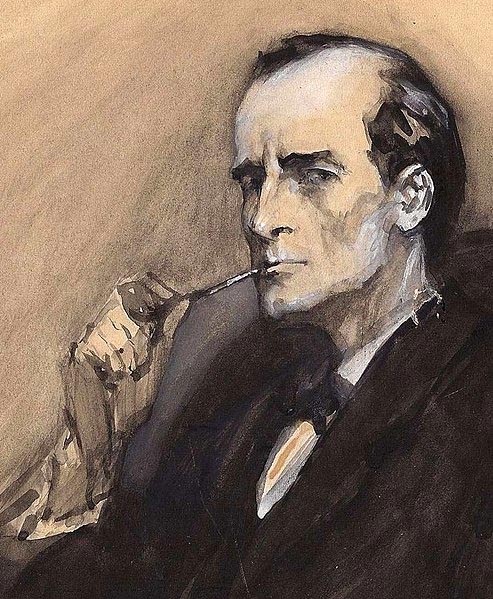
Sherlock Holmes in a 1904 portrait by Sidney Paget

Click to see Vol. I, Issue 2 of the newsletter in which this article first appeared.

Listen to the audio of this article! (3:36)

Someone's missing? You've misplaced your boss's money? Received five orange seeds in the mail without explanation?

This sounds like a case for... Sherlock Holmes!

In Mr. Holmes, the author Arthur Conan Doyle has created a character so vivid that many have mistaken him for a real person. The first Holmes stories appeared in 1887; by 1927, Doyle had written four novels and 56 short stories starring his "consulting detective."

Holmes uses highly scientific methods to untie the knottiest of problems--for a fee. Sometimes his powers of observation, logical deduction, and forensic science appear almost mystical, especially to his friend, biographer, and sometimes roommate Dr. John Watson.

With Watson, Holmes lives upstairs from his landlady, Mrs. Hudson, at 221B Baker Street, London. Watson writes down most of the stories, but Holmes claims that actual events were never nearly as sensational as Watson makes them out to be. Still, Watson is his only real friend. The relationship reveals to Watson that Holmes possesses "a great heart as well as... a great brain."

Holmes usually works for private clients, but he sometimes consults with Scotland Yard, and has been hired by high government officials in and out of England (including even the Vatican!). Sherlock admits that his brother, Mycroft, a government official, is the smarter of the two, but Mycroft is not interested in investigation.

In 1893, wishing to turn his attention to other projects, Doyle "killed off" Holmes in a struggle with his archnemesis, Professor James Moriarty. However, after 20,000 people cancelled their subscription to "The Strand," the magazine in which the stories had been published, Doyle was compelled to find an ingenious way to bring him back.

Holmes had "died" after a scuffle and fall near a waterfall; but as it turned out, he had faked his death to fool his enemies. (No body had ever been recovered.) This period is now known among fans (usually called "Holmesians" in the U.K. and "Sherlockians" in the U.S.) as "the Great Hiatus."

Sherlock Holmes was not the first fictional detective, but he is the best known. Stage, television, film, and print appearances--beyond those by Doyle--number in the tens of thousands, and no one who writes crime fiction today can ignore the character or the principles he practiced, including this one:

"When you have eliminated the impossible, whatever remains, however improbable, must be the truth."

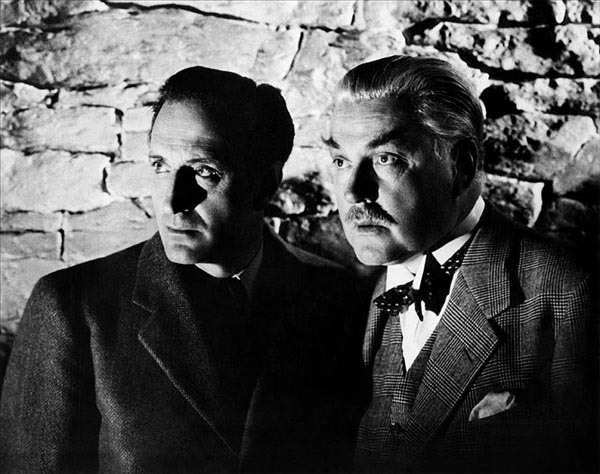
Sherlock Homes (Basil Rathbone) and John Watson (Nigel Bruce), in a 1943 film


Activities


Vocabulary Exercise

Match the words to their meaning. Answers in the first comment.

  1. archnemesis
  2. compelled
  3. consults
  4. deduction
  5. forensic
  6. hiatus
  7. ingenious
  8. knottiest
  9. sensational
  10. vivid
  1. break; interruption
  2. gives advice
  3. most difficult
  4. exaggerated for dramatic effect
  5. lively; realistic
  6. greatest enemy
  7. forced
  8. working from facts to a conclusion
  9. clever; brilliant
  10. for use in solving crimes

Questions

Answer the following questions in your own words. Suggested answers in the first comment.
  1. Is Sherlock Holmes a real person?
  2. What sorts of techniques does Holmes use to solve crimes?
  3. What character supposedly "wrote" the Holmes stories? How is he related to Holmes?
  4. What caused trouble for Arthur Conan Doyle and his publishers? How did Doyle fix the problem?
  5. What does this mean: "When you have eliminated the impossible, whatever remains, however improbable, must be the truth."

Sunday, September 12, 2021

Ten Famous Nursery Rhymes

The fictional author of many nursery rhymes
(Wikipedia)

I have placed these here for use with lesson #01-021: Mother Goose Rhymes. Try learning some of them by heart!