Showing posts with label Vol. I Issue 1. Show all posts

Wednesday, November 10, 2021

Vocabulary Builder: approach


Click to see Vol. I, Issue 1 of the newsletter in which this article first appeared.

approach (verb)

  • Meaning: to come near (or nearer) to.
    • This may be physical (to approach a town) or mental (to approach an agreement).
  • Verb forms: approach, approaches, approached, approaching
  • Noun form: (plural: approaches) approach, the act of drawing near (the flight was on approach"); the way of doing something ("an approach to improved health").
  • Adjectives:
    • approachable: able to be approached
    • unapproachable: unable to be approached


PRACTICE:

Place the correct form of "approach" in each sentence. Correct answers are in the first comment below.

  1. A smile and a friendly manner will make you seem more ________.
  2. Ladies and gentlemen, we are ________ our final destination.
  3. If you ________ a problem correctly, you're halfway to a solution.
  4. I'm afraid to talk to my teacher. He's so ________!
  5. If a grizzly bear ________ you, don't run! Lie down and "play dead."
  6. If you are ________ by a salesman on the street, smile politely and pass by without speaking.
  7. Let's try a different ________.

  1. approach
  2. approaches
  3. approached
  4. approaching
  5. approachable
  6. unapproachable

"Give the devil his due."

Proverb: Give the devil his due.

Meaning: Sometimes another person--especially one we don't like--does something well, and we don't want to admit it. When we do admit it, we are "giving the devil his due."

Mini-Dialogue:

Patrick: Oh, no! Michael got a higher score on the test than I did! 
Miriam: Patrick, no offense, but Michael studies a lot harder than you do. 
Patrick: Yeah, I have to give the devil his due. He really cracks the books!

QUESTION:

1. In which situation would you use the proverb, "Give the devil his due"? Correct answer is in the first comment below.

A. Your best friend, with really good grades, gets admitted to a good college.
B. Your hard-working but mean older brother gets a promotion at work.
C. Your favorite cousin, a really nice guy, gets engaged to a beauty queen.

The Hen that Laid the Golden Eggs by Aesop


Click to see Vol. I, Issue 1 of the newsletter in which this article first appeared.

Listen to the audio of this article!

This article is written for younger readers, with activities suitable for children.

One day a farmer went out to get the eggs from his chickens. He was shocked to see that one hen had laid an egg made of gold!

Every week after that the hen laid another golden egg. The farmer took the eggs to the market and sold them for a lot of money. He and his wife bought a bigger farm and a bigger house.

Later the farmer thought, "I don't like waiting a week for the golden egg." He started giving the hen special food, and she began laying the eggs two or three times a week.

At first the farmer was happy. But he still wanted more. He thought, "Maybe all of those eggs are inside her, waiting to come out. If I kill her, I can get them all at once." So he killed the hen and looked inside for the eggs. But there was nothing there.

--------

Some words to talk about:

  • golden: made of gold
  • hen: a female chicken
  • laid (an egg): made (an egg) from a chicken's body
  • shocked: very surprised

QUESTIONS:

Choose the best answer. Correct answers are in the first comment below.

1. What is special about the hen in this story?
A. She can lay eggs that look like gold.
B. She can lay eggs that are delicious.
C. She can lay eggs that are made of gold.

2. Why did the hen start laying the special eggs more quickly?
A. Because the farmer gave her special food.
B. Because the farmer bought a bigger house and farm.
C. Because the farmer went to the market.

3. Why did the farmer kill the hen at the end of the story?
A. To see what she looked like on the inside.
B. To try to get gold faster.
C. To cook and eat her.

4. How do you think the farmer feels at the end of the story?
A. Sad, because he won't get any more golden eggs.
B. Angry, because he wanted to eat more eggs.
C. Happy, because he is rich enough.

5. What is the main lesson of this story?
A. Learn to be happy with what you have.
B. Treat animals kindly.
C. Don't go to the market.

The Great Wheel of the Year (Part I)

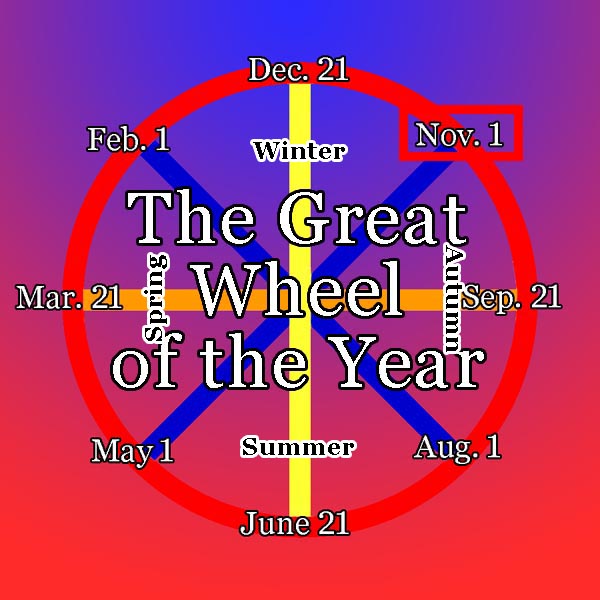
KEY: Yellow = solstices; Orange = equinoxes; Blue = cross quarter days

Click to see Vol. I, Issue 1 of the newsletter in which this article first appeared.

Listen to the audio of this article!

Today, November 1st, is the Feast of All Saints, and our feature article looks at a local celebration of that festival: The Mexican Dia de los Muertos, or Day of the Dead!

But before we talk about All Saints', Hallowe'en, and the Dia de los Muertos, let's take a brief look at the Great Wheel of the Year.

Ancient people of many cultures recognized certain celestial phenomena, including the shortest and longest days of the year: the winter and summer solstices, taking place around December 21 and June 21, respectively. (The dates I'm using apply to the Northern Hemisphere.) Halfway between these points, many cultures also recognized the point when day and night were roughly equal: the spring and summer equinoxes, around March 21 and September 21.

And, between these, a few cultures paid attention to the "cross quarter days," around the start of November, February, May, and August. In ancient reckoning, these days marked the beginning of the seasons. If winter solstice was the shortest day, than the six weeks or so before and after it were the shortest days: the season of winter, and of the dead.

Hallowe'en as we know it, then, was based on one such celebration, called Samhain (and pronounced SAW-winn). It was a time to recognize the thinness of the veil between the living and the dead.

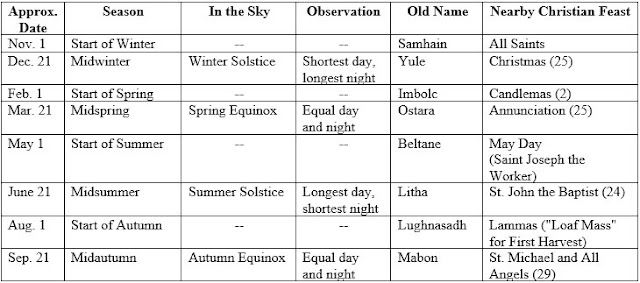
We'll look more closely at the other holidays in the Wheel as they come, but here's a brief table:


PRACTICE:

This article continues with El Dia de los Muertos. You will find vocabulary practices and questions for this article and that one at the end of that page.

The Dia de los Muertos

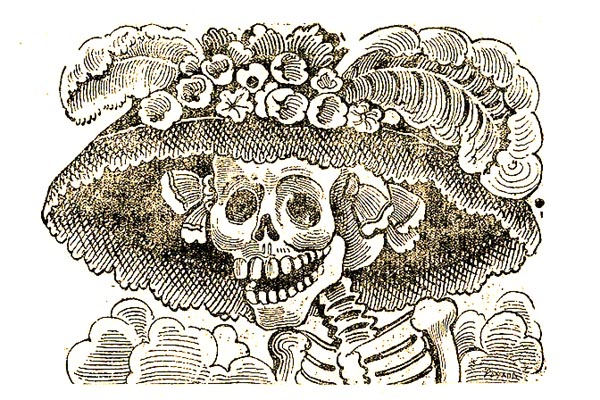
A calavera

Click to see Vol. I, Issue 1 of the newsletter in which this article first appeared.

Listen to the audio of this article!

For a better understanding of this article, read about the Great Wheel of the Year here.

When Christianity arrived in Europe, it took over this ancient custom of recognizing the dead who had gone before. On November 1, Christian practice restricts this observance to deceased (and sometimes living) Christians, and calls it "All Saints' Day." The following day, November 2, is for all of those who are gone; it's called "All Souls' Day."

Our own Hallowe'en is the eve or "even[ing]" (shortened to e'en) of All Saints', which is also called All Hallows ("hallow" being related to "holy," which is what saints are supposed to be). So the name "All Hallows' Evening" lost some pieces and became "Hallowe'en." The tradition of "Trick or Treat" follows customs from the days when people felt they needed to appease the spirits of the dead, lest misfortune befall them.

In Mexico, this celebration of the dead has taken on a decidedly festive air. When Mexican families and friends gather to remember their loved ones, they may assemble food and other offerings (called ofrendas) on altars, and themselves consume good things to eat, especially sweets like skulls made of sugar (called calaveras, meaning simply "skulls"). People also enjoy a kind of pastry called pan de muerto, or "bread of [the] dead," decorated with dough in the shape of skulls or crossbones.

So far, nothing here seems quite out of the ordinary. But here's a surprise: celebrations often take place in the cemetery where loved ones are buried! Family and friends will set up altars near the grave and "join" the departed, drinking and picnicking with them, sometimes even staying all night!

So this "day of the dead" is a time of reunion and good times for the living, too!

A home altar; pan de muerto; an ofrenda in a cemetery

VOCABULARY ACTIVITIES

Everyday Words: Place the words below in the correct sentence. Use a dictionary to look up words you're not sure of. Answers are in the first comment below.

  1. A solar eclipse is one of the most amazing ________ events I've seen.
  2. Jack is older than Mary by three months; they were born in March and June ________.
  3. Loss of a loved one is the saddest thing that may ________ us.
  4. According to my ________, I will be able to retire in six more years.
  5. Don't play with fire ________ you get burned.
  6. I like to dress up for ________ occasions.
  7. After a loved one is ________ he or she may still live on in our memories.
  8. Once the bus has ________, the office cannot sell any more tickets.
  9. Communication these days is ________ different from the past.
  10. I brought donuts to work to ________ my boss for being late.

  1. appease
  2. befall
  3. celestial
  4. deceased
  5. decidedly
  6. departed
  7. festive
  8. lest
  9. reckoning
  10. respectively

--------

Specialized Words: Match the words to their meaning. Answers are in the first comment below.

  1. altars
  2. calaveras
  3. Dia de los Muertos
  4. equinoxes
  5. offerings
  6. ofrendas
  7. pan de muerto
  8. Samhain
  9. skull and crossbones
  10. solstices

  1. "bread of the dead"
  2. a design like the one on a pirate flag
  3. things given to the spirits of the dead
  4. an old word for Hallowe'en
  5. places for religious activities
  6. "Day of the Dead"
  7. longest and shortest days of the year
  8. "offerings"
  9. skulls, including those made of sugar
  10. points in the year when the day and night are the same length

QUESTIONS

Answer the following questions in your own words. Suggested answers are in the first comment below.

  1. What happens at the winter solstice? What happens at the summer solstice? What happens at the equinoxes?
  2. What happens (in some traditions) on the cross quarter days?
  3. What was the significance of Samhain?
  4. What is the difference between All Saints' Day and All Souls' Day?
  5. What are some things people might do on the Day of the Dead?